
How Lenses Bend Light: The Physics Inside Glasses, Cameras, and Magnifiers

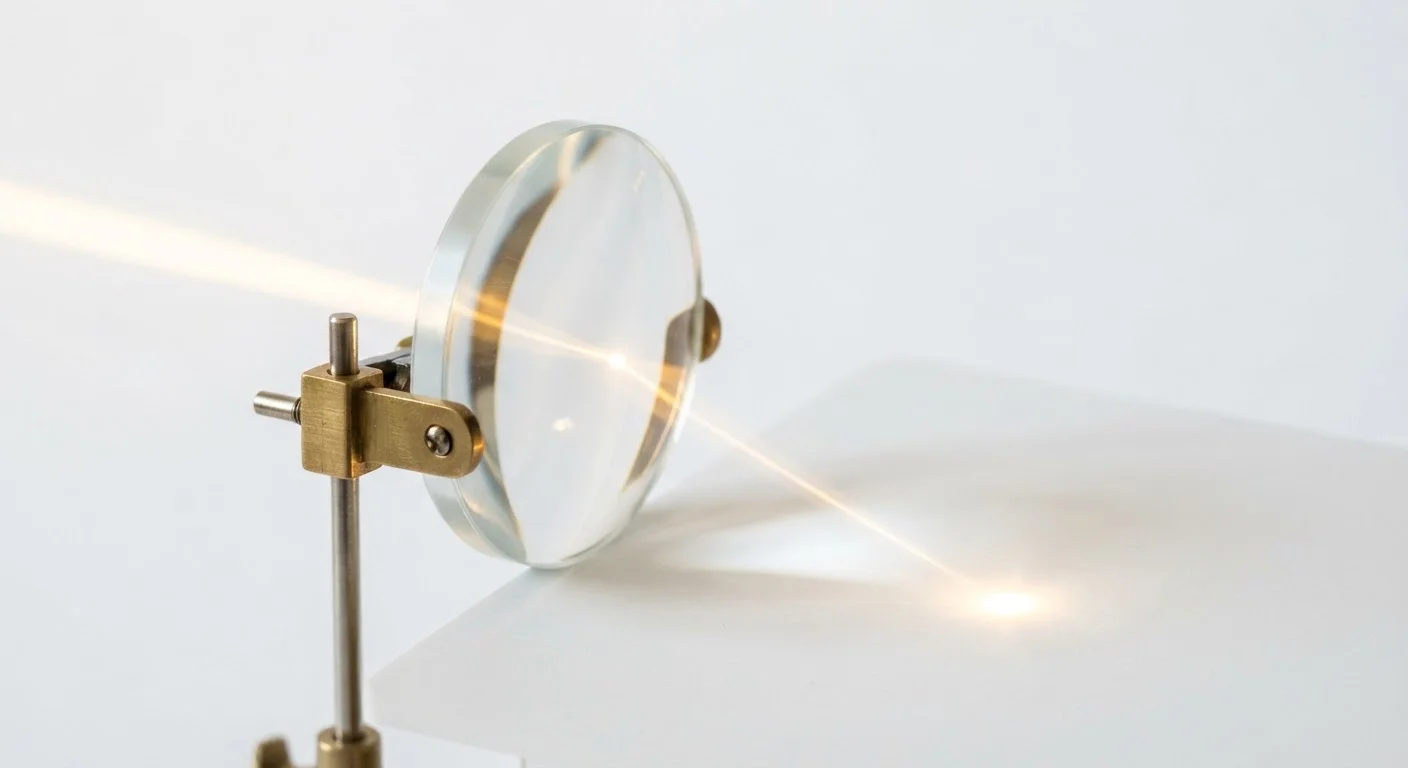
Photo: QuickAdvisor.net editorial
Key Takeaways
- Light bends when it crosses from one transparent material into another because its speed changes.
- Convex lenses converge light rays to a focal point; concave lenses spread them apart.
- Eyeglass lenses correct vision by redirecting light to land precisely on the retina.
- Camera lenses stack multiple curved elements to control focus, reduce distortion, and manage color.
- The focal length of a lens determines how strongly it bends light and how magnified an image appears.
Why Light Changes Direction at All
Imagine walking from a paved road onto soft sand at an angle. Your inside foot slows down first, causing your whole body to turn. Light behaves the same way. When a beam of light crosses from air into glass, it slows - glass is denser than air, so light moves through it at roughly two-thirds its usual speed. That speed change at the boundary causes the beam to bend. When the light exits the glass back into air, it speeds up again and bends a second time.
This is refraction, and every lens ever made exploits it deliberately. The shape of the glass surface determines the angle at which light hits the boundary, and therefore how sharply the beam bends. Lens makers use this relationship to direct light with extraordinary precision.
Refraction vs. Reflection: Not the Same Thing
Convex vs. Concave: Two Ways to Shape a Beam
All lenses fall into two fundamental families. A convex lens - thicker at the center than the edges - causes parallel light rays entering it to bend inward and meet at a single point called the focal point. Hold a magnifying glass over a page and you're using a convex lens to bring light rays together so your eye perceives the text as larger. Hold it in sunlight over paper long enough, and those converging rays concentrate enough energy to scorch it.
A concave lens - thinner at the center - does the opposite: it causes light rays to spread outward, as if they originated from a point in front of the lens. To an observer's eye, objects viewed through a concave lens appear smaller and farther away. This diverging effect is precisely what makes concave lenses useful for correcting nearsightedness.
1.5
Refractive index of standard optical glass
This value means light travels through glass at roughly 67% of its speed in a vacuum, causing the bending that makes lenses work.
~2.6 billion
People globally who use corrective lenses
The World Health Organization estimates that over a third of the global population relies on glasses or contact lenses to correct refractive vision errors.
17mm-600mm
Typical focal length range in consumer camera lenses
This range represents the spectrum from ultra-wide-angle lenses that capture broad scenes to telephoto lenses that magnify distant subjects.
How Vision Correction Works
The human eye contains its own biological lens, which focuses incoming light onto the retina at the back of the eye. When that system is slightly off - either because the eyeball is too long, too short, or the natural lens too curved - light converges at the wrong point and vision blurs.
Eyeglass and contact lenses act as a corrective first stage. A concave lens pre-diverges light for a nearsighted eye, so the eye's own lens brings it to a sharp focus further back, right on the retina. A convex lens pre-converges light for a farsighted eye for the same reason in reverse. The prescription number on an eyeglass lens, measured in diopters, describes the strength of this correction mathematically.
Cameras, Telescopes, and Compound Lenses
A single curved glass element bends different wavelengths of light by slightly different amounts - red light bends less than blue. This produces faint color halos around sharp edges, an artifact called chromatic aberration. To eliminate it, optical engineers stack multiple lens elements made from glass with differing refractive indexes. Elements that spread color are paired with elements that recombine it, resulting in crisp, accurate images.
A modern camera kit lens might contain a dozen or more elements in several groups. Each group handles a specific optical task: one corrects color, another manages distortion near the frame edges, another maintains sharpness when focusing close. Telescopes use a similar strategy, sometimes combining lenses with mirrors to gather as much light as possible while keeping the tube manageable in length.
Frequently Asked Questions
The content on this site is for informational purposes only and is not a substitute for professional advice. Always consult a qualified professional for guidance specific to your situation.