
Blood Types Decoded: What A, B, O, and Rh Factor Actually Mean

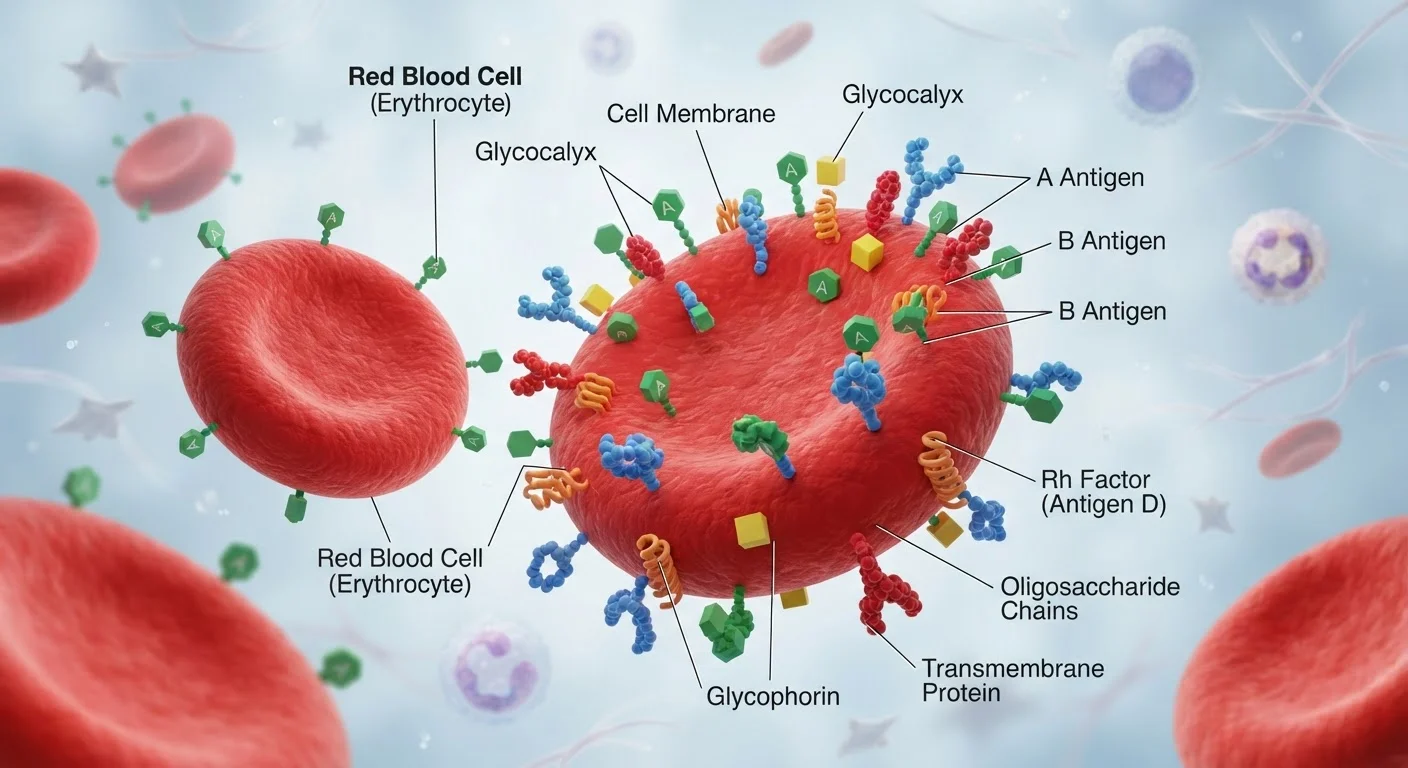
Photo: QuickAdvisor.net editorial
The ABO System: What Those Letters Actually Represent
Your blood type isn't a label assigned arbitrarily - it's a direct description of proteins sitting on the surface of your red blood cells. These proteins are called antigens, and the ABO blood group system classifies them into four main types: A, B, AB, and O.
| Most common blood type (US) | O positive (~37% of the population) (American Red Cross) |
| Rarest blood type (US) | AB negative (~1% of the population) (American Red Cross) |
| Rh-positive Americans | Approximately 85% (National Institutes of Health) |
| Total known blood group antigens | Over 300 (International Society of Blood Transfusion (ISBT)) |
| ABO system discovered | 1901, by Karl Landsteiner |
| Universal donor type | O negative |
If your red blood cells carry A antigens, your blood type is Type A. Carry B antigens, and you're Type B. Have both? You're Type AB. Have neither? You're Type O.
The other half of the equation involves your plasma, the liquid component of blood. Your immune system produces antibodies against whatever ABO antigens your own cells don't have. Type A individuals carry anti-B antibodies; Type B individuals carry anti-A antibodies; Type O individuals carry both; and Type AB individuals carry neither. This immune logic is precisely why mismatched transfusions can be dangerous - the recipient's antibodies attack the donated cells as foreign invaders.
The Rh Factor: What the Plus or Minus Sign Means
After the ABO letter, you'll see a plus (+) or minus (−) sign. This refers to the Rh factor - specifically, the presence or absence of a protein called the Rh(D) antigen on your red blood cells. About 85% of Americans are Rh-positive, meaning this protein is present.
Antigen
A molecule - often a protein - found on the surface of cells that the immune system uses to identify substances as "self" or "foreign." In blood typing, antigens on red blood cells define your ABO and Rh type.
Antibody
A protein produced by the immune system to recognize and bind to specific antigens. In blood transfusions, mismatched antibodies attacking donor antigens cause dangerous immune reactions.
Rh Factor
The presence or absence of the Rh(D) antigen on red blood cells. Being Rh-positive means you carry the antigen; Rh-negative means you do not.
Rh Incompatibility
A condition that can occur during pregnancy when an Rh-negative mother carries an Rh-positive fetus, potentially causing the mother's immune system to produce antibodies against the baby's red blood cells.
Co-dominance
A genetic inheritance pattern in which both alleles are fully expressed. In blood typing, inheriting both A and B alleles results in Type AB, not a blend or a dominant-over-the-other outcome.
Universal Donor
An informal term for Type O-negative blood, whose red blood cells lack ABO and Rh(D) antigens and can generally be transfused to any recipient in emergency situations.
Rh factor matters most in two contexts. First, during blood transfusions: an Rh-negative person who receives Rh-positive blood can develop antibodies against the Rh antigen, creating a serious immune response if exposed again. Second, during pregnancy: if an Rh-negative mother carries an Rh-positive fetus, a condition called Rh incompatibility can develop. The mother's immune system may recognize the baby's Rh antigen as foreign. This is now routinely managed with a medication called Rh immunoglobulin (RhIg), given to at-risk pregnant individuals - a good example of medicine using biological knowledge to prevent harm.
Compatibility, Universal Donors, and What Determines Your Type
The concept of a "universal donor" - Type O negative - exists because O-negative red blood cells carry no ABO antigens and no Rh(D) antigen, so they're unlikely to trigger an immune rejection in any recipient. This makes O-negative blood especially valuable in emergencies when a patient's blood type is unknown. Type AB positive individuals are sometimes called universal recipients for red blood cell transfusions, since their immune systems tolerate all ABO and Rh types.
However, real-world transfusion medicine is more nuanced than these shorthand labels suggest. Blood banking involves extensive cross-matching across multiple antigen systems - ABO and Rh are simply the most clinically prominent ones. There are over 300 other known blood group antigens recognized by researchers.
Your blood type is determined by genetics. You inherit one allele from each parent for the ABO gene and one for Rh. The ABO alleles for A and B are co-dominant, while O is recessive - which explains why two Type A parents can have a Type O child if both carry a hidden O allele. Rh-positive is dominant over Rh-negative.
This article is for general informational and educational purposes only and does not constitute medical advice. Always consult a qualified healthcare provider with questions about your health or medical care.
The content on this site is for informational purposes only and is not a substitute for professional advice. Always consult a qualified professional for guidance specific to your situation.