
The Case For and Against Crewed Mars Missions

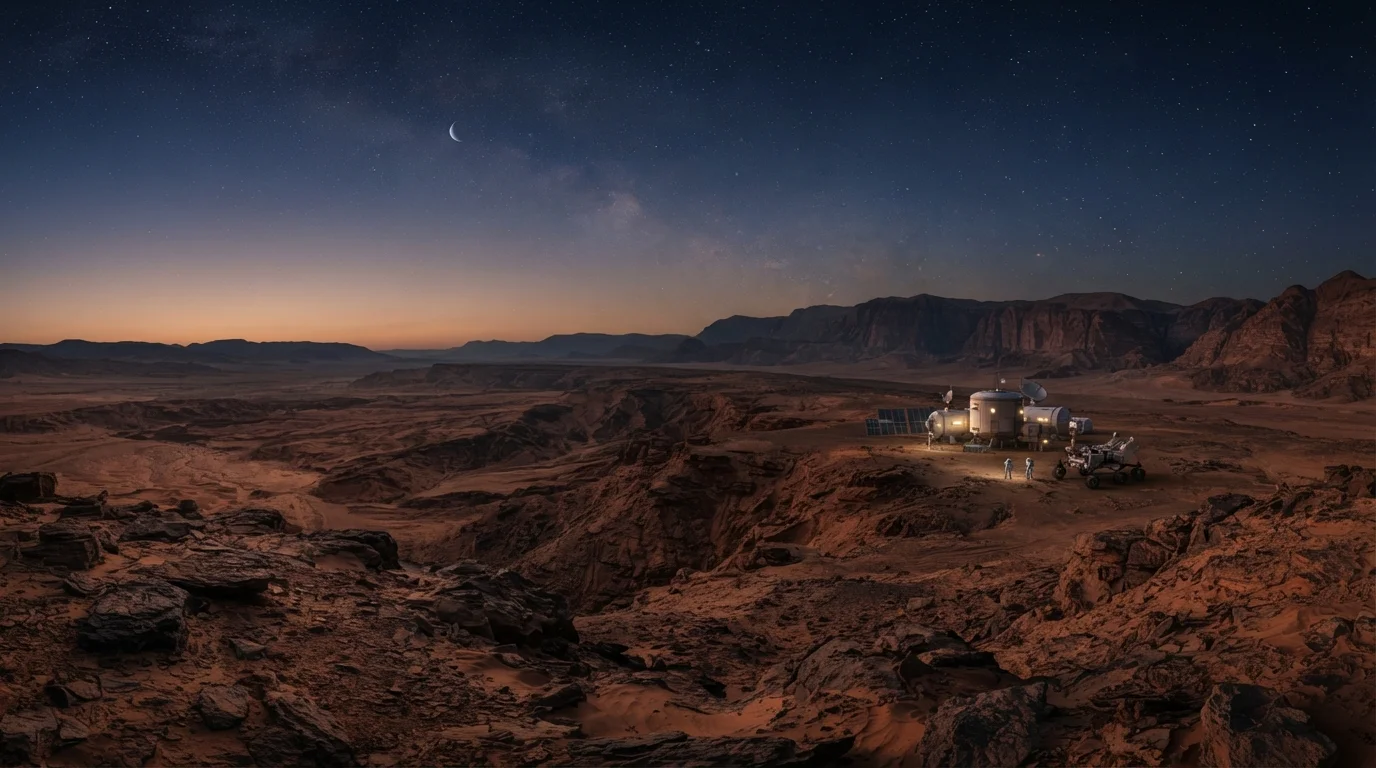
Photo: QuickAdvisor.net editorial
Key Takeaways
- A crewed Mars mission would enable real-time scientific discovery that rovers simply cannot replicate.
- Radiation exposure, psychological isolation, and life-support failures remain the most serious risks to human crew members.
- The cost of a crewed Mars mission is estimated to run into the hundreds of billions of dollars.
- Mars offers a potential long-term refuge for humanity, though this remains a distant and contested prospect.
- Robotic missions continue to advance Mars science at a fraction of the cost and with no risk to human life.
Real-time decision-making on the Martian surface
Human explorers can respond instantly to unexpected findings - adjusting sampling sites, testing hypotheses, and exercising scientific judgment in ways that remote-controlled robots cannot match given the communication delay.
Dramatically faster field science
Planetary scientists estimate a human crew could cover and analyze terrain in hours that would take rovers months, potentially accelerating answers to fundamental questions about Martian geology and past habitability.
Symbolic and inspirational value for humanity
Crewed Mars exploration would represent a historic milestone comparable to the Apollo missions, driving public engagement with science, technology, engineering, and mathematics at a generational scale.
Potential long-term refuge for the human species
While speculative and distant, establishing a permanent presence on Mars could provide an off-world backup for civilization in the event of large-scale catastrophes affecting Earth.
Drives transformative technological development
The engineering demands of a crewed Mars mission - closed-loop life support, advanced propulsion, in-situ resource utilization - would likely generate spinoff technologies with broad applications on Earth.
Severe radiation exposure with no complete solution
Deep-space radiation from galactic cosmic rays cannot be fully blocked by current spacecraft shielding. A Mars-duration mission could expose crew to radiation doses well above established career safety thresholds, elevating long-term cancer risk significantly.
Extreme psychological and cognitive risks
Prolonged isolation, confinement, and communication delays of up to 24 minutes each way create documented risks of cognitive decline, interpersonal conflict, and impaired decision-making - factors that could compromise mission safety.
Enormous and uncertain financial cost
Credible estimates for a full crewed Mars program span hundreds of billions of dollars over decades, raising serious questions about opportunity cost and whether that investment could yield greater scientific return through other means.
Life-support failure is a catastrophic, lethal risk
Unlike the ISS - where a rescue mission is days away - a crew on Mars has no rescue option. Any critical failure in life support, power, or medical systems could be unsurvivable with no possibility of outside intervention.
Planetary protection concerns for Martian science
Humans inevitably carry and shed microbes, which could contaminate the Martian environment and permanently compromise the search for native Martian life - the very goal the mission is partly designed to pursue.
Robotic missions deliver comparable science at lower risk
Advanced rovers and planned sample return missions can answer many of the same scientific questions without endangering human lives, at a fraction of the cost and logistical complexity.
Why Mars, and Why Humans?
Mars is the most Earth-like planet in our solar system - it has a day close to 24 hours, evidence of ancient rivers and lakes, and a thin but real atmosphere. For decades, robotic spacecraft like NASA's Curiosity and Perseverance rovers have returned extraordinary data. Yet rovers move slowly, cover limited terrain, and must wait minutes to hours for instructions relayed across millions of miles of space. A trained astronaut-geologist on the surface could do in one afternoon what a rover takes months to accomplish. That gap is at the heart of the argument for sending humans.
The question is whether the scientific and exploratory payoff justifies the cost, complexity, and very serious risk to human lives. Here is a balanced look at both sides.
The Case For Crewed Mars Missions
Real-time decision-making on the Martian surface
Human explorers can respond instantly to unexpected findings - adjusting sampling sites, testing hypotheses, and exercising scientific judgment in ways that remote-controlled robots cannot match given the communication delay.
Dramatically faster field science
Planetary scientists estimate a human crew could cover and analyze terrain in hours that would take rovers months, potentially accelerating answers to fundamental questions about Martian geology and past habitability.
Symbolic and inspirational value for humanity
Crewed Mars exploration would represent a historic milestone comparable to the Apollo missions, driving public engagement with science, technology, engineering, and mathematics at a generational scale.
Potential long-term refuge for the human species
While speculative and distant, establishing a permanent presence on Mars could provide an off-world backup for civilization in the event of large-scale catastrophes affecting Earth.
Drives transformative technological development
The engineering demands of a crewed Mars mission - closed-loop life support, advanced propulsion, in-situ resource utilization - would likely generate spinoff technologies with broad applications on Earth.
The scientific potential is significant. Humans can react in real time to unexpected discoveries - a crack in a rock, an unusual soil color, a whiff of chemical signal - in ways no remotely operated robot can. Planetary scientists argue that questions about whether Mars ever hosted microbial life may ultimately require human hands to answer, since drilling, sample collection, and contextual judgment all improve dramatically with a person on site.
There is also the longer civilizational argument: establishing a foothold on another world could serve as insurance for the human species against catastrophic events on Earth. While this scenario is speculative and far from imminent, it has shaped the thinking of several major space agencies and private ventures alike.
The Case Against Crewed Mars Missions
Severe radiation exposure with no complete solution
Deep-space radiation from galactic cosmic rays cannot be fully blocked by current spacecraft shielding. A Mars-duration mission could expose crew to radiation doses well above established career safety thresholds, elevating long-term cancer risk significantly.
Extreme psychological and cognitive risks
Prolonged isolation, confinement, and communication delays of up to 24 minutes each way create documented risks of cognitive decline, interpersonal conflict, and impaired decision-making - factors that could compromise mission safety.
Enormous and uncertain financial cost
Credible estimates for a full crewed Mars program span hundreds of billions of dollars over decades, raising serious questions about opportunity cost and whether that investment could yield greater scientific return through other means.
Life-support failure is a catastrophic, lethal risk
Unlike the ISS - where a rescue mission is days away - a crew on Mars has no rescue option. Any critical failure in life support, power, or medical systems could be unsurvivable with no possibility of outside intervention.
Planetary protection concerns for Martian science
Humans inevitably carry and shed microbes, which could contaminate the Martian environment and permanently compromise the search for native Martian life - the very goal the mission is partly designed to pursue.
Robotic missions deliver comparable science at lower risk
Advanced rovers and planned sample return missions can answer many of the same scientific questions without endangering human lives, at a fraction of the cost and logistical complexity.
~24 min
One-way communication delay at maximum Mars distance
NASA estimates a one-way signal between Earth and Mars can take anywhere from about 3 to 24 minutes depending on orbital positions, making real-time crew rescue coordination impossible.
~500 days
Estimated minimum Mars surface stay per mission
Due to orbital mechanics, crews would need to wait on Mars for roughly 500 days before the planets align favorably for a return journey, significantly extending total mission duration and risk exposure.
The challenges are not merely engineering problems - they are fundamental biological ones. Galactic cosmic rays and solar particle events bombard spacecraft with radiation that current shielding technology cannot fully block. Crew members on a roughly two-to-three-year round trip (depending on launch windows) could absorb radiation doses exceeding NASA's current career limits, significantly raising long-term cancer risk.
Beyond radiation, the psychological toll of 18 months or more of isolation in a confined spacecraft - with communication delays of up to 24 minutes each way - is difficult to overstate. Studies of long-duration missions on the International Space Station and Antarctic isolation analog research highlight cognitive fatigue, interpersonal conflict, and decision-making degradation as real concerns.
What Scientists Mean by 'Radiation Risk'
Can Robots Do the Job Instead?
Proponents of robotic exploration point out that Mars science has advanced enormously without putting a single human at risk. The Perseverance rover has collected and cached rock samples, documented ancient lake-bed geology, and even operated a small helicopter - all remotely. Planned Mars Sample Return missions aim to bring collected specimens to Earth laboratories, where far more sophisticated analysis is possible than anything a crew could perform on-site.
Robotic missions also cost a fraction of what a crewed program would require. Estimates for a full human Mars mission vary widely but routinely run into the hundreds of billions of dollars over multiple decades. That funding, critics argue, could support dozens of robotic missions across the solar system.
The honest answer from most planetary scientists is that the two approaches are complementary, not competing. Robots scout; humans ultimately go where science most demands their presence. The debate is really about timing, priority, and how much risk is acceptable.
The content on this site is for informational purposes only and is not a substitute for professional advice. Always consult a qualified professional for guidance specific to your situation.