
Free Weights vs. Machines: What the Research Actually Says

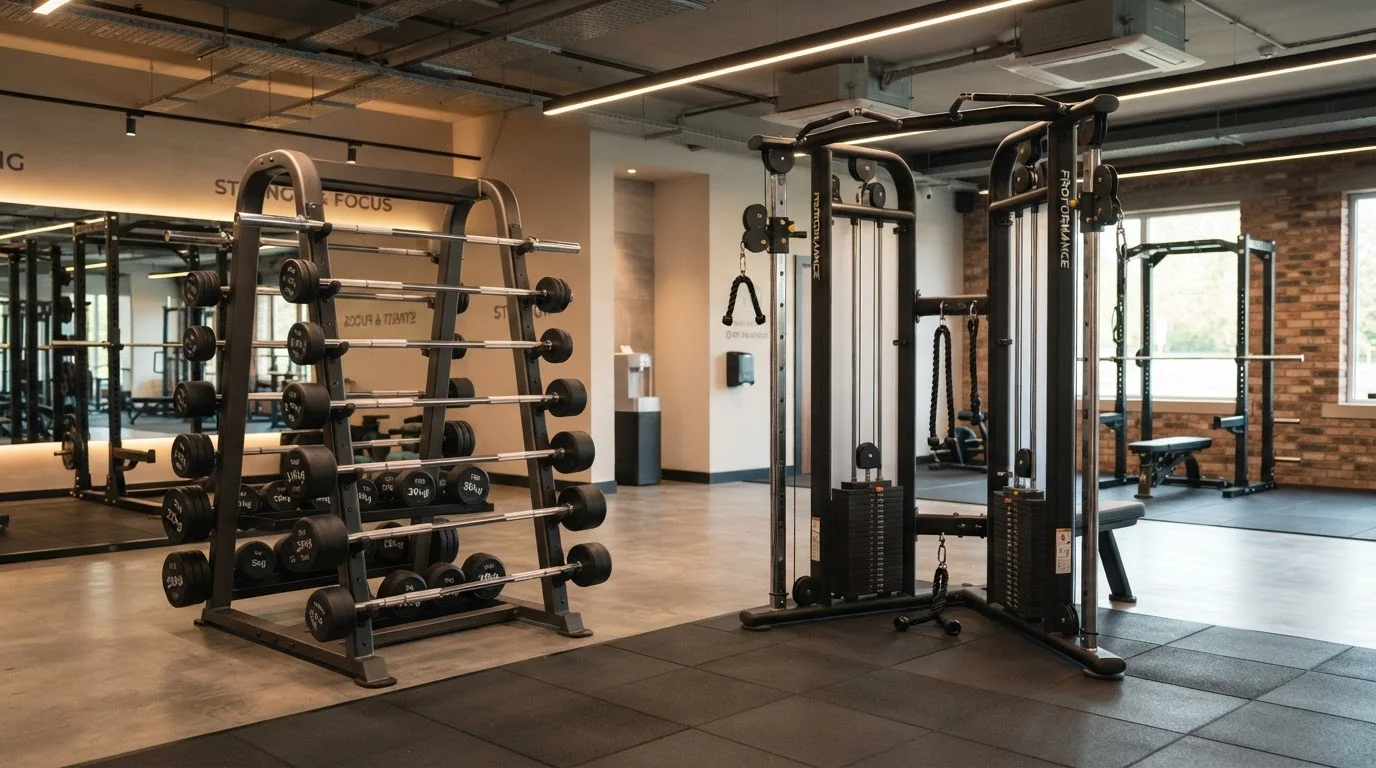
Photo: QuickAdvisor.net editorial
Key Takeaways
- Both free weights and machines effectively build muscle and strength when effort and programming are consistent.
- Free weights recruit more stabilizer muscles and transfer better to real-world and athletic movement patterns.
- Machines reduce injury risk for beginners and allow safer isolated loading during rehabilitation.
- Research does not strongly favor one over the other for hypertrophy (muscle growth) in most populations.
- The best approach for most people combines both tools strategically within a single program.
What the Evidence Actually Shows
The debate between free weights and resistance machines has persisted in gyms for decades, but the research tells a more nuanced story than most online arguments suggest. Both modalities reliably produce strength gains and muscle hypertrophy - the question is how they produce those adaptations and which context suits each tool best.
Studies comparing the two consistently show that when volume, intensity, and effort are equated, differences in muscle growth between free weights and machines are modest. A 2020 review published in the Journal of Human Kinetics found comparable hypertrophy outcomes across both modalities in trained individuals. Where free weights do show a meaningful edge is in neuromuscular activation: exercises like barbell squats and deadlifts engage significantly more stabilizer musculature than their machine counterparts, which matters for athletic carryover and functional movement.
This is not a minor distinction. Stabilizer recruitment - activating smaller muscles around a joint to control movement - is a key mechanism by which strength built in the gym transfers to sport and daily life. Machines largely remove this demand by fixing the movement path for you. That trade-off is sometimes a feature, not a flaw.
| Criterion | Free Weights | Resistance Machines |
|---|---|---|
| Stabilizer muscle activation | High - full 3D control required | Low - path is guided |
| Beginner accessibility | Steeper learning curve | Lower barrier to entry |
| Injury rehabilitation use | Limited - requires joint stability | Well-suited - controlled ROM |
| Hypertrophy outcomes | Equivalent to slightly superior | Equivalent in most research |
| Functional / athletic carryover | Strong - mirrors real movement | Moderate - isolated patterns |
| Exercise variety | Very high - nearly unlimited | Fixed by machine design |
| Progressive overload control | Flexible but technique-dependent | Easy to increment safely |
Safety, Skill, and Learning Curves
One of the most consistent findings in resistance training research is that technique quality drives outcomes - and technique takes time to acquire. Free weights require the trainee to control load through three-dimensional space, demanding coordination, balance, and body awareness that machines simply don't. For an experienced lifter, that challenge is productive. For a beginner, it can elevate injury risk if load is added before movement quality is established.
Machines solve this problem by providing a guided range of motion, making it easier to apply progressive overload safely during early training stages. This is also why machines are widely used in rehabilitation settings: they allow clinicians to target specific muscles while protecting surrounding structures. If you have a pre-existing joint condition or are returning from injury, working with a qualified healthcare professional to determine appropriate exercise selection is essential before progressing load.
For most beginners, a practical approach involves starting with machine-based movements to build foundational strength, gradually introducing free weight variations as movement competency improves. This is not a permanent hierarchy - it is a learning pathway. As you advance, separating fact from common fitness myths will help you avoid wasted effort and misguided training decisions.
~5-8%
Greater stabilizer activation with free weights
Research comparing barbell squats to leg press machines has found meaningfully higher EMG activity in stabilizing muscles during free weight movements.
No significant difference
Hypertrophy outcomes: free weights vs. machines
A 2020 review in the Journal of Human Kinetics found comparable muscle growth between modalities when volume and effort were equated across trained participants.
Building a Program That Uses Both
Research and real-world practice increasingly support a combined approach. Using free weights for compound, multi-joint movements - squats, deadlifts, bench press, rows - and machines for targeted isolation work or accessory exercises gives you the neuromuscular benefits of free weights alongside the volume and safety advantages of machines.
For example, a lower-body session might include barbell squats as the primary lift, followed by leg press and leg curl machines for supplemental volume with reduced fatigue accumulation. This structure allows heavier, more demanding free weight work when energy is highest, then uses machines to safely accumulate additional training stimulus.
Ultimately, the choice between free weights and machines should be driven by your goals, experience level, access to equipment, and any injury considerations - not gym culture or dogma. For a broader look at how resistance training fits alongside cardiovascular exercise, see how to balance strength training and cardio for your specific fitness objectives.
This article is for general informational purposes only and does not constitute medical or personal training advice. Consult a qualified healthcare professional or certified fitness professional before beginning any new exercise program, particularly if you have an existing health condition or injury.
The content on this site is for informational purposes only and is not a substitute for professional advice. Always consult a qualified professional for guidance specific to your situation.