
Why Basketball Games Are Often Decided in the Last Two Minutes

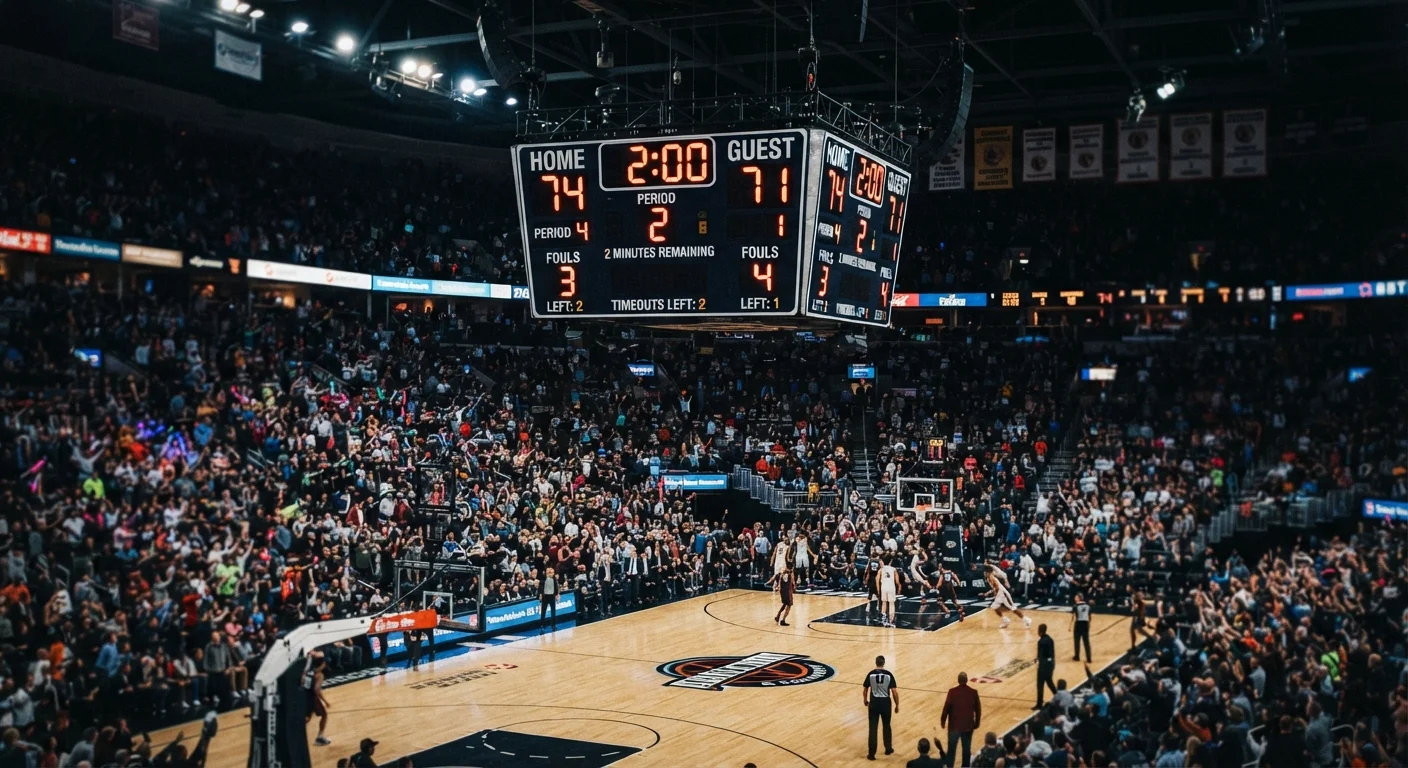
Photo: QuickAdvisor.net editorial
Key Takeaways
- Intentional fouling by the losing team stops the clock and forces free throws, slowing the game dramatically.
- Timeouts become a strategic currency - teams save them specifically for late-game decision-making.
- The fouling team's goal is to create opportunities to score while limiting the opponent's ability to run out the clock.
- Leading teams try to force the other side to foul repeatedly, accumulating free-throw points and burning time.
- Late-game strategy requires rapid in-game adjustments that expose coaching and player skill under pressure.
The Clock Changes Everything
For most of a basketball game, both teams play with the same broad objective: outscore the opponent on each possession. Defenses pressure, offenses execute, and the score moves in relatively predictable rhythms. But once a close game enters its final two minutes, those rhythms break down entirely.
The core reason is that time becomes a resource as valuable as points. A team trailing by four points doesn't just need to score - it needs to score quickly enough, and frequently enough, to overcome the deficit before the buzzer. That constraint forces coaches and players into a different decision-making mode where every second is weighed against every point.
This is why casual fans often notice the game seeming to slow down or fragment near the end. Multiple timeouts, deliberate fouls, and stoppages aren't accidental - they are the intended mechanics of late-game play.
Intentional Fouling: The Losing Team's Main Tool
The most visible - and often confusing - late-game tactic is intentional fouling. When a team is trailing, its biggest enemy is the running clock. If the leading team simply holds the ball and dribbles, time evaporates. Fouling stops that clock immediately.
By sending an opposing player to the free-throw line, the trailing team accomplishes two things. First, it halts the clock during the free-throw process. Second, if the fouled player misses one or both free throws, the trailing team can grab the rebound, score quickly, and narrow the gap faster than the game would otherwise allow.
“The last two minutes of a close basketball game are more about decision-making under pressure than pure athleticism. The team that executes its system - not the team with the most talent - usually wins.”
— Dean Oliver, Basketball statistician and author of 'Basketball on Paper'
This explains why coaches specifically target the weakest free-throw shooter on the floor - historically a center or power forward whose size is more valuable than perimeter shooting. A player converting only 50% of free throws is a genuine opportunity for the fouling team.
The tactic has limits. It doesn't work if the fouled player shoots well, and every foul also carries the risk of a successful two-shot sequence that effectively ends the game.
How the Leading Team Responds
Being in the lead doesn't mean being passive. Leading teams have their own late-game playbook designed to neutralize the trailing team's tactics.
The most straightforward response is to put the ball in the hands of reliable free-throw shooters. When the trailing team knows it needs to foul, the leading team deliberately keeps its best shooters with the ball to make fouling costly. A player who converts 90% of free throws turns each intentional foul into a near-automatic scoring opportunity for the leader.
Watch the Ball Handler, Not the Ball
Leading teams also use the shot clock strategically, running the clock down to its final seconds before shooting. This limits the number of possessions the trailing team can generate. Combined with careful ball handling and smart timeouts, this approach is sometimes called clock management - one of the most underappreciated skills in basketball coaching.
Why Timeouts Are Saved for This Moment
Experienced coaches treat timeouts like late-game currency. A team that burns all its timeouts in the second quarter loses one of its most powerful tools when the game is actually on the line.
In the final two minutes, a timeout lets a coach pause the action to draw a specific play, respond to what the opposing team is doing, or simply let players regroup mentally under pressure. For the trailing team, a timeout after a made basket can also stop the clock, giving a moment to inbound the ball with a set play rather than reacting in chaos.
The interplay of timeouts, fouls, and possessions in the final stretch is what makes late-game basketball feel almost chess-like. Each decision by one coach forces a counter-decision by the other - and mistakes in this phase, more than any other, tend to determine outcomes.
This article is for general informational and educational purposes. Basketball rules and strategies vary by league and level of play; consult official rulebooks for precise rule details.
Frequently Asked Questions
The content on this site is for informational purposes only and is not a substitute for professional advice. Always consult a qualified professional for guidance specific to your situation.