
Misconceptions About Gravity That Even Adults Carry Around

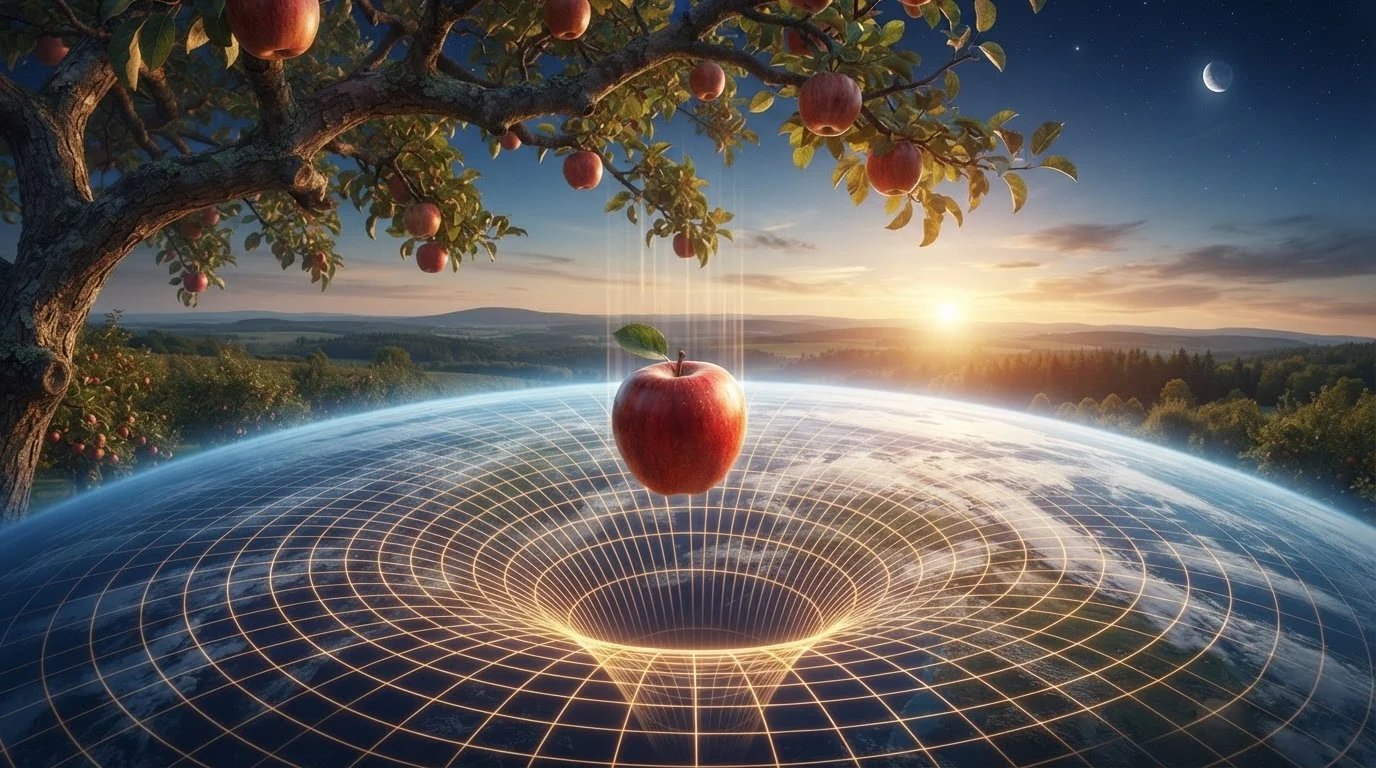
Photo: QuickAdvisor.net editorial
Key Takeaways
- Gravity does not disappear in orbit - astronauts float because they are in continuous free fall.
- Mass and weight are not the same thing; weight changes depending on where you are in the universe.
- All objects fall at the same rate in a vacuum, regardless of how heavy they are.
- Gravity operates across all distances; it never truly switches off.
- Einstein showed gravity is the curvature of spacetime, not just a pulling force between objects.
Why Gravity Keeps Getting Misunderstood
Gravity is one of the first forces we experience as children, yet it remains one of the most widely misunderstood concepts in everyday science. Part of the problem is that our intuitions are built on surface-level observations - things fall down, heavy objects seem harder to lift, and astronauts float in space. Each of those observations is real, but the explanations most people carry for them are incomplete or flat-out wrong.
These aren't just trivial mix-ups. Misconceptions about gravity can distort how people understand weight, motion, and even the structure of the universe. The myth-and-fact pairs below address the most persistent errors - the kind that show up in casual conversation and, occasionally, in TV documentaries that should know better.
For a related look at how everyday physics surprises us, see our article on how inertia shapes your daily experiences.
Myth
There is no gravity in space - that's why astronauts float on the International Space Station.
Fact
Gravity absolutely exists at the altitude of the ISS. Astronauts float because they and the station are in continuous free fall around Earth.
The ISS orbits at roughly 400 kilometers above Earth's surface. At that altitude, gravitational acceleration is still about 90% of what you experience on the ground. The station doesn't fall straight down because it's also moving horizontally at approximately 28,000 km/h - fast enough that as it falls, Earth's surface curves away beneath it at the same rate. Everything inside the station - crew, equipment, floating water droplets - is falling together, which is why nothing presses against anything else. Physicists call this microgravity, not zero gravity.
Myth
Weight and mass are the same thing - a heavier object simply has more matter.
Fact
Mass is the amount of matter in an object and never changes. Weight is the gravitational force acting on that mass, and it changes depending on location.
Mass is measured in kilograms and stays constant whether you are on Earth, the Moon, or floating between galaxies. Weight is measured in newtons (or pounds-force in everyday US usage) and equals mass multiplied by the local gravitational acceleration. An astronaut with a mass of 80 kg weighs about 784 newtons on Earth but only about 130 newtons on the Moon, where gravity is roughly one-sixth as strong. Their mass doesn't change at all - only the gravitational pull on that mass does. This distinction matters enormously in fields from medicine to aerospace engineering.
Myth
Heavier objects fall faster than lighter ones.
Fact
In the absence of air resistance, all objects fall at exactly the same rate regardless of mass.
This idea dates back to Aristotle and persisted for nearly two thousand years until Galileo challenged it - famously, though possibly apocryphally, by dropping objects from the Leaning Tower of Pisa. The mathematical reason comes directly from Newton's second law: gravitational force is proportional to mass, but so is inertia (resistance to acceleration). The two effects cancel out precisely, leaving the same downward acceleration - about 9.8 m/s² on Earth's surface - for every object. The reason a feather and a hammer don't hit the ground simultaneously when you drop them outdoors is air resistance, not gravity. NASA demonstrated this beautifully on the Moon in 1971, where Apollo 15 astronaut David Scott dropped a feather and a hammer simultaneously in the near-vacuum, and both landed at the same moment.
Myth
Gravity only matters close to a large object - once you're far enough away, it stops.
Fact
Gravity has infinite range. It weakens with distance but never reaches zero.
According to Newton's law of universal gravitation, the gravitational force between two objects decreases with the square of the distance between them - a relationship called an inverse-square law. Double the distance and the force drops to one-quarter; triple it and the force becomes one-ninth. But no matter how large the distance gets, the force approaches zero asymptotically - it never actually reaches it. The gravitational pull of the Milky Way's supermassive black hole, Sagittarius A*, reaches across roughly 26,000 light-years to influence our own solar system in measurable (if extremely small) ways. Gravity truly has no off switch. You can explore how this plays out on inclines in our article on why your car feels heavier going uphill.
Myth
Gravity is just a force that pulls objects toward each other - nothing more complicated than that.
Fact
Einstein's general relativity describes gravity not as a force but as the curvature of spacetime caused by mass and energy.
In the Newtonian picture, gravity is a force transmitted instantaneously across space - useful for most engineering problems, but ultimately incomplete. Einstein's 1915 general theory of relativity replaced this with a geometric model: massive objects warp the four-dimensional fabric of spacetime around them, and other objects simply follow the straightest possible path through that curved space. What we experience as a gravitational 'pull' is actually the geometry of spacetime directing motion. This framework predicts effects Newton's model cannot, including gravitational time dilation (clocks run slightly slower in stronger gravitational fields - a real correction built into GPS satellites) and gravitational waves, ripples in spacetime detected for the first time by LIGO in 2015. For a complementary look at how false models mislead us in other sciences, see our assumptions that lead new astronomers astray.
What the Science Actually Tells Us
The most important shift in understanding gravity came with Albert Einstein's general theory of relativity, published in 1915. Rather than describing gravity as an invisible force reaching across space, Einstein reframed it as the curvature of spacetime itself - massive objects bend the fabric of space and time around them, and other objects follow those curves. This framework correctly predicted phenomena that Newton's laws could not fully explain, including the bending of light around the Sun, confirmed during the 1919 solar eclipse.
None of this means Newton was wrong for everyday purposes. For most practical calculations - designing a bridge, predicting where a baseball will land - Newtonian gravity is accurate and sufficient. The relativistic picture becomes essential only at extreme masses, speeds, or distances. Understanding both levels helps make sense of why gravity behaves the way it does in everything from a dropped pen to a black hole's event horizon.
90%
Gravity strength at ISS altitude vs. Earth's surface
At approximately 400 km above Earth, gravitational acceleration is still roughly 90% of surface gravity - confirming that 'zero gravity' in orbit is a misnomer.
9.8 m/s²
Gravitational acceleration at Earth's surface
This standard value, defined by the International Bureau of Weights and Measures, applies to all objects regardless of mass in the absence of air resistance.
1/6th
Moon's surface gravity relative to Earth
The Moon's weaker gravitational field means an 80 kg person weighs roughly 130 newtons there, compared to about 784 newtons on Earth, though their mass is identical.
For a deeper look at how gravity and motion combine in real life, our companion piece on why a thrown ball always curves back down walks through projectile motion step by step. And if you enjoy having stubborn myths corrected by evidence, the same approach applies beyond physics - see our piece on nutrition science myths that just won't die.
The content on this site is for informational purposes only and is not a substitute for professional advice. Always consult a qualified professional for guidance specific to your situation.