
Sound Waves vs. Light Waves: Two Very Different Ways Energy Travels

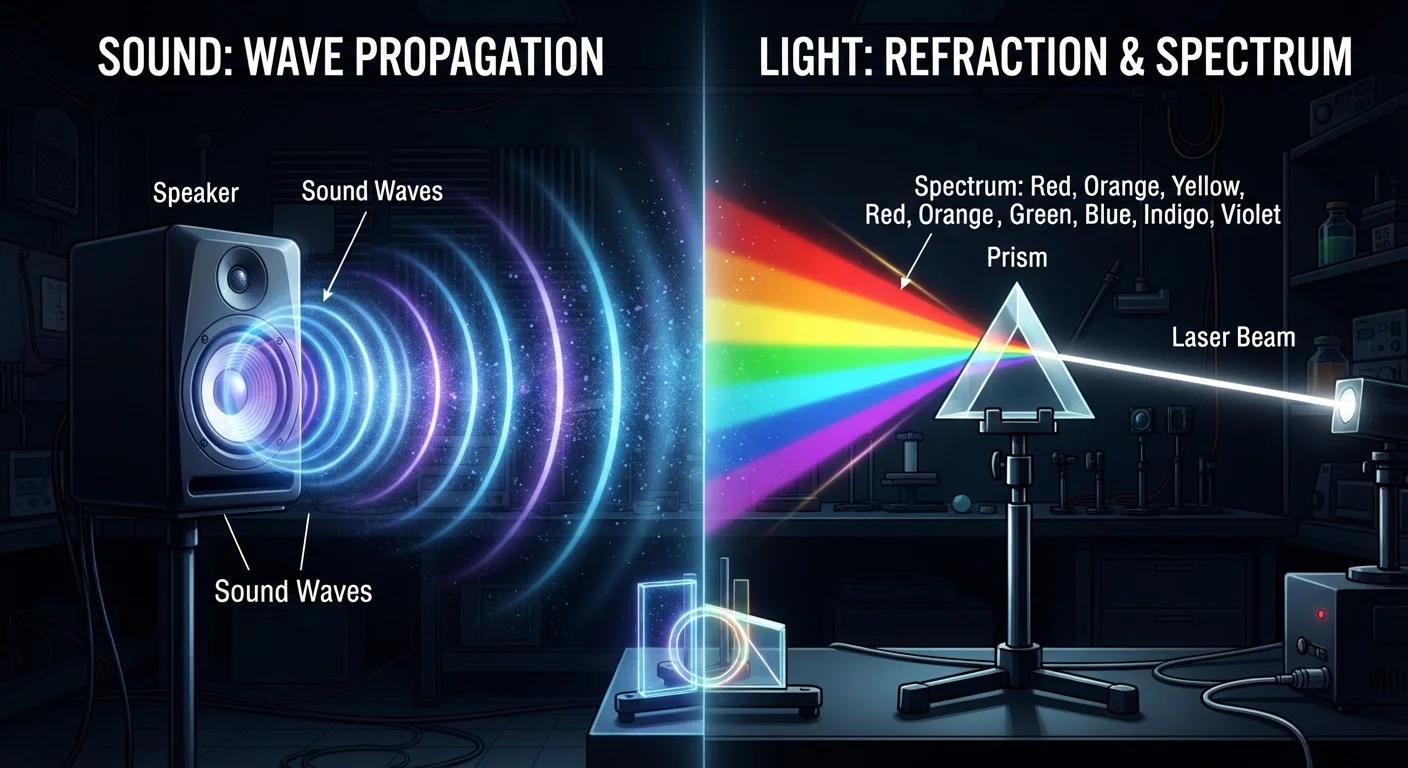
Photo: QuickAdvisor.net editorial
Key Takeaways
- Sound is a mechanical wave requiring a physical medium; light is electromagnetic and travels through a vacuum.
- Light travels at roughly 299,792 km/s - about 900,000 times faster than sound in air.
- Sound is a longitudinal wave (compressions and rarefactions); light is a transverse wave (oscillating fields).
- Both waves can reflect, refract, and carry energy - but by completely different mechanisms.
- The gap between a lightning flash and thunder directly demonstrates the speed difference.
The Fundamental Difference: What Each Wave Actually Is
Both sound and light are classified as waves - disturbances that carry energy from one place to another. But the underlying physics of how they do that couldn't be more different.
Sound is a mechanical wave. It exists as a series of pressure fluctuations - alternating compressions (where air molecules are pushed together) and rarefactions (where they spread apart) - that ripple outward from a vibrating source. Strike a drum, and the drumhead pushes against adjacent air molecules, which push their neighbors, and so on. This chain reaction requires a physical medium: air, water, metal, wood. In the absence of matter, sound simply cannot exist. The phrase "in space, no one can hear you scream" is not a metaphor - it's physics.
Light is an electromagnetic wave. It is a coupled, self-sustaining oscillation of electric and magnetic fields that propagates through space without needing any medium at all. Sunlight travels 93 million miles across the vacuum between the Sun and Earth in approximately eight minutes. No molecules required. This distinction - mechanical versus electromagnetic - is the single most important contrast between the two.
| Criterion | Sound Waves | Light Waves |
|---|---|---|
| Wave type | Mechanical (longitudinal) | Electromagnetic (transverse) |
| Requires a medium? | Yes - cannot travel in vacuum | No - travels through vacuum |
| Speed in air | ~343 m/s (~767 mph) | ~299,792 km/s |
| What oscillates | Air pressure (molecules) | Electric and magnetic fields |
| Can be polarized? | No | Yes |
| Can reflect and refract? | Yes | Yes |
| Real-world example | Thunder, music, ultrasound | Sunlight, laser, radio signal |
Speed, Shape, and How They Move
The difference in wave type also produces differences in wave shape and speed that show up in everyday life.
Sound waves are longitudinal: the molecules vibrate back and forth in the same direction the wave travels. Light waves are transverse: the electric and magnetic fields oscillate perpendicular to the direction of travel - which is why light can be polarized (filtered to allow only certain field orientations) and sound cannot.
~343 m/s
Speed of sound in air at room temperature
This value - established through centuries of measurement - varies with temperature, humidity, and the medium sound travels through.
299,792 km/s
Speed of light in a vacuum
Defined as an exact constant in the International System of Units (SI), this is the universal speed limit for energy and information in the cosmos.
~8 minutes
Time for sunlight to reach Earth
At the speed of light, electromagnetic radiation crosses the 93-million-mile Earth-Sun distance in roughly eight minutes and twenty seconds.
Speed is where the contrast becomes most dramatic. In dry air at room temperature, sound travels at roughly 343 meters per second (about 767 mph). Light travels at approximately 299,792 kilometers per second in a vacuum - around 900,000 times faster. This is why, during a thunderstorm, you see lightning essentially the moment it strikes, then wait seconds for the sound to arrive. Every five seconds between flash and thunder represents roughly one mile of distance. That real-world lag is one of physics' most accessible demonstrations.
Sound also changes speed significantly depending on the medium - it moves faster through water than air, and faster still through steel. Light slows when it passes through transparent materials (a property called the refractive index), which is why a straw appears bent in a glass of water. Understanding how sound reflects and scatters in physical environments is explored further in how echoes and reverb shape the spaces around us.
Shared Behaviors - and Where the Analogy Breaks Down
Despite their differences, sound and light share several wave behaviors: both can reflect (bounce off surfaces), refract (bend when moving between different media), diffract (spread around obstacles), and interfere (combine in ways that amplify or cancel each other). Noise-canceling headphones exploit sound interference; thin-film interference creates the rainbow colors on a soap bubble.
But the analogy breaks down at deeper levels. Light's electromagnetic nature means it can transfer energy across empty space, carry information encoded in its frequency or intensity, and interact with matter in ways that produce chemical changes - photosynthesis, sunburn, photography. Sound, being purely a pressure disturbance, depends entirely on the mechanical properties of the medium it's moving through. This is why energy transfer through physical collisions shares conceptual ground with sound propagation - both involve forces transmitted through direct contact between particles.
Understanding these two wave types gives a foundation for much of modern physics, from medical ultrasound imaging (mechanical waves) to fiber-optic communication and radio astronomy (electromagnetic waves). They represent nature's two broad strategies for moving energy from place to place - one requiring matter, one needing nothing at all.
The content on this site is for informational purposes only and is not a substitute for professional advice. Always consult a qualified professional for guidance specific to your situation.