
Energy Transfer in Everyday Collisions: Bumper Cars, Billiards, and Fender Benders

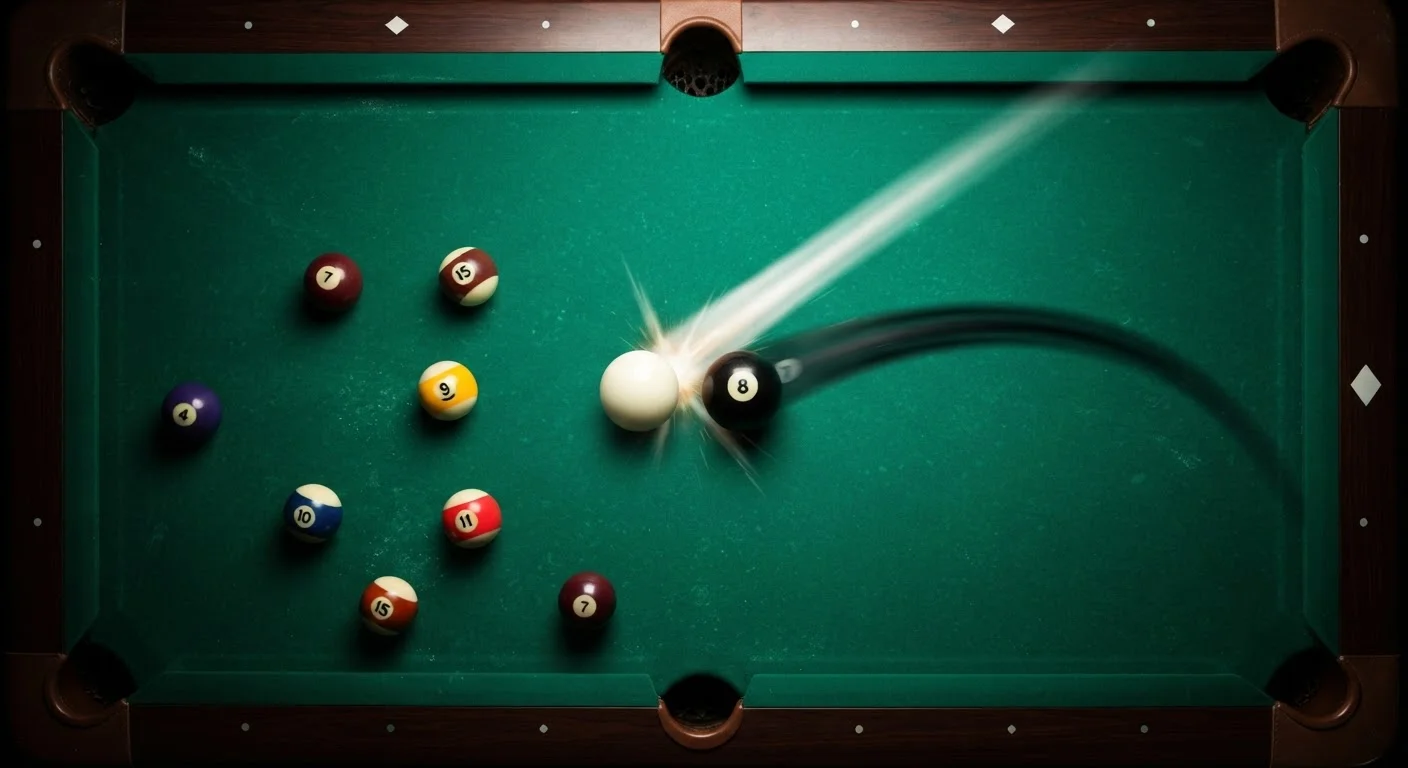
Photo: QuickAdvisor.net editorial
Key Takeaways
- Momentum is always conserved in a collision; kinetic energy may or may not be.
- Elastic collisions preserve kinetic energy; inelastic collisions convert some to heat, sound, or deformation.
- Mass and velocity both determine how much energy an object carries into a collision.
- Real-world collisions - from bumper cars to fender benders - are almost always partially inelastic.
- Crumple zones in cars are engineered to convert kinetic energy gradually, reducing injury forces.
The Physics Behind Every Impact
Every collision you've ever witnessed - a cue ball slamming into the rack at a pool table, bumper cars bouncing off each other at a fair, or the sickening crunch of a fender bender - obeys the same underlying rules of physics. Two quantities govern what happens: momentum and kinetic energy.
Momentum is the product of an object's mass and its velocity. Kinetic energy is proportional to mass and to the square of velocity - meaning speed matters enormously. Double an object's speed and its kinetic energy quadruples. These aren't just classroom formulas; they explain why highway accidents are so much more destructive than parking-lot taps, and why a bowling ball rolling slowly can still knock down pins with authority.
The law of conservation of momentum states that, within a closed system, the total momentum before a collision equals the total momentum after. Kinetic energy, however, doesn't get the same guarantee - some of it can and often does convert into other forms. Understanding which form it takes is what separates a satisfying billiards break from a costly car repair.
Inertia and Newton's first law are closely connected to this story - objects in motion resist changes to that motion, which is precisely why collision forces feel so jarring.
Billiard Balls: The Closest Thing to a Textbook Elastic Collision
Pool is perhaps the most intuitive demonstration of elastic collision physics available outside a laboratory. When a cue ball strikes a stationary billiard ball head-on at the same mass, something remarkable happens: the cue ball stops almost dead, and the target ball rolls away at approximately the original speed. Momentum has transferred almost completely from one ball to the other.
This happens because billiard balls are made of very hard phenolic resin, which deforms minimally on impact. Very little kinetic energy is lost to heat or permanent deformation - the collision is close to perfectly elastic. Skilled players exploit this predictability, calculating angles based on how momentum will distribute across multiple balls.
4×
Kinetic energy increase when speed doubles
Because kinetic energy scales with the square of velocity, doubling an object's speed quadruples its energy - a fundamental principle of classical mechanics.
~98%
Energy returned in near-elastic billiard collision
High-quality phenolic resin billiard balls lose only a small fraction of kinetic energy to heat and deformation, making pool one of the most elastic common collisions in everyday life.
40%
Reduction in crash fatality risk from crumple zones
Research published in automotive safety literature has consistently associated modern crumple zone and structural design improvements with substantial reductions in occupant fatality rates in frontal crashes.
Glancing blows - where the cue ball strikes at an angle - split momentum into components, sending each ball off at predictable angles. The geometry is rigid and reliable, which is why professional players can plan shots several moves ahead. The physics doesn't change; only the geometry does.
This contrasts sharply with how energy travels in wave form, as explored in our piece on sound waves vs. light waves - where energy propagates through a medium rather than between discrete objects.
Bumper Cars: Designed Collisions With Built-In Bounce
The bumper car ride at an amusement park is a carefully engineered collision experience. Each car is surrounded by a thick rubber bumper that acts as a temporary energy store: it compresses on impact, absorbing kinetic energy, then springs back - returning much of that energy and propelling the cars apart.
Because the vehicles move slowly and riders are secured by seat structures, the energy exchanged in each impact stays within a range the human body handles comfortably. The collisions are partially elastic - some energy is lost to the deformation of rubber and to the electric motor systems - but enough rebounds to create the characteristic jolting fun.
Speed Is the Biggest Factor in Crash Energy
Mass asymmetry matters even here. If two bumper cars of very different sizes collide, the lighter car receives a larger velocity change. A child's car struck by an adult-occupied car will rebound more sharply, reflecting the conservation of momentum across unequal masses. This is the same principle that makes large-vehicle highway collisions so dangerous - scaled up by orders of magnitude in speed and mass.
Fender Benders and Full Crashes: Inelastic Collisions With Real Consequences
Real automobile collisions are almost never elastic. Metal crumples, glass shatters, and tires screech - all of these are kinetic energy leaving the system as deformation, heat, and sound. The greater the speed difference between vehicles at impact, the more energy must go somewhere, and that somewhere is increasingly destructive.
Modern vehicle engineering turns this physics into a safety advantage. Crumple zones - structural sections of a car's body designed to collapse progressively - are engineered to absorb kinetic energy by deforming over a longer time interval. By extending the duration of the collision event, the peak force on passengers is reduced, even though the same total energy must still be managed. It's the difference between stopping a falling egg with a pillow versus a concrete floor.
Airbags operate on the same principle: they extend the time over which a passenger's momentum changes, reducing the force of impact on the body. These aren't just clever gadgets - they are the direct application of impulse-momentum physics to human survival. Understanding the rules that govern merging and traffic flow can help prevent these collisions from occurring in the first place; see our explainer on right-of-way rules drivers most often misapply.
Friction also plays a critical role before and after impact - it's what allows brakes to slow a vehicle and tires to grip pavement, changing the momentum of a car before a collision even occurs.
Frequently Asked Questions
The content on this site is for informational purposes only and is not a substitute for professional advice. Always consult a qualified professional for guidance specific to your situation.