
Static Electricity: From Doorknob Shocks to Lightning Bolts

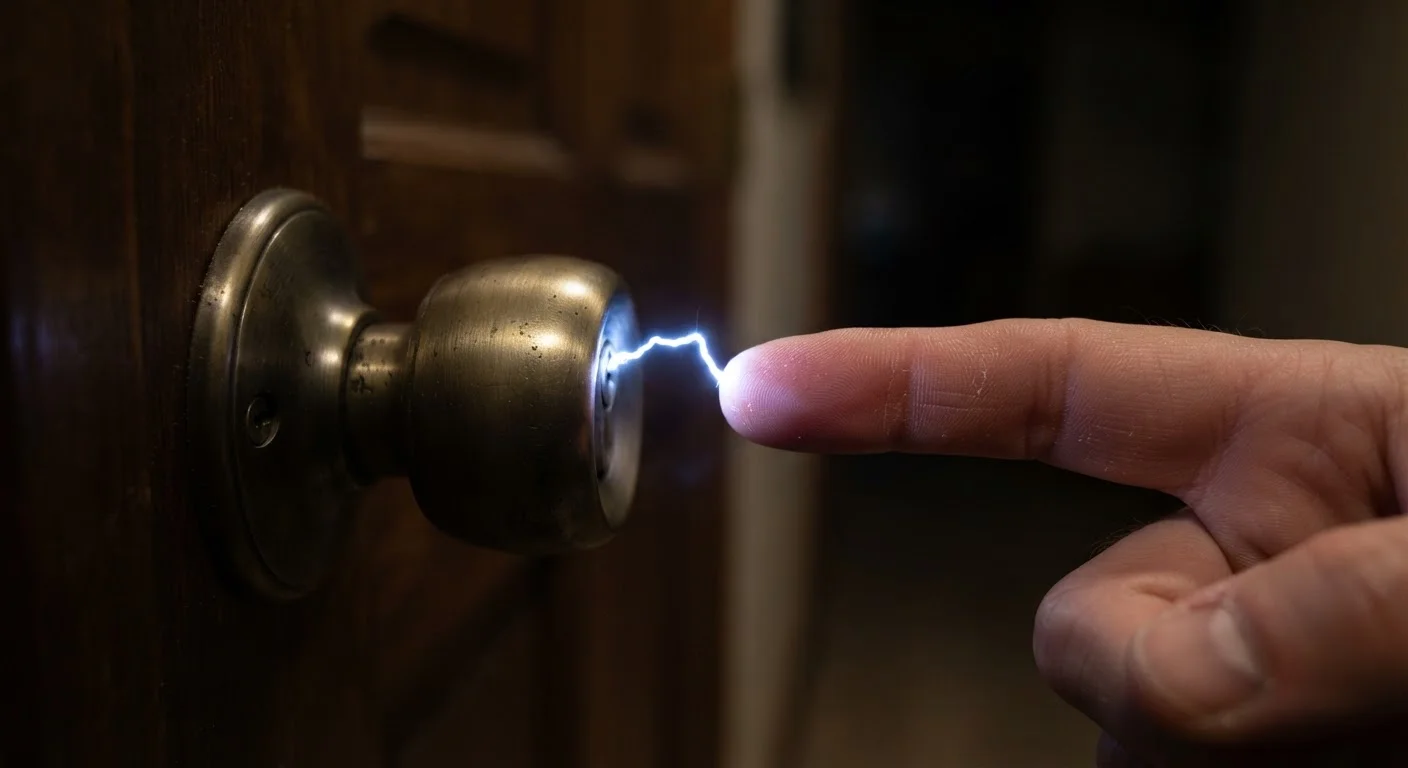
Photo: QuickAdvisor.net editorial
Key Takeaways
- Static electricity results from an imbalance of electric charge on a surface, not from electricity flowing through a circuit.
- Friction between two different materials transfers electrons from one to the other, creating that charge imbalance.
- A discharge - the zap - occurs when the built-up charge finds a conductive path to equalize.
- Lightning is essentially a massive static discharge between charged regions of a storm cloud and the ground.
- Dry air and certain materials make static buildup far more likely in everyday environments.
What Is Static Electricity?
Everything around you - your body, your carpet, your metal doorknob - is made of atoms. Each atom contains a nucleus of positively charged protons surrounded by negatively charged electrons. Under normal conditions, the number of protons and electrons in an object is balanced, making it electrically neutral.
Static electricity appears when that balance is disturbed: one object ends up with more electrons than protons (a net negative charge), and another ends up with fewer (a net positive charge). Unlike the electricity flowing through your wall outlets in a continuous circuit, static electricity is stationary charge sitting on a surface - hence the name.
Electric charge
A fundamental property of matter; protons carry positive charge and electrons carry negative charge. Objects become charged when they have an unequal number of each.
Triboelectric effect
The transfer of electrons between two materials when they come into contact and then separate, leaving one surface positively charged and the other negatively charged.
Electrical insulator
A material that does not allow electrons to flow through it easily, so charge stays put rather than spreading out or leaking away.
Electrostatic discharge (ESD)
The sudden flow of electricity between two objects with different charge levels - the 'zap' you feel is a common, small-scale example.
Electric field
An invisible region of influence surrounding a charged object where other charges experience a push or pull force.
Ionization
The process by which an atom gains or loses electrons, making it electrically charged. In air, strong electric fields can ionize molecules, turning normally insulating air into a temporary conductor.
How Charge Builds Up
The most common way charge accumulates is through friction - specifically, the contact and separation of two different materials. When you shuffle across a carpeted floor in socks, electrons transfer between the carpet fibers and the material of your socks. One surface gives up electrons; the other gains them. The result is that your body carries a net electrical charge, sometimes thousands of volts above the surroundings.
Scientists rank materials by their tendency to gain or lose electrons in a scale called the triboelectric series. Materials at opposite ends of this scale - say, rubber and fur - exchange electrons most readily when rubbed together. This is why rubbing a balloon on your hair makes the balloon stick to a wall: the balloon gains electrons from your hair, becoming negatively charged, and is attracted to the positively charged wall surface.
Importantly, charge doesn't have to involve vigorous rubbing. Even just peeling tape off a surface or pulling a synthetic sweater over your head transfers electrons efficiently.
The Moment of Discharge
Opposite charges attract. When you reach toward a metal doorknob after shuffling across carpet, the charge built up on your body creates an electric field strong enough to ionize the thin layer of air between your fingertip and the metal. Air is normally a good insulator, but under a sufficiently strong electric field, its molecules get stripped of electrons and become conducting. A rapid, tiny current flows - neutralizing the charge imbalance in a fraction of a second.
That's the zap. The snap you hear is a miniature shockwave from the rapidly heated air along the discharge path - the same acoustic principle behind thunder, just orders of magnitude smaller.
Discharge Safely Before Touching Electronics
Understanding energy transfer helps here: just as kinetic energy shifts between objects in a collision, electrical potential energy built up as static charge converts into light, heat, and sound during a discharge. See our guide to energy transfer in everyday collisions for more on how energy moves between systems in familiar situations.
Lightning: Static Electricity at Scale
A thunderstorm is essentially a giant static electricity machine. Inside a cumulonimbus cloud, violent updrafts and downdrafts drive ice crystals and supercooled water droplets into continuous collision. These collisions transfer charge: smaller, lighter ice particles tend to acquire positive charge and get carried upward by updrafts, while larger, heavier graupel (soft hail) acquires negative charge and sinks toward the cloud base.
This charge separation creates an enormous electric field between the negatively charged cloud base and the positively charged ground below. When the field grows strong enough - typically requiring hundreds of millions of volts - the air ionizes in a stepped, branching path called a stepped leader. A return stroke of current then surges upward along that ionized channel at roughly one-third the speed of light, releasing the energy we see as a lightning bolt.
The thunder that follows is the shockwave produced by air superheated to around 30,000 Kelvin - about five times hotter than the surface of the Sun - along the lightning channel.
Everyday Encounters and Practical Takeaways
Static electricity isn't just a curiosity - it shows up across technology and industry. Photocopiers and laser printers use controlled static charge to attract toner to paper in precise patterns. Air filtration systems use electrostatic attraction to pull particles from the air. And static discharge is a genuine hazard in environments handling flammable gases or fine dust, which is why workers in those settings use grounding straps and anti-static flooring.
At home, the simplest way to reduce unwanted shocks is to raise indoor humidity - moist air lets charge leak away continuously rather than building to a discharge. Touching a grounded metal object (like a part of a metal appliance connected to a ground wire) briefly before reaching for a sensitive item can also safely bleed off accumulated charge before it causes a problem.
The physics connecting a minor household annoyance to a towering thunderstorm is the same: charge imbalance, the irresistible pull of opposite charges, and the dramatic moment when insulating air gives way and lets the energy flow.
Static Electricity vs. Current Electricity
Frequently Asked Questions
The content on this site is for informational purposes only and is not a substitute for professional advice. Always consult a qualified professional for guidance specific to your situation.