
The Real Reason Your Car Feels Heavier Going Uphill

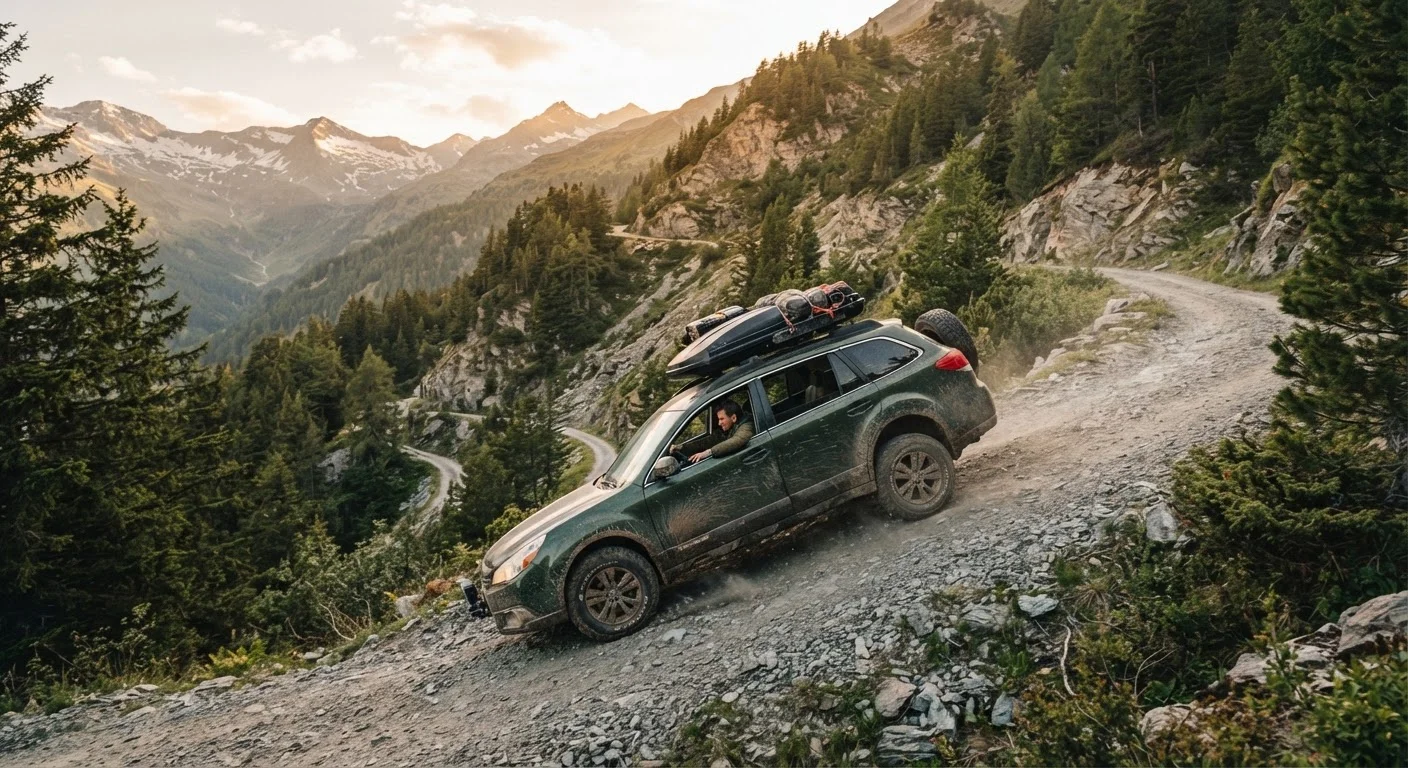
Photo: QuickAdvisor.net editorial
Key Takeaways
- Gravity acts along the slope's surface on an incline, not just straight down toward the ground.
- The steeper the hill, the greater the fraction of gravitational force working against your engine.
- Your car is also storing potential energy as it climbs, which requires real energy expenditure.
- Rolling resistance and aerodynamic drag add to the challenge, but gravity dominates on steep hills.
- Understanding incline physics explains why fuel consumption rises significantly on hilly roads.
Why Gravity Doesn't Just Pull You Straight Down on a Hill
Most people know gravity pulls objects downward. But on an incline, "downward" and "along the road" point in different directions - and that distinction is everything.
When your car sits on a slope, gravity still pulls it vertically toward Earth's center. However, physicists routinely break that force into two separate components relative to the surface beneath the car. One component pushes the car perpendicular into the road (which is why the tires stay planted). The other component acts parallel to the slope, pulling the car back down the hill. That second component is the one your engine is fighting every second you're climbing.
This is not a metaphor or approximation - it's a direct consequence of vector mathematics. A 3,500-pound vehicle on a 10° slope experiences roughly 600 pounds of force continuously pulling it back down the hill. Your engine must overcome that force just to maintain constant speed, on top of the rolling resistance and air drag it was already managing on flat ground.
Grade Percentage vs. Angle: A Common Confusion
Your Car Is Also Doing Energy Accounting in Real Time
There's a second, equally important reason uphill driving demands more from your engine: potential energy. Every foot of elevation your car gains, it stores energy in the form of height. Physicists call this gravitational potential energy, and it's calculated as mass × gravitational acceleration × height gained.
That stored energy has to come from somewhere. In a conventional vehicle, it comes from burning fuel. A 3,500-pound car climbing 500 vertical feet stores roughly 2.4 million foot-pounds of potential energy - energy that was chemically locked inside gasoline moments before. On the way back down, that stored energy is released, which is why your car accelerates freely on descents and why hybrids can recapture some of it through regenerative braking.
So when your engine sounds strained climbing a steep grade, it's not just working against a resisting force - it's actively loading energy into an invisible reservoir of height. Both demands hit simultaneously, which is why steep hills hit fuel consumption so hard.
~17%
Of vehicle weight opposing motion at 10° incline
At a 10-degree slope angle, the sine-based gravitational component equals roughly 17% of total vehicle weight acting against forward motion.
20-30%
Typical fuel economy reduction on hilly routes
Vehicles commonly experience a 20-30% drop in fuel efficiency on significantly hilly terrain compared to equivalent flat-road driving, due to gravitational resistance and potential energy demands.
80%+
Of total resistance from gravity alone on steep grades
On grades of 15 degrees or more, the gravitational slope component accounts for over 80% of total opposing force, vastly outweighing rolling resistance and aerodynamic drag.
The Other Forces at Play - and Why Gravity Still Dominates
Gravity's slope component isn't the only force resisting your climb, but on any meaningful grade it dwarfs the others. Rolling resistance - caused by tire deformation as the wheel rolls - remains relatively constant regardless of slope. Aerodynamic drag increases with speed but is insignificant at typical hill-climbing speeds. On a 15° grade, the gravitational component alone accounts for well over 80% of the total resistance a vehicle faces.
This is also why engine displacement and torque matter more than raw horsepower on hills. Torque - the rotational force an engine generates - is what pushes against that gravitational load. A high-torque diesel truck handles steep grades more comfortably than a high-revving sports car producing similar peak horsepower, because torque is available at lower RPMs where hill-climbing actually happens.
For a deeper look at how gravity influences motion in ways that often surprise us, see our exploration of common gravity misconceptions. Many of the intuitions people carry about weight and gravitational force don't quite hold up when examined carefully.
Use Lower Gears Before You Need Them
What This Means for Everyday Driving
Understanding incline physics has practical implications well beyond satisfying curiosity. Fuel economy on hilly routes drops noticeably - sometimes 20 to 30 percent compared to flat-road driving - because of the compounding demands of both opposing force and potential energy storage. Towing a trailer amplifies the effect dramatically, since every additional pound of mass increases both the gravitational force component and the potential energy required per foot of climb.
Transmission behavior also makes more sense through this lens. Automatic transmissions downshift on hills to access higher torque at the wheels, trading speed for force - exactly what the physics demands. Manual drivers do the same instinctively. The gear change isn't about the engine struggling; it's about matching output to the specific force profile the slope requires.
The next time your car feels noticeably heavier cresting a long hill, you're not imagining it. The slope has geometrically redirected part of gravity's pull against your direction of travel, while simultaneously extracting energy to store as altitude. Your engine is doing more work - and now you know precisely why.
Frequently Asked Questions
The content on this site is for informational purposes only and is not a substitute for professional advice. Always consult a qualified professional for guidance specific to your situation.