
Inside the Gut-Brain Axis: How Your Digestive System Talks to Your Mind

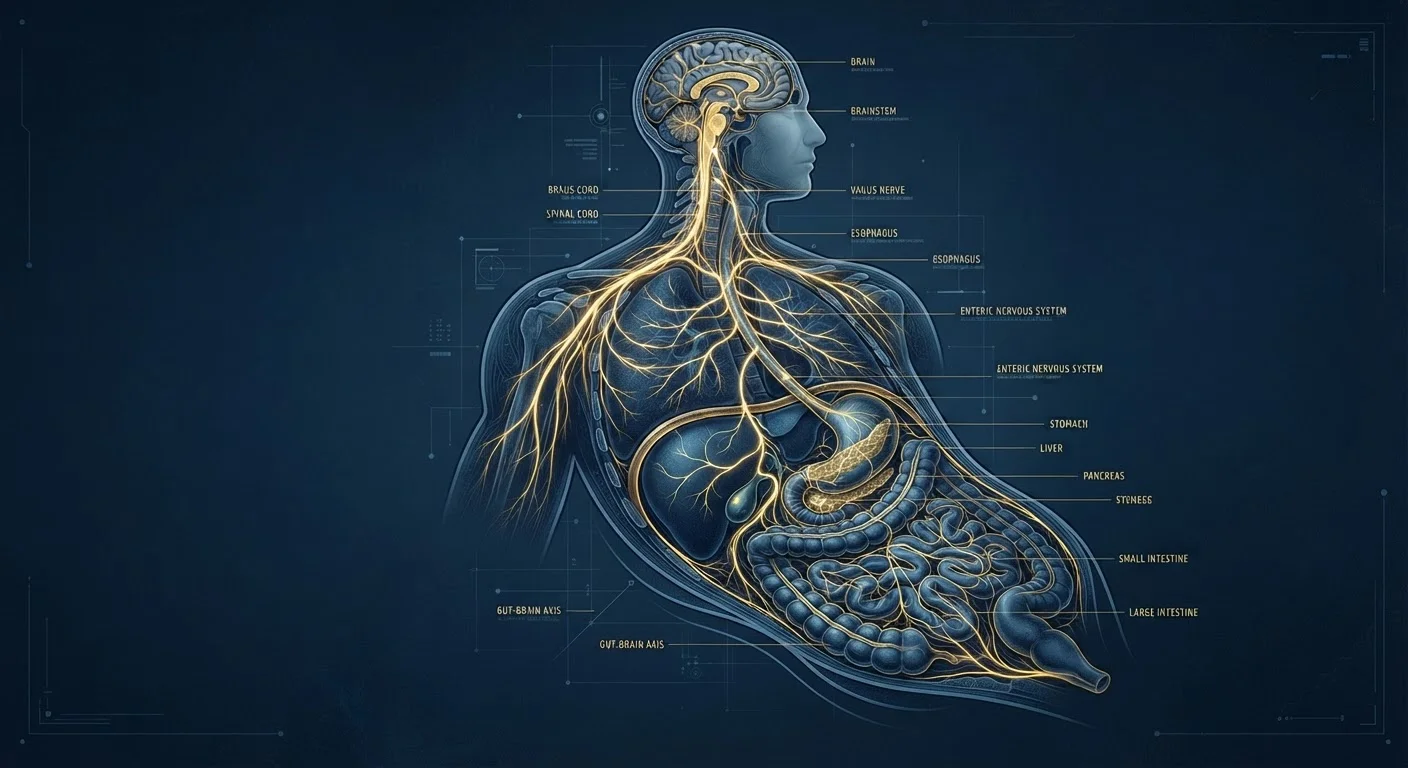
Photo: QuickAdvisor.net editorial
Key Takeaways
- The gut contains roughly 500 million neurons, forming a nervous system capable of operating independently of the brain.
- About 90% of serotonin - a key mood-regulating chemical - is produced in the gut, not the brain.
- Signals travel both ways: the brain influences digestion, and the gut sends chemical and neural messages back to the brain.
- The vagus nerve is the main physical cable connecting gut and brain in this two-way system.
- Gut microbiota (bacteria and other microorganisms) appear to play a meaningful role in mental health, though research is still evolving.
Your Gut Has Its Own Nervous System
Most people know the brain runs the show - but the gut has its own elaborate neural infrastructure that operates largely on its own terms. The enteric nervous system (ENS) is a web of approximately 500 million neurons embedded in the walls of your gastrointestinal tract, stretching from your esophagus to your rectum. It coordinates the muscular contractions that move food through your digestive system, regulates secretions, and monitors the chemical environment inside your gut - all without waiting for instructions from above.
This degree of autonomy is why scientists call the ENS the "second brain." It doesn't think or feel in any conscious sense, but it processes information and triggers responses independently. Even when the vagus nerve - the main physical cable connecting gut and brain - is severed in animal studies, the gut continues to function. As researchers in the field describe it, the ENS is genuinely capable of local reflex activity.
Understanding that the gut has this kind of neural complexity reframes how we think about digestion. It isn't a passive pipe - it's an active, sensing, signaling organ. As our coverage of commonly misunderstood body processes shows, many assumptions about where the body's work actually happens turn out to be wrong.
The Chemical Messengers in the Middle
Nerve fibers alone don't explain the full conversation between gut and brain. The axis also relies heavily on neurotransmitters and hormones - chemical messengers that circulate through the blood and interact with receptors throughout the body.
Serotonin is the most frequently cited example. Often thought of purely as a brain chemical tied to mood, approximately 90% of the body's serotonin is actually synthesized in the gastrointestinal tract by specialized gut cells called enterochromaffin cells. In the gut, serotonin helps regulate intestinal movement and signals fullness. Its relationship to mood is real but indirect - gut-produced serotonin doesn't freely cross the blood-brain barrier, so the connection is mediated through nerve signaling and other cascades rather than a simple chemical pipeline.
Other key chemical players include ghrelin (a hunger-signaling hormone), cortisol (a stress hormone that directly slows digestion when elevated), and a broad class of short-chain fatty acids produced when gut bacteria break down dietary fiber. Each of these molecules crosses or influences the gut-brain boundary in distinct ways, making this a far richer signaling environment than any single chemical can represent.
~500 million
Neurons in the enteric nervous system
The human gut contains roughly 500 million neurons - more than the spinal cord - according to established neurogastroenterology research.
~90%
Of body's serotonin produced in the gut
Research consistently estimates that approximately 90% of serotonin is synthesized in the gastrointestinal tract, not the brain.
38 trillion
Estimated microbial cells in the human gut
A widely cited 2016 estimate by Sender et al. placed the number of bacteria in the human body at roughly the same order of magnitude as human cells.
The Microbiome's Emerging Role
Perhaps the most actively researched - and least settled - piece of this puzzle is the gut microbiome: the trillions of bacteria, fungi, viruses, and other microorganisms living in your digestive tract. These aren't passive passengers. They digest certain foods humans can't process alone, produce metabolites that enter the bloodstream, and interact with the immune system in ways that appear to reach the brain.
Research in animal models has shown that germ-free mice (raised without any gut bacteria) display altered stress responses and anxiety-like behaviors compared to mice with normal microbiomes. Human studies have found associations between microbiome composition and conditions like depression, though association is not causation - the field is careful about that distinction.
“The microbiome is not an accessory to human biology - it is a core component of it. Understanding how it communicates with the brain may reshape how we think about mental health.”
— John Cryan, Professor and neuroscientist specializing in the microbiome-gut-brain axis, University College Cork
What researchers can say with confidence is that the gut microbiome produces neurotransmitter precursors, regulates the permeability of the gut lining, and communicates with immune cells that in turn affect brain function. The mechanisms are real; the clinical implications are still being mapped.
This article is for informational purposes only and does not constitute medical advice. Consult a qualified healthcare professional for any concerns about your digestive or mental health.
Frequently Asked Questions
The content on this site is for informational purposes only and is not a substitute for professional advice. Always consult a qualified professional for guidance specific to your situation.