
Dark Matter and Dark Energy: The Universe's Biggest Unknowns Explained

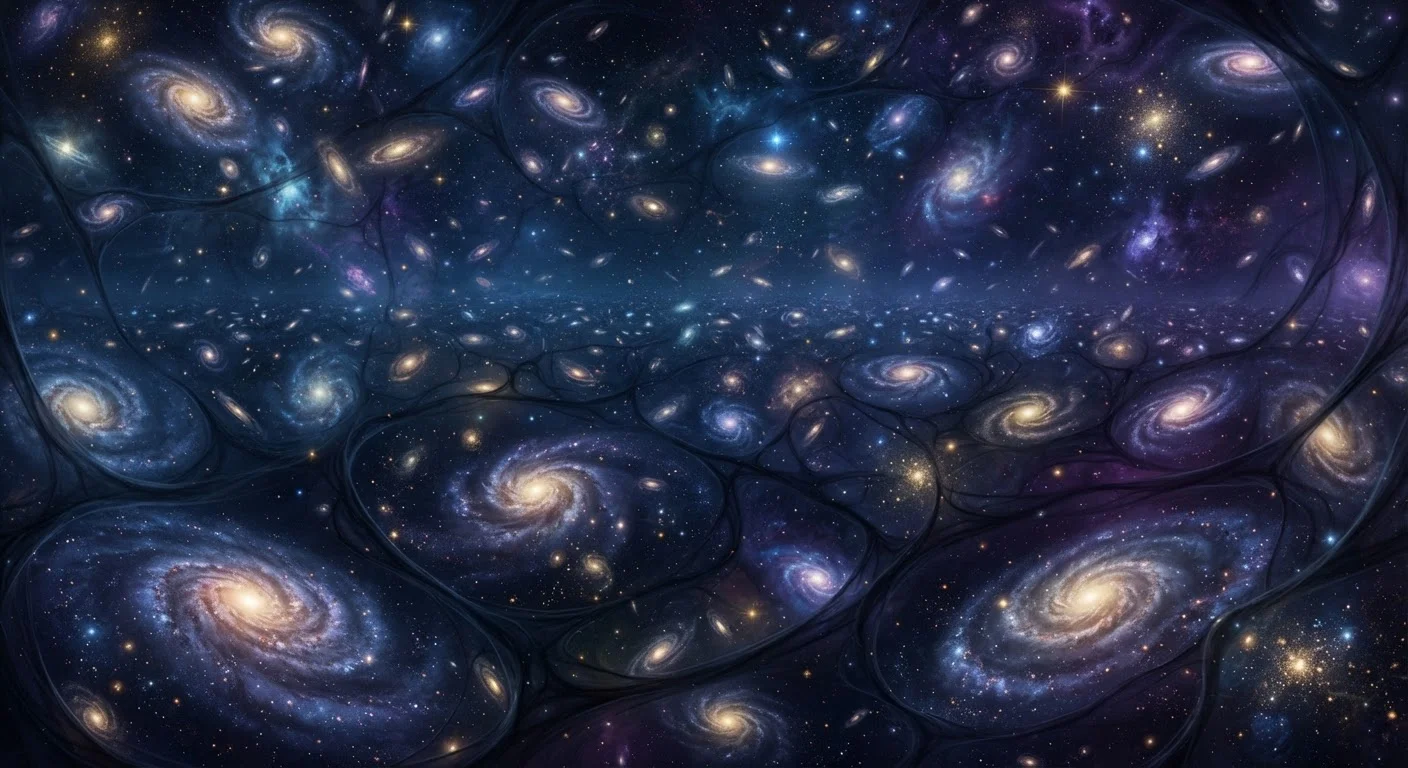
Photo: QuickAdvisor.net editorial
Key Takeaways
- Dark matter and dark energy together make up about 95% of the universe's total mass-energy content.
- Neither has been directly detected; both are inferred from their measurable effects on ordinary matter and spacetime.
- Dark matter holds galaxies together; dark energy is pushing the universe apart at an accelerating rate.
- Leading candidates for dark matter include WIMPs and axions, but none have been confirmed experimentally.
- Scientists broadly agree these phenomena exist, but their fundamental nature remains one of physics' deepest open questions.
The Universe Is Mostly Missing
Look up on a clear night and you see stars, planets, and perhaps the faint smear of the Milky Way. That picture is deeply misleading. Everything you can see - every atom in every star, planet, gas cloud, and galaxy - makes up only about 5% of the universe. The other 95% is dark matter and dark energy: invisible, undetected, and poorly understood.
This isn't a fringe idea or a placeholder for ignorance. It's one of the most robustly supported conclusions in modern cosmology, backed by independent lines of evidence from galaxy surveys, cosmic microwave background maps, and supernova observations. Physicists are confident these phenomena exist; what they don't yet know is what they fundamentally are.
As you read about space's visible contents, it helps to know that even the gas, dust, and cosmic rays filling the gaps between stars - explored in our companion piece Space Is Not Empty - represent only a small slice of the full cosmic inventory.
~68%
Share of universe composed of dark energy
According to NASA's ΛCDM cosmological model, dark energy accounts for approximately 68% of the total energy content of the observable universe.
~27%
Share of universe composed of dark matter
Dark matter is estimated to constitute around 27% of the universe's mass-energy, compared to just 5% for all ordinary, visible matter.
1998
Year accelerating expansion was discovered
Two independent teams studying Type Ia supernovae published findings in 1998 showing the universe's expansion is accelerating, leading to the modern concept of dark energy.
Dark Matter: The Invisible Scaffolding of Galaxies
The first serious hint of dark matter came from Swiss astronomer Fritz Zwicky in the 1930s, who noticed that galaxies in the Coma Cluster were moving far too fast to be held together by their visible mass alone. Decades later, astronomer Vera Rubin's painstaking measurements of galactic rotation confirmed the puzzle: the outer edges of spiral galaxies orbit their centers at roughly the same speed as the inner regions, when physics predicts they should slow down dramatically - much like the outer planets in our solar system move more slowly than inner ones.
The only way to explain this is if enormous amounts of invisible mass - a dark matter halo - surround each galaxy, providing extra gravitational grip. Additional evidence comes from gravitational lensing, where light from distant objects bends around invisible mass concentrations exactly as Einstein's general relativity predicts. The Bullet Cluster, formed by two colliding galaxy clusters, provides particularly compelling visual evidence: the gravitational mass (inferred from lensing) is clearly separated from the visible hot gas, exactly as dark matter models predict.
Leading theoretical candidates for dark matter particles include WIMPs (Weakly Interacting Massive Particles) and axions, but none have yet been confirmed in experiments. Sensitive underground detectors screen out cosmic ray interference and listen for the rare interactions dark matter particles might have with ordinary atoms. So far, the detectors remain quiet.
Dark Energy: The Force Pulling the Universe Apart
In 1998, two independent research teams studying distant Type Ia supernovae - which act as reliable cosmic distance markers - made a startling discovery: the universe isn't just expanding, it's expanding faster and faster. This accelerating expansion earned the researchers the Nobel Prize in Physics in 2011, and it demanded an explanation.
That explanation is dark energy - a property of space itself (or something embedded in it) that produces a repulsive effect, counteracting gravity on the largest scales. In Einstein's equations, it corresponds to the cosmological constant (Λ), a term Einstein originally introduced and later dismissed, but which modern observations have effectively reinstated.
Dark energy is more uniformly distributed than dark matter - spread throughout all of space rather than clustered around galaxies. It currently makes up approximately 68% of the universe's total energy content. Its exact nature is unknown. Is it a fixed property of the vacuum? A dynamic field that changes over time (sometimes called quintessence)? A sign that Einstein's general relativity needs modification? Researchers are actively investigating all of these possibilities.
“The most incomprehensible thing about the universe is that it is comprehensible - but dark matter and dark energy remind us how much of that comprehension still lies ahead of us.”
— Composite scientific perspective, Reflecting the consensus view among cosmologists on the frontier of dark universe research
Where the Science Stands - and What Comes Next
The so-called Standard Model of Cosmology (also called ΛCDM - Lambda Cold Dark Matter) incorporates both dark energy and cold dark matter and successfully reproduces the large-scale structure of the universe with remarkable precision. Yet its success at the macro scale doesn't mean the constituent mysteries are solved.
New observatories are actively probing these questions. The James Webb Space Telescope is delivering sharper looks at early galaxy formation, testing predictions of dark matter models. The Euclid space mission, launched by the European Space Agency, is mapping the geometry of the universe across billions of light-years to better characterize dark energy. Meanwhile, experiments like LUX-ZEPLIN (LZ) are searching for WIMP interactions with unprecedented sensitivity.
A confirmed detection of dark matter particles - or a definitive characterization of dark energy's nature - would rank among the most consequential scientific discoveries in human history. Until then, the universe keeps most of its secrets, reminding us that our current picture of reality is still magnificently incomplete.
Frequently Asked Questions
The content on this site is for informational purposes only and is not a substitute for professional advice. Always consult a qualified professional for guidance specific to your situation.