
Certification Labels and Safety Marks: A Practical Reference

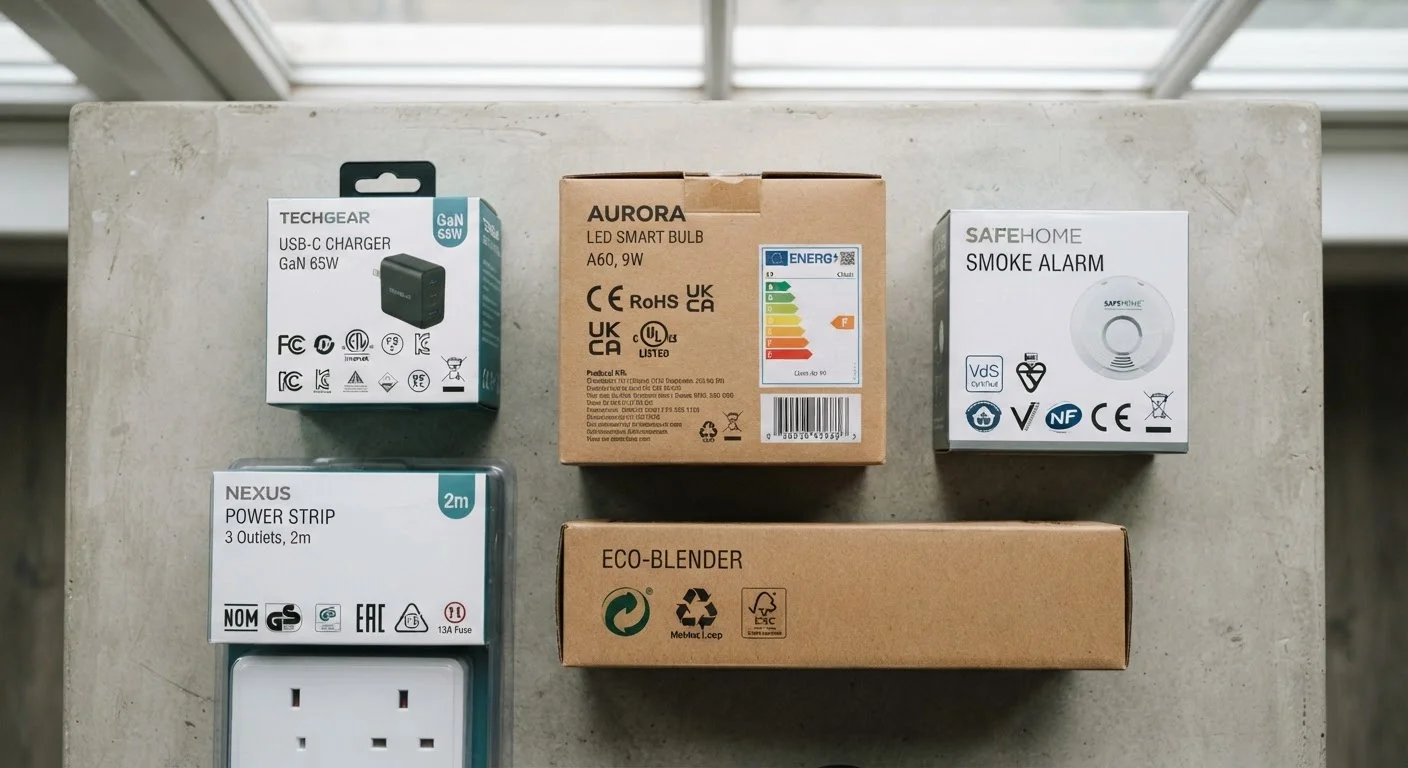
Photo: QuickAdvisor.net editorial
Why Certification Marks Vary So Widely in Meaning
Not all certification labels are created equal. Some represent rigorous, independent third-party testing. Others are manufacturer self-declarations. A few are pure marketing constructs with no standards body behind them at all. The mark itself tells you almost nothing until you know who issued it and what process backed it.
The single most important distinction is between third-party certification and self-certification. In third-party certification, an independent lab tests the product against a defined standard before any mark is awarded. In self-certification, the manufacturer declares compliance - no outside verification required. That gap can mean the difference between a product that has been stress-tested for electrical faults and one that simply has a logo printed on its box.
For a complementary framework on decoding product claims, see how to read between the lines of a product spec sheet.
| OSHA-recognized NRTLs | Over 20 accredited labs (U.S. OSHA NRTL Program) |
| ENERGY STAR program established | 1992 (U.S. Environmental Protection Agency) |
| CE marking - verified by | Manufacturer (self-declaration) (European Commission product safety framework) |
| UL founded | 1894 (Underwriters Laboratories corporate history) |
| NSF certification scope | Water, food equipment, dietary supplements (NSF International) |
| FCC authorization applies to | All electronic devices sold in the U.S. (Federal Communications Commission) |
Common Marks and What They Actually Verify
UL (Underwriters Laboratories): One of OSHA's Nationally Recognized Testing Laboratories, UL has been testing products against U.S. safety standards since 1894. A UL listing means the specific product was independently tested for electrical and fire hazards. Note that the mark is product-specific - it doesn't extend to uncertified accessories bundled in the same package.
ENERGY STAR: Administered by the U.S. EPA, this voluntary program requires products to meet defined energy-efficiency thresholds verified by EPA-recognized labs. The EPA's certified product database is publicly searchable, so you can confirm any model number before purchase.
CE marking: Required for many products entering the European Economic Area, CE is primarily a manufacturer's self-declaration of compliance with EU directives.
CE Does Not Mean "Safety Tested"
NSF International: Covers water filtration, food-contact materials, and dietary supplements. NSF certification involves laboratory testing, facility inspections, and annual re-audits - a notably robust process for its scope.
FCC authorization: Any electronic device legally sold in the U.S. must receive FCC authorization confirming it won't interfere with licensed radio communications. This is a baseline regulatory requirement, not a quality or safety endorsement.
The same critical approach applies to food labels. See what a nutrition label is actually telling you for a parallel framework on decoding packaged food claims.
How to Verify a Mark Is Legitimate
Counterfeit and misapplied certification marks are a documented problem, particularly on products sold through open online marketplaces. Four practical checks reduce your exposure:
- Search the certifier's database directly. UL, ENERGY STAR, and NSF all maintain publicly searchable listings. A mark on the box that doesn't appear in the database is a red flag worth acting on.
- Confirm the testing lab is OSHA-recognized. OSHA publishes the full NRTL list. Unknown lab names designed to look official are a documented counterfeit tactic.
- Match the certification to the product category. A UL mark for a power supply component doesn't certify the entire assembled product. Read what the mark specifically covers.
- Be skeptical of vague marks. Labels reading "Quality Assured" or "Safety Verified" with no identifiable issuing body are marketing language, not certifications.
Certification and design quality are related but separate evaluations. Signals of genuinely well-designed products often correlate with verified certifications, but a certified product can still be poorly designed - and vice versa.
Third-party certification
Testing and verification conducted by an independent organization with no financial stake in the product's outcome. This independence is what gives a certification mark its credibility.
Self-certification
A declaration made by the manufacturer that their product meets a standard, without independent verification. Common in some regulatory frameworks, but offers less consumer assurance than third-party testing.
NRTL
Nationally Recognized Testing Laboratory - a designation from the U.S. Occupational Safety and Health Administration (OSHA) for labs accredited to test products against U.S. safety standards. UL, CSA, and Intertek are examples.
CE marking
A conformity mark required for many products sold in the European Economic Area. It indicates the manufacturer's self-declaration of compliance with EU directives - not independent safety testing by a lab.
ENERGY STAR
A voluntary U.S. EPA program certifying products that meet defined energy-efficiency thresholds. Products must be tested by EPA-recognized labs and verified before carrying the mark.
Conformity mark
A symbol indicating that a product meets a specific set of standards, which may be regulatory requirements, voluntary industry standards, or both - depending on the issuing body.
The content on this site is for informational purposes only and is not a substitute for professional advice. Always consult a qualified professional for guidance specific to your situation.