
Envelope Budgeting in the Digital Age: Strengths, Limitations, and Who It Suits

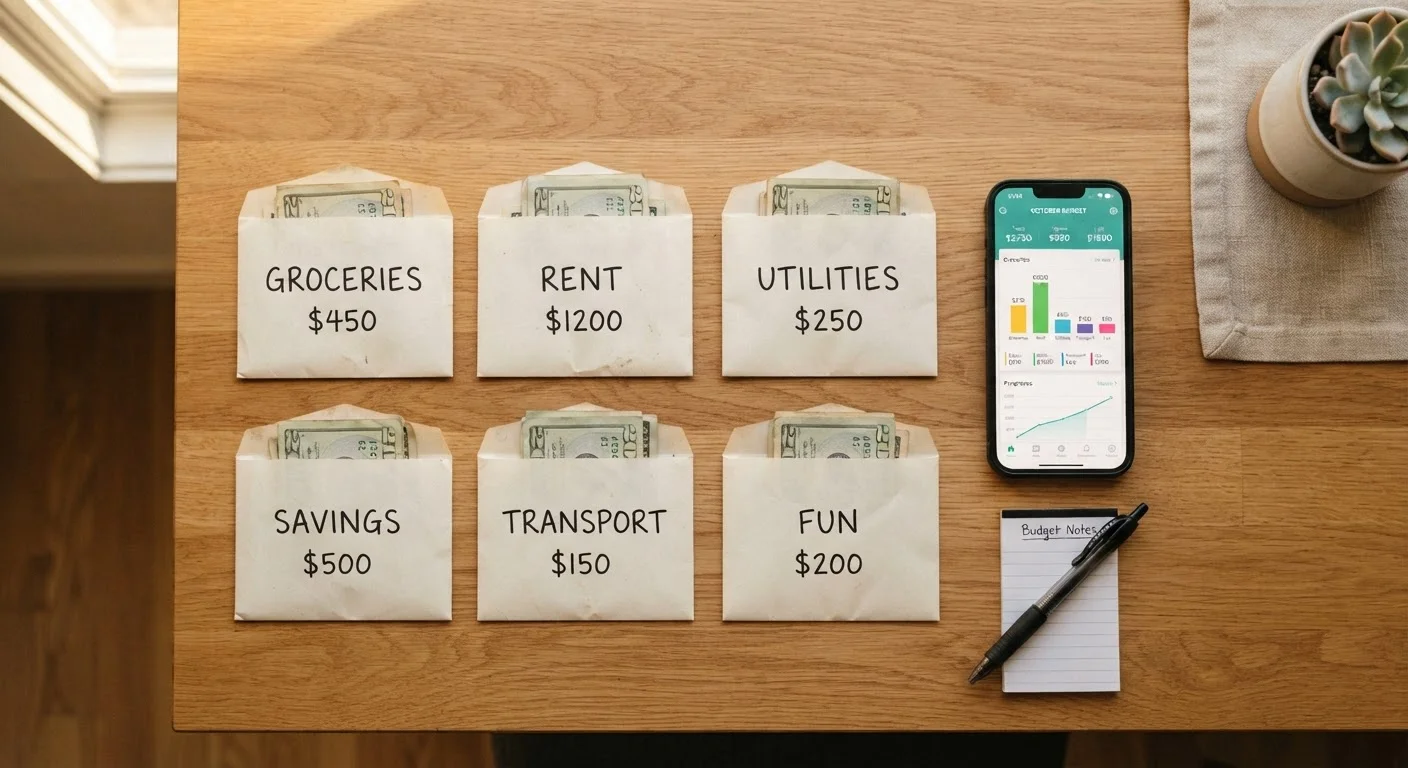
Photo: QuickAdvisor.net editorial
Key Takeaways
- Envelope budgeting assigns every dollar to a spending category before the month begins.
- It works best for people who overspend on variable categories like dining or entertainment.
- Digital versions of the method remove the need for physical cash while keeping the core discipline.
- The system struggles with irregular income, automatic payments, and credit card users.
- Envelope budgeting is a habit-building tool, not a long-term wealth strategy on its own.
Prevents overspending before it happens
Money is allocated to categories at the start of the month, making it structurally difficult to overspend without a conscious choice to break the rule.
Creates immediate, tangible spending awareness
Seeing a depleted envelope - physical or digital - provides real-time feedback that a credit card statement reviewed weeks later cannot replicate.
Simple enough for budgeting beginners
The concept requires no financial background to understand and can be started with paper and a pen, lowering the barrier to entry significantly.
Reduces impulse spending through friction
The physical or psychological act of drawing from a limited envelope adds a pause before spending that many people find effective at curbing unplanned purchases.
Easily adaptable to digital tools
Several budgeting apps replicate envelope logic with bank account syncing, category alerts, and rollover controls, removing the need for cash management.
Poorly suited to irregular or variable income
When monthly income fluctuates, setting fixed envelope amounts in advance becomes guesswork, undermining the method's predictability.
Friction-heavy for credit card users
Reconciling envelope categories with credit card billing cycles requires consistent manual tracking that many users abandon within weeks.
Doesn't address debt reduction or investing
Envelope budgeting controls spending but provides no built-in strategy for eliminating high-interest debt or building savings beyond what you allocate manually.
Category rigidity can cause frustration
Life rarely fits neat monthly buckets; an unexpected car repair or medical bill can destabilize the entire envelope structure, discouraging continued use.
Cash-based version is impractical for most modern spending
Online purchases, subscriptions, and contactless payments make it difficult to physically use cash envelopes without constant digital workarounds.
What Envelope Budgeting Actually Is
Envelope budgeting is a zero-based spending method: you divide your take-home income into labeled categories - groceries, gas, dining out, utilities - and allocate a fixed dollar amount to each. Traditionally, that meant stuffing physical cash into labeled envelopes. When an envelope was empty, spending in that category stopped for the month.
The core logic hasn't changed much. Digital tools like budgeting apps now let users replicate the envelope structure without carrying cash. You assign virtual "envelopes" and track spending against each bucket in real time. The mechanic is identical; only the medium differs.
If you're new to budgeting concepts altogether, our beginner's introduction to budgeting lays out the foundational vocabulary before you commit to any single method.
Where the Envelope Method Excels
The envelope system's biggest strength is its visibility. Unlike reviewing a bank statement after the fact, envelope budgeting forces a spending decision before the purchase - you can see exactly how much remains in a category at any moment.
Prevents overspending before it happens
Money is allocated to categories at the start of the month, making it structurally difficult to overspend without a conscious choice to break the rule.
Creates immediate, tangible spending awareness
Seeing a depleted envelope - physical or digital - provides real-time feedback that a credit card statement reviewed weeks later cannot replicate.
Simple enough for budgeting beginners
The concept requires no financial background to understand and can be started with paper and a pen, lowering the barrier to entry significantly.
Reduces impulse spending through friction
The physical or psychological act of drawing from a limited envelope adds a pause before spending that many people find effective at curbing unplanned purchases.
Easily adaptable to digital tools
Several budgeting apps replicate envelope logic with bank account syncing, category alerts, and rollover controls, removing the need for cash management.
This pre-commitment structure is especially effective for variable spending categories: groceries, clothing, entertainment, dining out. These are precisely the areas where quiet budget drains accumulate. When $200 in a dining envelope is gone, the constraint is concrete and immediate - no mental math required.
Research in behavioral economics consistently finds that people spend more freely with credit and debit cards than with cash, partly because digital transactions feel less "real." Physical envelopes exploit that psychology in reverse: the finite stack of bills creates friction that a swipe does not. Digital apps that mimic this model attempt to recreate the same effect.
Where the Envelope Method Falls Short
Envelope budgeting has meaningful limitations that can make it impractical for a significant portion of households.
Poorly suited to irregular or variable income
When monthly income fluctuates, setting fixed envelope amounts in advance becomes guesswork, undermining the method's predictability.
Friction-heavy for credit card users
Reconciling envelope categories with credit card billing cycles requires consistent manual tracking that many users abandon within weeks.
Doesn't address debt reduction or investing
Envelope budgeting controls spending but provides no built-in strategy for eliminating high-interest debt or building savings beyond what you allocate manually.
Category rigidity can cause frustration
Life rarely fits neat monthly buckets; an unexpected car repair or medical bill can destabilize the entire envelope structure, discouraging continued use.
Cash-based version is impractical for most modern spending
Online purchases, subscriptions, and contactless payments make it difficult to physically use cash envelopes without constant digital workarounds.
Fixed-income households benefit most. For freelancers, gig workers, or anyone with variable monthly income, pre-allocating specific dollar amounts to envelopes is genuinely difficult - you may not know your income until mid-month. The system also presupposes that most spending is discretionary and controllable, which isn't always accurate when fixed costs like rent or loan payments dominate a budget.
Credit card users face a structural mismatch: envelope budgeting was designed around cash, and reconciling envelope balances with credit card statements adds friction. While workarounds exist - treating each card purchase as an immediate "withdrawal" from the digital envelope - they require discipline most people find hard to sustain.
It's also worth noting what envelope budgeting is not: it's a spending constraint tool, not an investing framework. It won't automatically build wealth, reduce debt strategically, or optimize tax efficiency. For a broader comparison of budgeting philosophies, see our breakdown of zero-based budgeting vs. the 50/30/20 rule.
Practical Adaptations Worth Knowing
Most people who sustain envelope budgeting long-term adapt it rather than follow it rigidly. Common practical adjustments include:
- Hybrid envelopes: Only discretionary variable categories get envelopes; fixed bills are handled separately and automatically.
- Weekly resets: Rather than monthly envelopes, some households find weekly allocations easier to track and less prone to "front-loading" spending early in the month.
- Sinking funds: A separate envelope (or sub-account) is used for irregular but predictable expenses - car registration, holiday gifts, annual subscriptions - funded gradually each month.
The sinking fund adaptation is particularly useful for travel planning. If you've ever wondered how to allocate realistically for a trip, our guide to the anatomy of a travel budget shows how to break down costs by category - a natural fit for envelope-style pre-allocation.
Digital Envelope Apps: What to Look For
Envelope budgeting also pairs naturally with a broader look at what's holding people back from budgeting in the first place. Many assumptions about budgeting - that it means deprivation or constant sacrifice - are worth examining. Our article on frugal living myths addresses several of these directly.
The content on this site is for informational purposes only and is not a substitute for professional advice. Always consult a qualified professional for guidance specific to your situation.