
Engine Oil Types and What Your Car Actually Needs

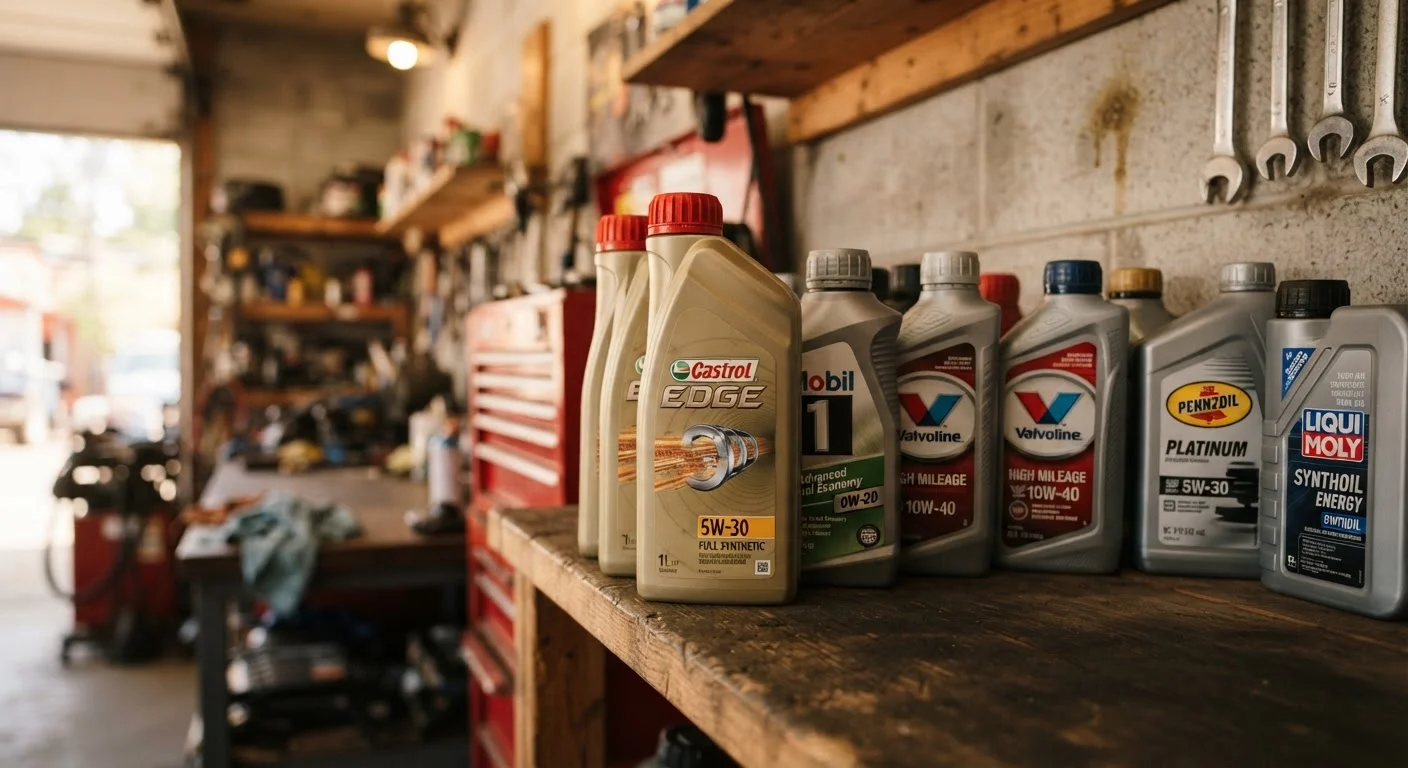
Photo: QuickAdvisor.net editorial
Key Takeaways
- Your owner's manual specifies the exact oil type and viscosity your engine requires - follow it.
- Full synthetic oil outperforms conventional oil in temperature extremes and engine protection, but costs more.
- Viscosity ratings like 5W-30 describe how oil flows at cold starts and operating temperature.
- Synthetic blends offer a middle ground in performance and price for many everyday drivers.
- Using the wrong oil type won't immediately destroy an engine, but sustained misuse accelerates wear.
The Core Difference: How Each Oil Type Is Made
Motor oil starts with a base oil combined with an additive package that controls oxidation, wear, and deposit formation. What separates conventional, synthetic blend, and full synthetic oils is the origin and refinement of that base oil.
Conventional oil is refined directly from crude petroleum. It does the job engines were originally designed around, but it contains natural impurities and molecular inconsistencies that cause it to break down more quickly under heat and stress.
Full synthetic oil is either chemically engineered from scratch or processed to a far greater degree of purity. Its molecules are more uniform in size, which means more consistent lubrication, better resistance to thermal breakdown, and improved flow when temperatures drop.
Synthetic blend oil combines conventional and synthetic base oils. It performs better than straight conventional - especially in temperature extremes - while keeping cost closer to the conventional range.
| Criterion | Conventional Oil | Full Synthetic Oil |
|---|---|---|
| Base material | Refined crude petroleum | Chemically engineered base stocks |
| Molecular consistency | Variable, natural impurities present | Uniform, highly refined |
| Cold-weather performance | Adequate; slower at startup | Superior; flows quickly at low temps |
| Heat resistance | Breaks down faster under high heat | Resists thermal breakdown effectively |
| Typical change interval | Often shorter; check your manual | Often longer; check your manual |
| Cost | Lower per quart | Higher per quart |
| Best application | Older, simpler engines | Modern, turbocharged, or high-stress engines |
None of these types is universally superior in every situation. The right choice depends entirely on your vehicle's requirements, your driving conditions, and how you use the car.
Understanding Viscosity: What Those Numbers Mean
Every motor oil bottle displays a viscosity rating - something like 5W-30 or 0W-20. These numbers aren't arbitrary. They follow a grading system established by the Society of Automotive Engineers (SAE) and tell you two key things about how the oil behaves.
The number before the W (which stands for winter) indicates how the oil flows in cold temperatures. A lower number means better flow at startup - critical because most engine wear occurs in the first moments after a cold start, before oil fully circulates. The number after the W indicates the oil's viscosity at operating temperature (roughly 212°F). A higher number means the oil remains thicker under heat, providing a more robust protective film between moving parts.
So a 0W-20 oil flows extremely well at cold starts and remains moderately thin at operating temperature - ideal for many modern fuel-efficient engines. A 10W-40
~25% Engine wear occurring at cold startup Industry engineers widely cite startup as a disproportionate contributor to engine wear, since oil hasn't yet fully circulated to all surfaces. 0W-20 Most common OEM spec for new vehicles Low-viscosity full synthetic grades like 0W-20 have become the dominant factory specification for fuel efficiency and cold-start protection in newer engines. 3 types Primary motor oil categories Conventional, synthetic blend, and full synthetic represent the three core categories drivers encounter, each with distinct base oil compositions and performance profiles.
The single most reliable source for the correct viscosity for your vehicle is your owner's manual. Manufacturers test their engines with specific oil grades and document those requirements explicitly. See how to get the most from your owner's manual for a closer look at why this resource is so often overlooked.
Matching Oil Type to Your Engine and Driving Habits
Modern engines - particularly those with turbochargers, direct injection, or variable valve timing - often specify full synthetic oil. These systems run hotter, have tighter tolerances, and rely on rapid oil circulation that thicker or less refined oils struggle to deliver. Using conventional oil in an engine that requires synthetic isn't just a minor downgrade; over time it can accelerate wear and void manufacturer warranties.
Conventional oil remains appropriate for many older, simpler engines where the manufacturer specified it. If your vehicle was designed before synthetic formulations became standard, conventional oil likely meets your engine's design parameters. That said, switching to a synthetic or synthetic blend generally won't harm an older engine - but it also won't transform its performance.
High-Mileage Oil: A Fourth Option Worth Knowing
Driving habits also matter. Short trips, frequent cold starts, towing, and stop-and-go city driving all place additional stress on oil. Under these conditions, a synthetic or synthetic blend can provide a meaningful margin of protection that conventional oil degrades through more quickly. For a fuller picture of what delayed oil attention actually does to an engine, see what happens when scheduled maintenance is skipped.
Finally, engine oil doesn't work alone. Keeping other fluids - coolant, brake fluid, transmission fluid - in good condition is equally important to long-term reliability. Other fluids you shouldn't ignore between oil changes covers what to check and when.
The content on this site is for informational purposes only and is not a substitute for professional advice. Always consult a qualified professional for guidance specific to your situation.