
Common Road Sign Meanings Americans Get Wrong

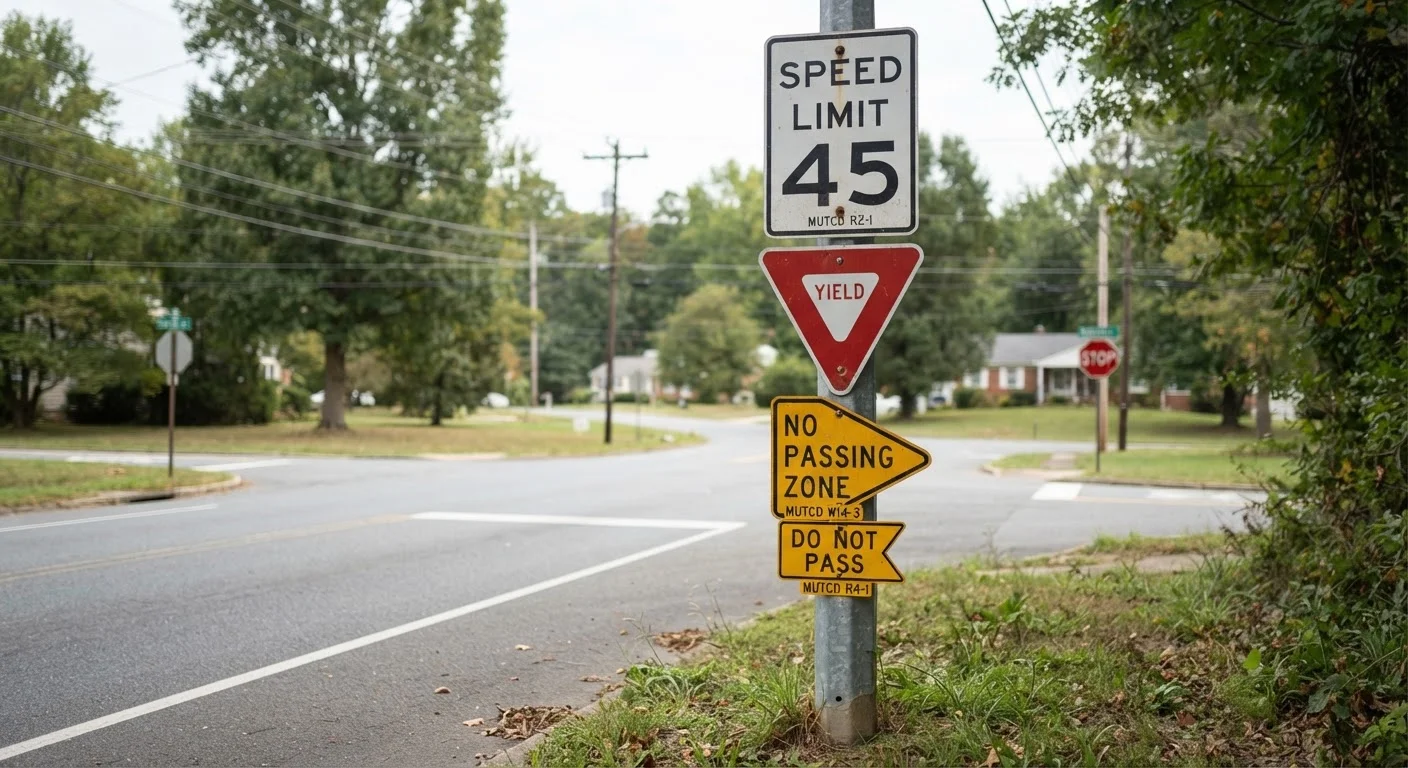
Photo: QuickAdvisor.net editorial
Key Takeaways
- A flashing yellow light means proceed with caution, not stop - many drivers confuse it with red.
- The 'Yield' sign requires you to give up the right-of-way, not merely slow down.
- Speed limit signs set a legal maximum, not a recommended safe cruising speed for all conditions.
- A white rectangular regulatory sign with a line through a symbol means that action is prohibited.
- "No Turn on Red" applies even when the intersection appears clear - it is not optional.
Why Road Sign Confusion Is a Real Safety Problem
Most drivers passed their written licensing exam years - sometimes decades - ago. Day-to-day familiarity with roads can breed overconfidence, leading to casual misinterpretations of signs that carry precise legal and safety meanings. The Federal Highway Administration's Manual on Uniform Traffic Control Devices (MUTCD) standardizes sign shapes, colors, and meanings across the United States, yet surveys and traffic safety research consistently show that a meaningful share of drivers misread or misapply some of the most common signs on the road.
Misreading a sign isn't just a minor mistake - it can put you at legal risk and, more importantly, create dangerous situations for other drivers, cyclists, and pedestrians. The myth-vs-fact pairs below address the signs most commonly misunderstood by everyday American drivers.
For a broader look at how confusion on the road leads to collisions, see our article on merging, yielding, and right-of-way rules.
Myth
A flashing yellow traffic light means slow down and prepare to stop, just like a flashing red.
Fact
A flashing yellow light means proceed with caution - you are not required to stop. A flashing red light functions like a stop sign and does require a full stop.
The two flashing signals have entirely different meanings. Flashing red = treat it as a stop sign: come to a complete stop, yield to cross traffic and pedestrians, then proceed when safe. Flashing yellow = slow down, check for hazards, and continue through if it is safe to do so. Treating a flashing yellow as a stop can cause rear-end collisions from drivers behind you who correctly anticipate you will keep moving.
Myth
A Yield sign just means tap the brakes and slow down a little before entering.
Fact
Yielding legally requires you to give the right-of-way to any oncoming vehicle or pedestrian in or approaching the intersection - even if that means coming to a complete stop.
Many drivers treat a Yield sign as a soft suggestion to reduce speed momentarily. In reality, if traffic in the lane you are entering is present or approaching, you must wait until it is clear - just as you would at a stop sign. The key difference from a stop sign is that you are not required to stop if the way is already clear. Misjudging this rule is a leading cause of intersection merge crashes, particularly on highway on-ramps and roundabout entries.
Myth
The posted speed limit is the ideal speed to drive regardless of conditions.
Fact
Speed limits represent the legal maximum under ideal conditions. Traffic law in every U.S. state also includes a 'basic speed rule' requiring drivers to adjust speed for weather, visibility, road surface, and traffic density.
Driving exactly at the posted limit during heavy rain, dense fog, or an icy road surface can still constitute reckless or unsafe driving under state law. Conversely, driving significantly below the limit without cause can impede traffic and create its own hazards. The posted number is a ceiling, not a target. Always factor in actual road and weather conditions when choosing your speed. For more on how speed choices affect highway safety, see our piece on highway driving habits that raise crash risk.
Myth
A "No Turn on Red" sign only applies when other vehicles are coming - if the intersection looks clear, it's fine to go.
Fact
"No Turn on Red" is an absolute prohibition at that location regardless of traffic conditions. Turning on red there is illegal at any time, not discretionary.
These signs are posted for specific engineering or safety reasons: limited sightlines, heavy pedestrian activity, complex geometry, or proximity to a school. The instruction is unconditional. Disregarding it - even when the road appears clear - can result in a moving violation citation and, more critically, a collision with a pedestrian, cyclist, or vehicle not yet in your field of view. Always obey the posted restriction and wait for a green light.
Myth
A white sign with a red circle and a diagonal line through a symbol is just an advisory recommendation.
Fact
This is a standard prohibition sign under the MUTCD - the crossed-out symbol indicates that action is legally forbidden at that location.
The red-circle-with-slash is an internationally standardized regulatory symbol used on U.S. roads to indicate prohibition. Common examples include no U-turn, no left turn, and no bicycles. These are enforceable legal restrictions, not courtesy notices. Treating them as optional guidance is both a traffic violation and a safety risk. If you see this sign type, the depicted action is off-limits, full stop.
Putting Correct Sign Knowledge Into Practice
Understanding what a sign means in the abstract is only half the equation - applying that knowledge in real driving situations is where it counts. Regulatory signs (typically white rectangles with black text or symbols) are legally binding instructions, not suggestions. Warning signs (yellow diamonds) alert you to a condition ahead and call for adjusted speed or attention. Guide signs (green rectangles) provide directional information.
1 in 6
Drivers who fail a basic sign-recognition quiz
GMAC Insurance's National Drivers Test found roughly one in six licensed American drivers could not pass a standard written driving exam, including sign identification questions.
~40%
Of crashes occurring at or near intersections
The National Highway Traffic Safety Administration has reported that a large share of all traffic crashes in the U.S. involve intersection-related decisions, where sign compliance is critical.
One practical habit: when you approach an unfamiliar or complex intersection, consciously scan for every posted sign before committing to a maneuver. This is especially important near school zones, construction areas, and highway on-ramps, where temporary signage can override standard rules. Drivers sharing lanes with large commercial trucks should pay particular attention to advisory signs about turning clearance and lane restrictions - see our guide on sharing the road with large trucks for context on why these rules matter in mixed traffic.
Refreshing your knowledge of the MUTCD sign library - available through your state's DMV or the FHWA website - is a low-effort step that can meaningfully sharpen your awareness behind the wheel.
Don't Assume Familiarity Equals Accuracy
The content on this site is for informational purposes only and is not a substitute for professional advice. Always consult a qualified professional for guidance specific to your situation.