
Passenger Vehicle vs. Large Truck: What Car Drivers Should Understand About Sharing the Road

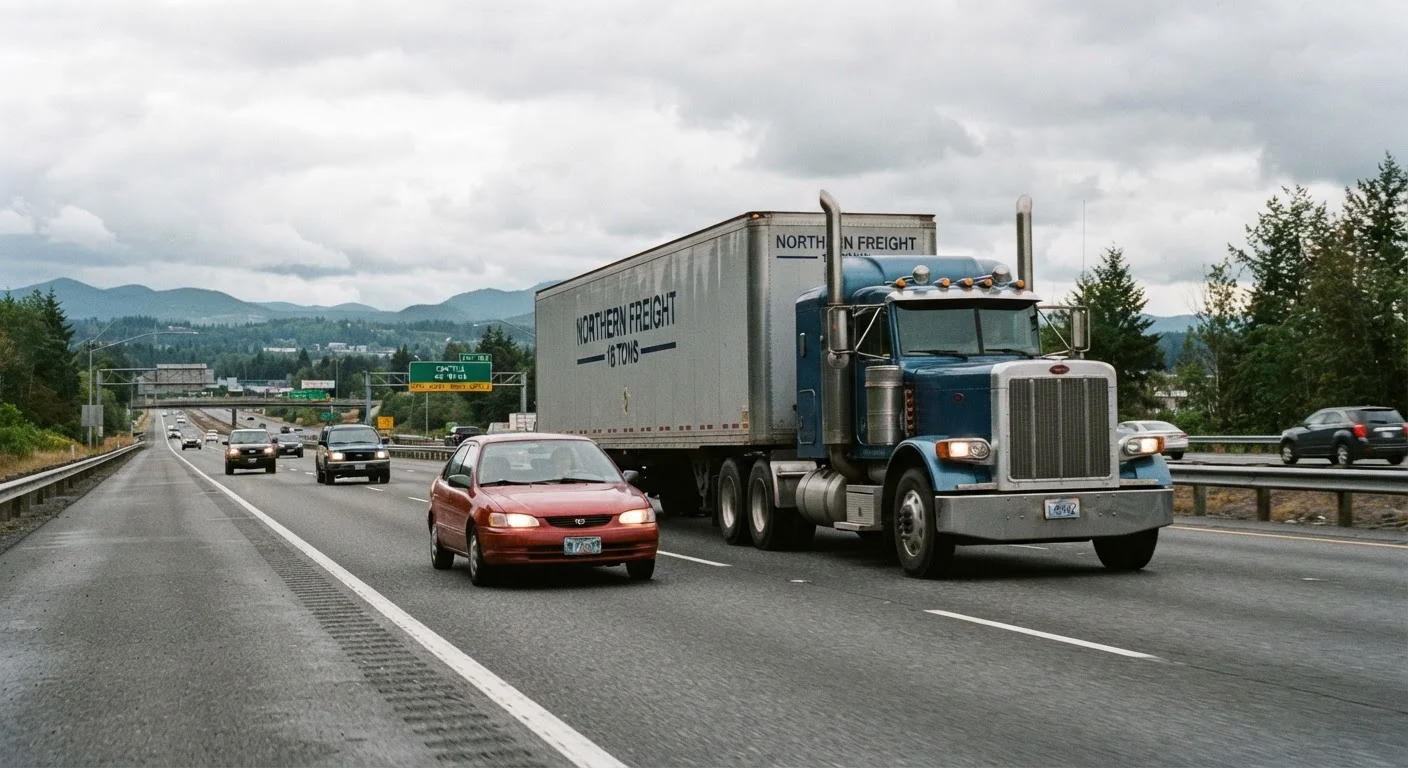
Photo: QuickAdvisor.net editorial
Key Takeaways
- Large trucks have blind spots on all four sides - the rear and right side are especially dangerous for car drivers to linger in.
- A fully loaded semi-truck traveling at highway speed can take nearly two football fields to stop completely.
- Wide right turns by trucks require car drivers to stay back and resist squeezing between the truck and the curb.
- Cutting off a large truck or braking suddenly in front of one dramatically increases your crash risk.
- Understanding truck limitations - not blame - is the key to safer shared-road behavior.
Why Trucks Behave So Differently From Cars
A fully loaded commercial semi-truck - also called a tractor-trailer or 18-wheeler - can weigh up to 80,000 pounds under federal limits. The average passenger car weighs roughly 3,500 to 4,500 pounds. That weight disparity alone reshapes every aspect of how these two vehicles interact on the road.
Large trucks require significantly more distance to accelerate, turn, and stop. Their height creates aerodynamic turbulence that can physically push smaller vehicles when they pass. Their cargo shifts during braking and cornering, adding unpredictability. Understanding these physical realities isn't about fear - it's about making informed decisions in the lane next to one.
For a broader look at preparation before sharing highways with heavy traffic, see our pre-drive safety walkthrough before any long trip.
Stopping Distance: The Most Underestimated Difference
This is where most car drivers' intuitions fail them. At 65 mph, a typical passenger car needs roughly 300 feet to come to a complete stop under normal conditions. A fully loaded semi-truck traveling at the same speed may require 525 feet or more - nearly the length of two football fields. Wet roads, worn brakes, or heavy cargo can extend that even further.
What this means in practice: never cut in front of a truck and brake immediately. The truck driver may physically be unable to stop in time, even if they react instantly. Merge ahead of a truck only when you can see its full front grille in your rearview mirror - that's a reliable rule of thumb for safe clearance.
525+ ft
Stopping distance for a loaded semi at 65 mph
According to FMCSA guidance, stopping distance for large trucks is significantly greater than for passenger vehicles under the same conditions.
~72%
Of fatal large-truck crashes involving passenger vehicle occupants
NHTSA data consistently shows that in crashes between large trucks and passenger vehicles, the majority of fatalities occur among the occupants of the smaller vehicle.
Following distance matters from the car side too. If you're trailing a truck closely, you lose visibility of road hazards ahead and put yourself in the underride danger zone - the gap beneath a truck's trailer where a car can slide in a crash. Tailgating is dangerous with any vehicle, but the stakes multiply behind a large truck.
Blind Spots: Where Trucks Simply Cannot See You
Trucks have four significant blind zones - called "No Zones" by the Federal Motor Carrier Safety Administration (FMCSA). These are areas where the truck driver has limited or no visibility, regardless of mirror adjustment:
- Directly behind the trailer - roughly 30 feet back, with no rear window for reference
- The right side - extending up to two full lanes wide alongside the cab and trailer
- Directly in front of the cab - approximately 20 feet forward
- The left side - a narrower but still meaningful blind zone alongside the driver's door
A simple self-check: if you cannot see the truck driver's face in their side mirror, they almost certainly cannot see you. Move through these zones deliberately and quickly rather than cruising alongside a truck for extended periods.
Our article on what blind spots actually cover offers additional context that applies to both car and truck interactions.
The Mirror Rule for Truck Blind Spots
Wide Turns and Intersection Hazards
A truck making a right turn often swings left first to create clearance - a maneuver that can easily mislead a car driver into thinking the truck is moving out of the way. If you pull forward into the gap on the right, you may find the truck's trailer sweeping directly toward you.
At intersections, watch for truck turn signals early and hold your position. Never pull up alongside a truck near an intersection if there's any chance it will turn. The trailer follows a tighter arc than the cab, and a car caught in that path has very little room for error. This connects directly to right-of-way rules that drivers most often misapply in high-stress traffic moments.
Comparison: Passenger Car vs. Large Truck at a Glance
The table below summarizes key operational differences that directly affect how car drivers should behave around large trucks.
| Passenger Car | Large Commercial Truck | |
|---|---|---|
| Typical weight | 3,500-4,500 lbs | Up to 80,000 lbs (loaded) |
| Highway stopping distance (65 mph) | ~300 feet | 525+ feet (loaded) |
| Blind spot coverage | Limited - mainly sides and rear | Four zones; right side covers 2 lanes |
| Turning radius | Tight; turns easily in lane | Wide; requires extra swing room |
| Wind turbulence for nearby vehicles | Minimal | Significant - affects adjacent cars |
| Braking predictability | Consistent under normal conditions | Varies with load, road surface, cargo shift |
These numbers aren't meant to intimidate - they're meant to recalibrate expectations. Driving predictably, leaving generous space, and staying out of blind zones are habits that work for any road environment.
Practical Habits That Reduce Your Risk
Knowing truck limitations is only useful if it changes how you drive. These evidence-based habits make a measurable difference:
- Pass trucks decisively. Don't linger in the right-side blind zone. Move through at a steady speed and return to a lane position with visibility.
- Increase your following distance. Maintain at least four seconds of following distance behind a truck - more in poor weather. This gives you a sightline over the road ahead and an escape route.
- Anticipate before intersections. Slow down and watch for right-turn signals before pulling alongside a truck at a light or stop sign.
- Expect wide stops. Trucks brake earlier than you expect. When one brakes, back off - their stopping event takes longer and involves greater forces than a car's.
- Stay visible. If you must drive next to a truck temporarily, position yourself where the driver can see your vehicle in their mirrors.
These habits pair naturally with the broader checklist covered in our road trip safety walkthrough.
The content on this site is for informational purposes only and is not a substitute for professional advice. Always consult a qualified professional for guidance specific to your situation.