
Soul Food and Southern Cuisine: Shared Roots, Different Stories

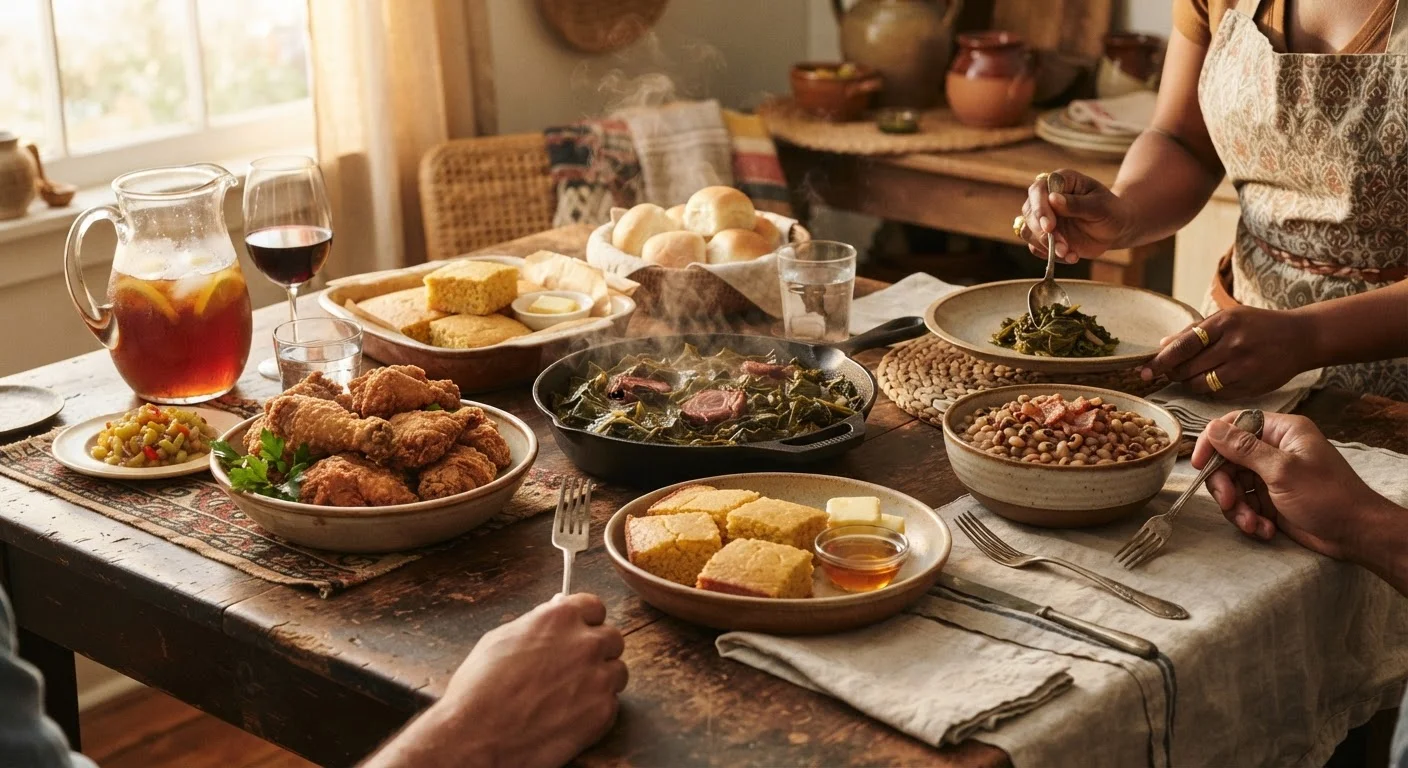
Photo: QuickAdvisor.net editorial
Key Takeaways
- Soul food emerged from the specific experience of enslaved and free Black Americans, making it a distinct cultural tradition.
- Southern cuisine is a broader regional category that encompasses many ethnic traditions, including but not limited to soul food.
- Many dishes appear in both traditions but carry different histories, meanings, and community contexts.
- Treating the two terms as interchangeable erases the specific cultural authorship of soul food.
- Both traditions continue to evolve, influencing modern American food culture in significant ways.
Two Names, Two Histories
Walk into a diner in Mississippi and you might see the same plate of fried chicken, collard greens, and cornbread described as both soul food and Southern cooking. The overlap is real - but so is the distinction. Using these terms interchangeably flattens stories that deserve to be told separately.
Soul food has a specific origin: it grew from the food practices of enslaved African Americans who were given the castoff cuts - pig intestines (chitterlings), ham hocks, feet - and had to transform scarcity into nourishment. That act of making something sustaining and even celebratory from almost nothing is the foundation of soul food. The term itself gained currency during the civil rights era of the 1960s as a proud assertion of Black cultural identity.
Southern cuisine, by contrast, is a geographic category. It spans Appalachian cooking built on Cherokee and Scots-Irish traditions, the French- and African-influenced Creole food of New Orleans, Lowcountry rice dishes shaped by West African enslaved laborers, and the barbecue traditions explored in regional American barbecue. Soul food is one thread in that wider fabric - but a thread with its own distinct identity.
| Criterion | Soul Food | Southern Cuisine |
|---|---|---|
| Origin | African American communities, rooted in slavery era | Broad regional tradition across the American South |
| Cultural scope | Specific to Black American cultural identity | Encompasses multiple ethnic and regional traditions |
| Term coined | Popularized in the 1960s civil rights era | Long-standing geographic/regional descriptor |
| Signature ingredients | Chitterlings, ham hocks, collards, black-eyed peas | Varies: biscuits, BBQ, rice, seafood, Creole spices |
| Political dimension | Deeply tied to resistance, survival, and pride | Less explicitly political; more broadly regional |
| African influence | Central and foundational | Present but often historically underacknowledged |
What They Share - and Where They Part Ways
The commonality is undeniable. Both traditions draw heavily on pork, field crops like black-eyed peas and sweet potatoes, and slow-cooked greens. This overlap reflects a shared Southern agricultural landscape and the intertwined - if deeply unequal - lives of Black and white Southerners for centuries.
But context matters enormously. In soul food, collard greens simmered with smoked ham hocks aren't just a side dish - they're a living link to grandmothers who fed families under Jim Crow. In broader Southern cuisine, the same preparation might appear without that specific cultural weight. The food looks similar on the plate; the story behind it is not.
This distinction extends to who has historically had the power to name, define, and profit from these traditions. As food writers and historians have noted, Southern cuisine has at times been celebrated in mainstream culture while its debt to Black cooks and African techniques went underacknowledged. The language used around food consistently encodes questions of power and credit.
~400 years
Depth of soul food's historical roots in America
Soul food's origins trace to enslaved Africans brought to North America beginning in the early 1600s, making it one of the oldest continuous food traditions on the continent.
6 million+
Black Americans who moved north during the Great Migration
The Great Migration (roughly 1910-1970) carried soul food traditions into Northern and Midwestern cities, expanding its cultural footprint far beyond the South.
Multiple
Distinct sub-regional cuisines under 'Southern food'
Food scholars recognize at least five to seven distinct culinary subregions within the American South, each shaped by different ethnic, geographic, and agricultural histories.
Evolution, Influence, and What Comes Next
Neither tradition is frozen in time. Soul food has its own internal debates - around health, authenticity, and how the cuisine adapts while holding onto its meaning. Some Black chefs and food scholars have worked to reclaim the African and Indigenous roots of the food, highlighting West African cooking techniques and ingredients that survived the Middle Passage.
Southern cuisine, meanwhile, continues to absorb influences from new waves of migration, much as it always has. A century of culinary transformation shows how each migration wave reshapes regional cooking - and the modern South is no exception, with Vietnamese, Mexican, and South Asian influences now woven into its food landscape.
Understanding the difference between soul food and Southern cuisine isn't about drawing rigid boundaries or policing a plate. It's about giving credit where it's due, reading food as the cultural text it actually is, and recognizing that what gets called "Southern cooking" has often been built on Black hands, Black knowledge, and Black ingenuity. Honoring that history makes both traditions richer - and American food culture more honest.
A Note on Terminology and Ongoing Debate
The content on this site is for informational purposes only and is not a substitute for professional advice. Always consult a qualified professional for guidance specific to your situation.