
Immigration and the American Plate: A Century of Culinary Transformation

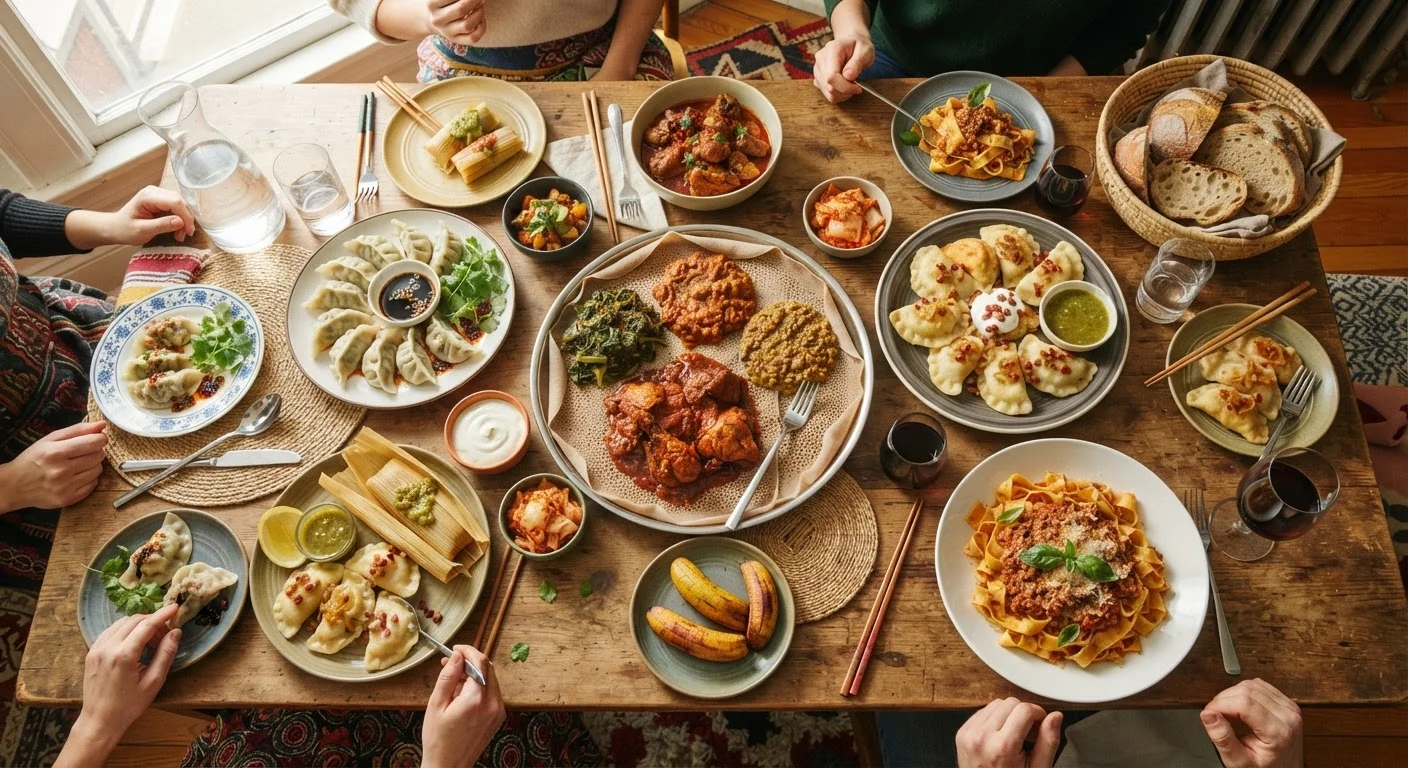
Photo: QuickAdvisor.net editorial
Key Takeaways
- Every major wave of immigration has permanently altered what Americans cook and eat at home.
- Immigrant communities often adapted traditional recipes using locally available ingredients, creating hybrid dishes.
- Food can simultaneously celebrate cultural heritage and flatten it through oversimplification.
- The mainstream adoption of immigrant foods is rarely straightforward - it involves negotiation, erasure, and recognition.
- Understanding culinary history helps Americans appreciate the social forces still shaping their plates today.
Food as a Mirror of Migration
No document records the history of immigration more honestly than the American dinner table. Long before scholars wrote about cultural assimilation, cooks were quietly doing the work - adapting recipes to unfamiliar pantries, feeding homesickness with familiar spices, and gradually changing what their neighbors considered normal food.
Food functions as a cultural lens unlike almost any other artifact. It is intimate, daily, and embodied - you don't just observe it, you consume it. As food historian Donna Gabaccia has argued, Americans have long been willing to eat foods long before they were willing to fully accept the people who brought those foods. That tension between appetite and prejudice is central to understanding how the American plate evolved.
This guide traces that evolution across roughly a century of immigration waves, examining not just which foods crossed borders but how, why, and at what cost. For a deeper look at specific dishes and their journeys, see how immigrant foods found a place in America.
20M+
European immigrants arrived between 1880 and 1924
This wave from southern and eastern Europe fundamentally altered urban American food culture across the Northeast and Midwest.
1965
Year U.S. immigration law dramatically expanded
The Immigration and Nationality Act of 1965 removed national-origin quotas, enabling immigration from Asia, Latin America, and Africa at unprecedented scale.
90%+
Of Americans eat pizza regularly
According to industry surveys, pizza - a dish rooted in Italian immigrant communities - has become one of the most consumed foods in the United States.
The First Great Wave: European Kitchens Take Root
Between roughly 1880 and 1924, more than 20 million people arrived in the United States from southern and eastern Europe - Italians, Poles, Jews from the Russian Empire, Greeks, and many others. Each group brought a culinary tradition shaped by climate, religion, and agricultural history that bore little resemblance to the Anglo-Protestant cooking already dominant in American homes.
Italian immigrants, concentrated initially in urban neighborhoods like New York's Little Italy, introduced Americans to pasta, tomato sauce, garlic, and olive oil - ingredients that were either unknown or regarded with suspicion by mainstream consumers. Jewish immigrants from Eastern Europe brought bagels, rye bread, pastrami, and a deli culture built around preservation techniques refined over centuries. Polish and Czech communities planted sausage-making traditions in Midwestern cities that persisted for generations.
These foods did not enter American culture wholesale. They were adapted. Neapolitan pizza, originally a street food topped simply with tomatoes and cheese, was scaled up in American cities and eventually piled with toppings that would have been unrecognizable to its originators. What emerged was neither purely Italian nor conventionally American - it was something new, forged in the negotiation between tradition and circumstance.
When exploring a cuisine new to you, seek out restaurants owned and operated by people from that culinary tradition - the food is more likely to reflect genuine regional and family variation rather than a generalized version created for broad appeal.
Before judging a 'Americanized' dish as inauthentic, consider the historical conditions under which adaptation happened - ingredient scarcity, economic pressure, and survival often drove changes that became traditions in their own right.
Latin American and Asian Influences Reshape the Menu
The Immigration and Nationality Act of 1965 dramatically shifted the origin countries of incoming migrants, opening doors to people from Latin America, East and Southeast Asia, South Asia, and Africa. The culinary consequences were profound and are still unfolding.
Mexican food had long been present in the American Southwest - itself a region whose cultural identity predates the U.S. border. But post-1965 migration brought Mexican culinary traditions deeper into American cities and suburbs, while Central American, Salvadoran, and Guatemalan communities added their own distinct contributions. The taco, the tamale, and the tortilla became familiar to Americans far removed from any border.
Asian immigration produced an equally dramatic transformation. Chinese American food had existed since the mid-19th century, largely shaped by earlier migrants who adapted Cantonese techniques to available ingredients. But the later 20th century brought Vietnamese pho, Thai curries, Korean barbecue, Japanese ramen, and Indian dal to cities across the country. Each cuisine arrived with its own internal complexity - regional variation, religious dietary traditions, seasonal logic - that was often compressed or simplified for mainstream American consumption.
The rise of fusion cuisine is partly a story of this era: chefs, many of them children of immigrants, began synthesizing these traditions deliberately rather than incidentally.
How Immigrant Food Gets Translated - and Sometimes Distorted
The path from an immigrant community's kitchen to a chain restaurant menu is rarely straightforward, and it is almost never neutral. Foods are adapted, simplified, sweetened, or de-spiced to appeal to a broader audience. Sometimes the community of origin benefits - culturally, economically, in terms of recognition. Often, they do not.
The process has been described as culinary appropriation when the commercial success flows primarily to people outside the originating culture, and as culinary appreciation when credit, compensation, and representation accompany adoption. In practice, the line between these is frequently contested and context-dependent. The complicated legacy of ethnic restaurants illustrates how even well-intentioned framing can reduce rich food cultures to exotic novelties.
Oversimplification Erases Cultural Depth
What gets lost in translation matters. A dish stripped of its context - its ritual significance, its regional variation, its class history - becomes a product rather than a practice. Understanding this distinction is part of becoming a more thoughtful eater, someone who can engage with culinary diversity without flattening it. The psychology of comfort food offers another angle on why food carries such deep cultural weight.
What's on the American Plate Today
The contemporary American food landscape is genuinely plural in ways that would have surprised observers from even 50 years ago. Grocery stores in mid-sized American cities now routinely carry ingredients - fish sauce, tahini, gochujang, masa harina - that once required a specialty trip to an ethnic neighborhood market. Home cooks across demographic lines cook recipes that originated on other continents.
This is not a completed story. New immigrant communities continue to arrive, and with them come new flavor traditions, new agricultural practices, and new ways of thinking about what a meal is for. West African, Ethiopian, Filipino, and Bangladeshi food cultures are each at various stages of broader American recognition - carried forward by restaurants, food trucks, social media, and the quiet persistence of home cooking.
The American plate, understood honestly, has never been a single thing. It has always been an ongoing negotiation - between the familiar and the foreign, between commerce and heritage, between appetite and identity. Soul food and Southern cuisine offer one of the most layered examples of how those negotiations play out across race, history, and region simultaneously.
Tracing what Americans eat is ultimately a way of tracing who Americans have been willing to become. The kitchen, more than almost any other space, is where that becoming happens - one meal, one borrowed technique, one adapted recipe at a time.
The content on this site is for informational purposes only and is not a substitute for professional advice. Always consult a qualified professional for guidance specific to your situation.