
The Physics of a Good Night's Sleep: Springs, Pressure, and Support

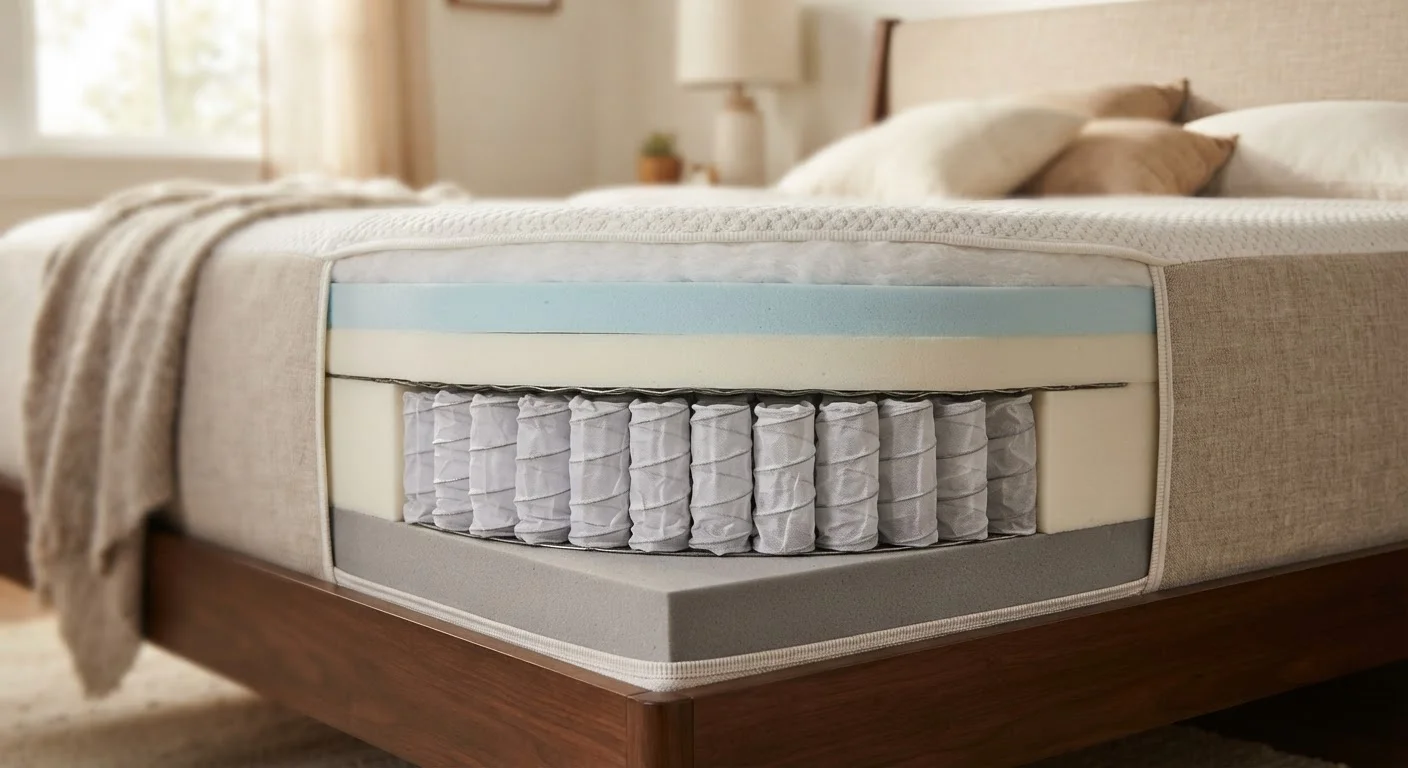
Photo: QuickAdvisor.net editorial
Key Takeaways
- Mattresses work by distributing your body weight across the largest possible surface area to reduce pressure.
- Springs in innercoil mattresses follow Hooke's Law - compressing proportionally to the weight applied.
- Memory foam redistributes pressure by conforming to body contours, reducing peak stress at bony areas.
- Spinal alignment depends on how well a surface supports the natural curves of your body.
- Pillow physics involves the same compression and rebound principles as mattress design.
- No single sleep surface works best for everyone - body weight, position, and anatomy all affect the physics.
Why Physics Is Hiding in Your Bed
When you lie down at night, you probably aren't thinking about Newton's laws. But the moment your body meets the mattress, a cascade of physical forces kicks in. Your weight - the gravitational force pulling you downward - doesn't disappear. It has to go somewhere, and how a sleep surface manages that force determines whether you wake up rested or sore.
The central challenge is straightforward: your body is not flat, but most sleep surfaces start out that way. The pressure you exert isn't spread evenly - it concentrates at protruding contact points like hips, shoulders, and heels. A well-designed sleep surface uses physics to counteract that concentration, redistributing force before it disrupts tissue, blood flow, or joint alignment. To understand how, it helps to look at the mechanics one layer at a time.
Springs, Elasticity, and Hooke's Law
Innerspring mattresses are the most literal example of applied physics in your bedroom. Each coil is an elastic element governed by Hooke's Law - the principle stating that the force a spring exerts is proportional to how far it is compressed. A heavier load compresses the coil more; a lighter one compresses it less. When the load is removed, a healthy spring returns to its original length.
The stiffness of a coil - its spring constant - determines the mattress's firmness in that zone. Modern innerspring designs use pocketed coils, where each spring is individually wrapped in fabric and operates independently. This allows a coil under your hip to compress deeply while one under your lower back stays relatively extended, accommodating body contour without a rigid, single-plane response.
~1,000
Coil count in a quality queen innerspring mattress
Industry sources generally cite pocketed coil counts between 800 and 1,000+ for queen-size mattresses, with each coil responding independently to localized weight.
32 mmHg
Pressure threshold linked to capillary blood flow restriction
This figure is widely referenced in clinical pressure injury literature as the approximate threshold at which sustained contact pressure can begin to impede capillary perfusion in skin tissue.
~7-9 hrs
Recommended adult sleep duration per night
The American Academy of Sleep Medicine and Sleep Research Society recommend 7 or more hours of sleep per night for adults to promote optimal health.
The physics problem with pure spring systems is that springs push back uniformly in one direction. If a bony prominence contacts a firm coil, that coil pushes straight up - concentrating rather than dispersing the return force. This is why most modern mattresses layer foam on top of coils, softening the interface between the spring's return force and your skin.
How Memory Foam Changes the Equation
Memory foam is a viscoelastic material - meaning it has both viscous (fluid-like, slow-responding) and elastic (spring-like, shape-recovering) properties. Unlike a steel coil, memory foam doesn't resist immediately. Instead, it deforms gradually under your body heat and weight, conforming precisely to your contours over seconds rather than milliseconds.
This slow deformation is the key to its pressure-reduction effect. By spreading contact across a larger surface area, memory foam reduces contact stress - the force per unit area - at any single point. A hip that might press intensely against a firm innerspring coil instead sinks into foam that wraps around it, spreading that same force across a much wider region.
“The ideal sleep surface is one that pushes back with exactly the right force in exactly the right place - enough to support the skeleton, not so much that it concentrates stress on soft tissue.”
— Biomedical Engineering Perspective, General principle from sleep surface biomechanics research
The tradeoff is heat retention and a sluggish response to movement. Because the material is slow to rebound, some sleepers feel "trapped" when shifting positions. Hybrid mattresses attempt to balance both effects - using pocketed coils for responsive support and airflow, topped with viscoelastic foam for pressure relief.
Spinal Alignment: The Physics of Your Neutral Curve
Your spine is not a straight rod. It has natural curves - a gentle inward curve at the neck (cervical lordosis), an outward curve at the upper back (thoracic kyphosis), and another inward curve at the lower back (lumbar lordosis). A sleep surface that supports these curves keeps your spine in what biomechanists call a neutral position - aligned the same way it would be if you were standing with good posture.
When a mattress is too soft, heavier body segments like the hips sink disproportionately, creating a hammock-like position that forces the lumbar spine to flex unnaturally. When a mattress is too firm, the hips and shoulders can't sink at all, leaving the lumbar spine unsupported and suspended in mid-air on the relatively narrow lower back. The physics goal is a surface that gives proportionally - allowing denser areas to sink more while continuing to support lighter, curved regions.
Pillow design follows the same logic for the cervical spine. For a side sleeper, the pillow must fill the gap between the head and the mattress - roughly the width of one shoulder. Too little fill and the neck bends downward; too much and it bends upward. Both create tension that compounds over hours. You can learn more about how sleep affects your body at a biological level in our guide: what happens to your body during sleep, hour by hour.
Pressure Distribution and Why It Matters Beyond Comfort
Pressure distribution isn't only about comfort - it has measurable physiological effects. Sustained pressure above roughly 32 mmHg (millimeters of mercury) at a given skin site is widely cited in clinical research as the threshold at which capillary blood flow can be impaired. For most healthy sleepers, normal movement prevents this from becoming a serious issue. But the principle explains why sleep position matters and why waking with numbness, tingling, or stiffness is a physical - not merely psychological - event.
The same physics that governs mattress design also operates at a much larger scale. Atmospheric pressure and contact pressure are governed by the same foundational principle - force applied over area - even if the mechanisms look very different. Understanding pressure in one context reinforces intuition about the other.
Sleep quality, in turn, connects to far more than physical comfort. Research consistently links restorative sleep to mental health, cognition, and emotional regulation. If you're curious how these systems interact, our coverage of the sleep-mental health connection explores what the science says.
Frequently Asked Questions
The content on this site is for informational purposes only and is not a substitute for professional advice. Always consult a qualified professional for guidance specific to your situation.