
The Life Cycle of a Star, From Nebula to Remnant

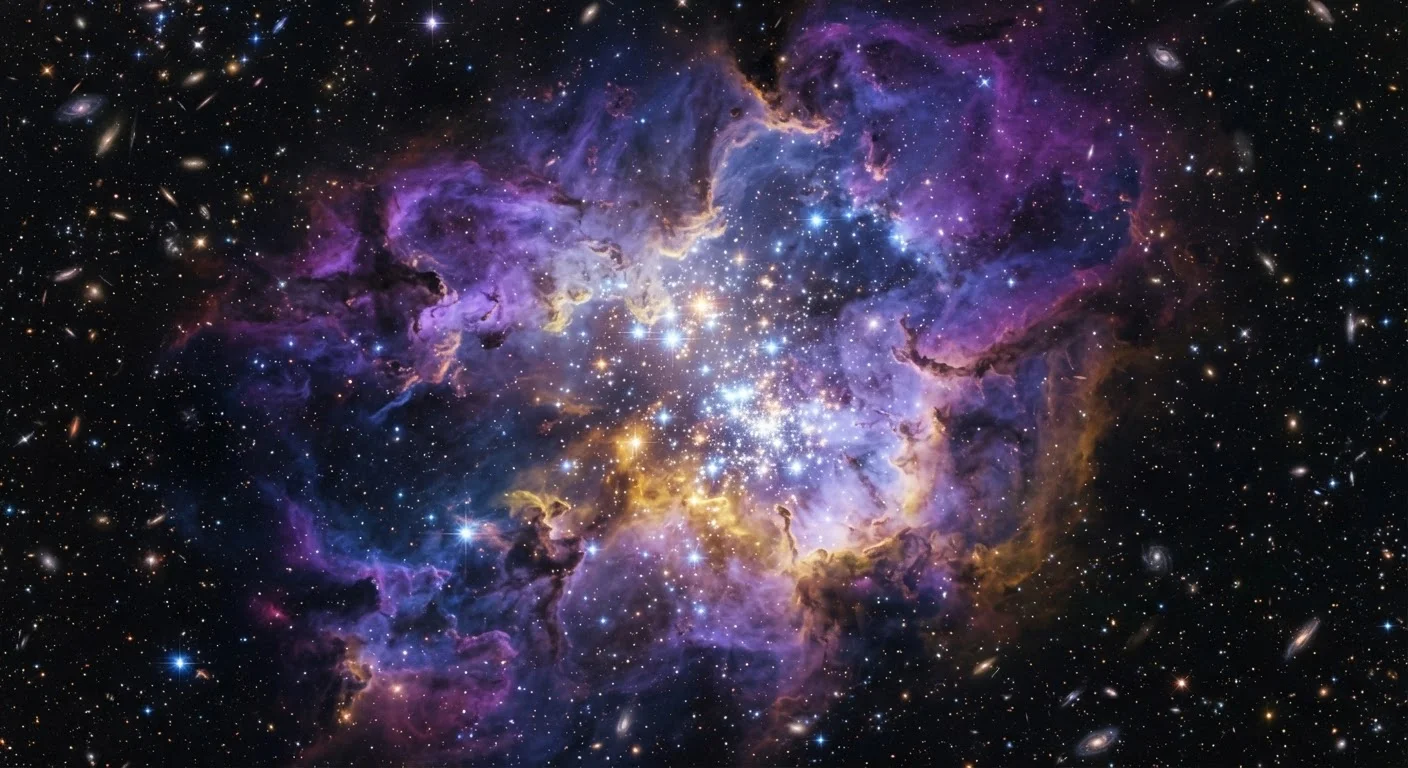
Photo: QuickAdvisor.net editorial
Key Takeaways
- Stars are born when gravity collapses clouds of hydrogen gas and dust called nebulae.
- A star's mass is the single biggest factor determining how long it lives and how it dies.
- Our Sun is a mid-sized star that will eventually expand into a red giant and shed its outer layers.
- Massive stars end their lives in spectacular supernova explosions, leaving neutron stars or black holes.
- Every heavy element in your body was forged inside a dying star.
Where Stars Begin: The Nebula
Every star in the night sky began as a nebula - an enormous cloud of hydrogen gas, helium, and trace amounts of dust drifting through interstellar space. These clouds can span hundreds of light-years and contain enough raw material to build thousands of stars. For a long time, nothing happens. Then something disturbs the cloud: perhaps a nearby supernova sends a shockwave rippling through it, or two gas clouds collide.
Gravity takes over. Denser pockets within the nebula begin pulling surrounding material inward, a process called gravitational collapse. As the gas compresses, it heats up. The collapsing core - now called a protostar - grows hotter and denser over millions of years, surrounded by a spinning disk of leftover material. You can think of it like a slow-motion whirlpool of gas tightening around a central drain, except the "drain" is becoming a star.
For a deeper look at the vocabulary astronomers use to describe these early stages, see our plain-language astronomy glossary.
Ignition: Becoming a Main-Sequence Star
When the protostar's core temperature reaches roughly 10 million degrees Celsius, something remarkable happens: nuclear fusion begins. Hydrogen nuclei are crushed together under immense pressure and fuse into helium, releasing enormous amounts of energy in the process. This is the moment a protostar becomes a true star.
The outward pressure of that energy now pushes back against the inward pull of gravity. The two forces balance - a state astronomers call hydrostatic equilibrium - and the star stabilizes. It has joined what is called the main sequence, the long, stable phase that defines most of a star's life. On the common misconceptions new astronomers hold, the idea that stars are perpetually dramatic is addressed - in reality, most of a star's life is this stable, steady burn.
Use the Hertzsprung-Russell Diagram
Middle Age: Life on the Main Sequence
A star's time on the main sequence can last anywhere from a few million years to trillions of years - almost entirely determined by its mass. This seems counterintuitive at first: bigger stars have more fuel, so shouldn't they last longer? The answer is no, because massive stars burn their fuel at a far faster rate to sustain the greater outward pressure needed to balance their own gravity.
~10 billion
Years the Sun will spend on the main sequence
According to NASA, the Sun is roughly halfway through its main-sequence lifespan, with about 5 billion years remaining.
~70%
Proportion of a star's mass that is hydrogen
Hydrogen is the primary fuel for nuclear fusion in main-sequence stars, according to standard stellar physics models.
~1 million km
Estimated diameter of a red giant Sun
When the Sun exhausts its core hydrogen, models predict it will expand to roughly 100 times its current diameter.
Our Sun, a mid-sized star, has been fusing hydrogen for about 4.6 billion years and has a similar span ahead of it. During this entire time, it changes slowly and imperceptibly from our perspective. The Sun is not an exception - this steady middle age is the norm for stars across the galaxy.
When learning stellar evolution, always anchor each stage to a star's mass - it is the single variable that controls almost every outcome, from lifespan to death type.
Look at a star's color to get a quick read on its temperature: blue stars burn hottest and live shortest, while red stars burn coolest and can outlive the current age of the universe.
The Final Acts: Giants, Supergiants, and Explosions
Eventually, a star exhausts the hydrogen in its core. What happens next depends again on mass. For stars like our Sun, the core contracts while the outer layers expand dramatically, transforming the star into a bloated red giant. The Sun's outer layers are predicted to eventually engulf the orbits of Mercury and Venus. After this phase, a Sun-like star sheds those outer layers entirely, producing a glowing shell of ejected gas called a planetary nebula - one of the most visually spectacular events in astronomy.
Mass Determines Destiny
Stars with much greater mass follow a far more violent path. As they exhaust successive fuels - helium, then carbon, oxygen, and ultimately iron - the core builds up a layer structure like an onion. Iron cannot yield energy through fusion, so when the core becomes iron, fusion stops abruptly. The core collapses in less than a second, and the resulting shockwave tears the star apart in a supernova - briefly outshining entire galaxies. The energy released in those seconds can exceed what our Sun will emit across its entire lifetime.
What's Left Behind: Stellar Remnants
After a star dies, something always remains. The nature of that remnant depends on the mass of the original star's core after the explosion or collapse.
- White dwarf: The ash-like core left by a Sun-like star. Roughly Earth-sized but packed with the mass of a star, a white dwarf slowly radiates heat over billions of years with no new fusion occurring.
- Neutron star: Left by more massive stars, neutron stars are city-sized objects of extreme density - a teaspoon of their material would weigh roughly a billion tons. Some spin hundreds of times per second and are detected as pulsars.
- Black hole: When the remaining core exceeds a critical mass, even the compressed neutrons cannot resist gravity, and the core collapses to a singularity. Its gravitational pull becomes so strong that not even light can escape.
The Chandrasekhar Limit Explained
For a detailed side-by-side comparison of these extraordinary objects, see how stellar remnants compare in size, density, and behavior.
Why Stellar Life Cycles Matter Here on Earth
The story of stars is not just a cosmic spectacle - it is the story of where everything around you came from. Hydrogen and helium were forged in the first minutes after the Big Bang, but every heavier element - carbon, oxygen, iron, calcium - was manufactured inside stars and scattered across space when those stars died.
“We are made of star stuff. The nitrogen in our DNA, the calcium in our teeth, the iron in our blood - all were made in the interiors of collapsing stars.”
— Carl Sagan, Astronomer and science communicator, from 'Cosmos: A Personal Voyage'
The iron in your blood, the oxygen in every breath, the calcium in your bones: these atoms were created inside stars that exploded billions of years before our solar system formed. In that very literal sense, understanding stellar life cycles is understanding our own origins. The universe is not a static backdrop to human life - it is the ongoing process that made life possible in the first place.
Don't Confuse Stellar Timescales with Human Ones
The content on this site is for informational purposes only and is not a substitute for professional advice. Always consult a qualified professional for guidance specific to your situation.