
Black Holes, Neutron Stars, and White Dwarfs: How Stellar Corpses Differ

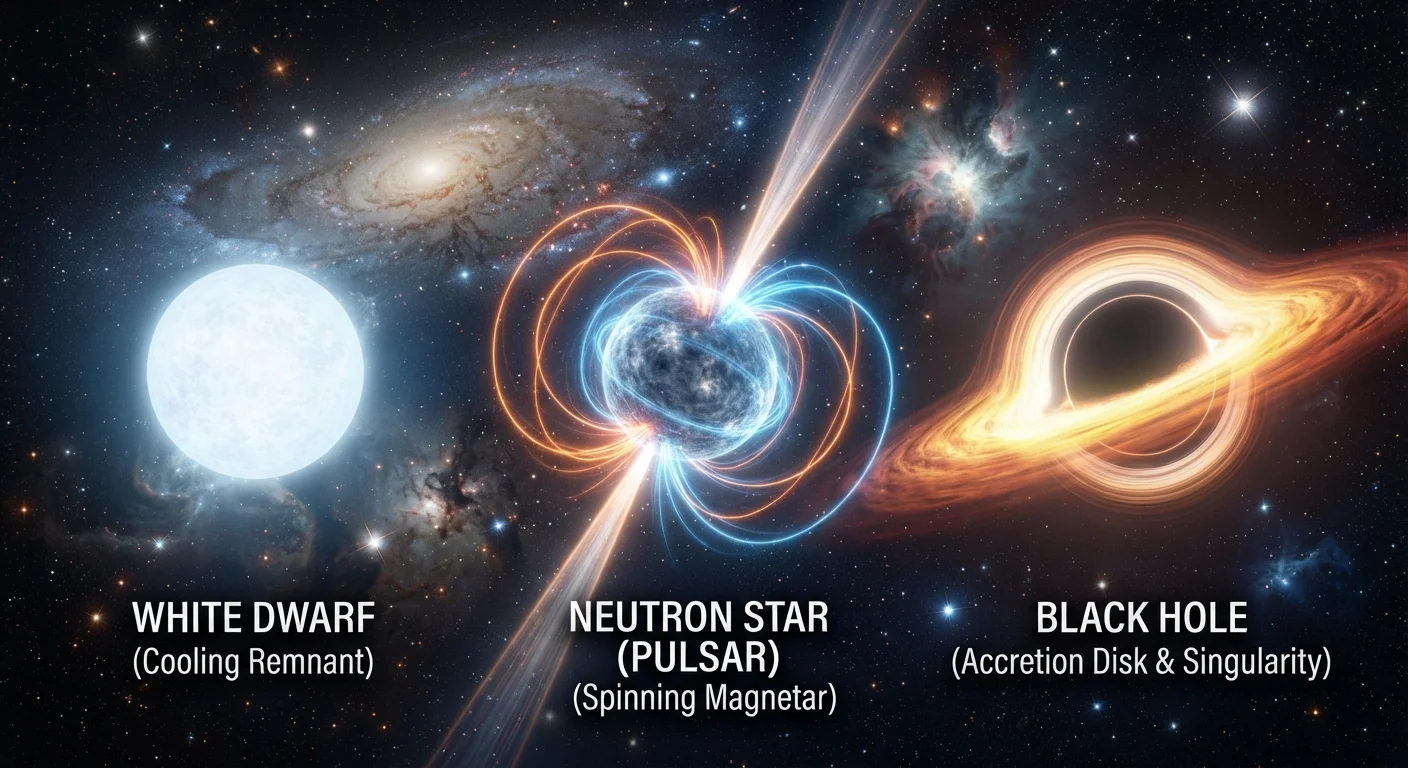
Photo: QuickAdvisor.net editorial
Key Takeaways
- A star's mass at death determines whether it becomes a white dwarf, neutron star, or black hole.
- White dwarfs are Earth-sized remnants supported by electron pressure, not fusion.
- Neutron stars pack more mass than the Sun into a sphere roughly 12-15 miles across.
- Black holes have gravity so extreme that not even light can escape past the event horizon.
- All three types are confirmed to exist and have been observed with modern telescopes.
What Determines a Star's Final Form
Every star is in a constant tug-of-war between two forces: the outward pressure of nuclear fusion and the inward pull of gravity. For billions of years, these forces balance. But when a star exhausts its nuclear fuel, gravity wins - and the result depends almost entirely on how much mass the star had to begin with.
Low- to medium-mass stars (up to about eight times the Sun's mass) shed their outer layers and leave behind a white dwarf. More massive stars collapse violently in a supernova, and if the core that remains is between roughly 1.4 and 3 solar masses, it compresses into a neutron star. Cores heavier than that continue collapsing past any known stopping point, forming a black hole. These thresholds - known as the Chandrasekhar limit and the Tolman-Oppenheimer-Volkoff limit - are well-established in astrophysics, though the precise upper boundary for neutron stars is still an active research area.
For a broader grounding in the scale of these objects within the cosmos, see how solar systems, galaxies, and the observable universe relate.
White Dwarfs: Dense, Cooling, and Surprisingly Common
A white dwarf is what our own Sun will eventually leave behind. After a Sun-like star expels its outer gas layers as a glowing planetary nebula, the remaining core - typically composed of carbon and oxygen - is compressed to roughly the size of Earth. Yet it retains about half the original star's mass. The result is an object with a teaspoon of material weighing several tons.
White dwarfs are not held up by fusion - that's finished. Instead, a quantum mechanical phenomenon called electron degeneracy pressure keeps gravity from crushing the core further. Electrons, because of the laws of quantum mechanics, resist being squeezed into the same space. Over trillions of years, a white dwarf simply cools and dims. Astronomers estimate that the universe is not yet old enough for any white dwarf to have completely cooled to a theoretical "black dwarf."
| White Dwarf | Neutron Star | Black Hole | |
|---|---|---|---|
| Typical mass | ~0.5-1.4 solar masses | ~1.4-2 solar masses | 3+ solar masses |
| Approximate size | ~Earth-sized (~8,000 mi) | ~12-15 miles across | Event horizon varies; stellar ~6-60 miles |
| Density | ~1 million g/cm³ | ~500 trillion g/cm³ | Effectively infinite at singularity |
| What stops collapse | Electron degeneracy pressure | Neutron degeneracy pressure | Nothing known |
| Observable directly? | Yes, by light it emits | Yes, as pulsars/X-ray sources | No, only indirectly |
| Progenitor star mass | Up to ~8 solar masses | ~8-20+ solar masses | ~20+ solar masses (core dependent) |
| Abundance in Milky Way | Most common remnant | Estimated ~100 million | Estimated ~100 million stellar-mass |
White dwarfs are the most common stellar remnant in the Milky Way. They frequently appear in binary systems where, if a companion star feeds them mass, they can reignite in a thermonuclear explosion called a Type Ia supernova - one of the most useful tools astronomers use to measure cosmic distances.
Neutron Stars: Where Matter Reaches Its Limit
When a more massive star's core collapses, electron degeneracy pressure isn't strong enough to stop it. Electrons are forced into protons, creating neutrons - and a new quantum barrier, neutron degeneracy pressure, halts the collapse. What remains is a neutron star: typically 1.4 to 2 solar masses squeezed into a sphere only about 12 to 15 miles (20-25 km) across. A single teaspoon of neutron star material would weigh roughly a billion tons.
Neutron stars rotate rapidly - some hundreds of times per second - and emit beams of electromagnetic radiation. When Earth happens to sit in the path of those rotating beams, we detect regular pulses of radio waves. These objects are called pulsars, and they serve as some of the most precise natural clocks in the universe. Neutron stars also produce powerful magnetic fields, and collisions between two neutron stars (detected as gravitational waves) are now understood to be a major source of heavy elements like gold and platinum in the universe.
Pulsars as Cosmic Clocks
To understand the terminology used when discussing these objects - from event horizons to accretion disks - the space enthusiast's glossary of key terms is a useful reference.
Black Holes: Gravity Without a Floor
If the collapsing core exceeds the mass limit neutron degeneracy pressure can support, no known force stops the collapse. The result is a black hole - a region of spacetime where gravity is so intense that the escape velocity exceeds the speed of light. The boundary beyond which nothing returns is called the event horizon. It isn't a physical surface; it's a point of no return.
Stellar-mass black holes (formed from single collapsing stars) typically range from about 3 to several dozen solar masses, but they occupy almost no physical volume - mass compressed to a mathematical singularity, according to general relativity, though quantum mechanics is expected to modify that picture in ways physicists are still working out. Black holes are observed indirectly: through the behavior of nearby gas and stars, gravitational lensing of background light, and gravitational waves from mergers detected by observatories like LIGO.
The interstellar medium surrounding these objects - the gas, dust, and magnetic fields between stars - plays an important role in feeding black holes through accretion. Space between the stars is far from empty, and that material shapes how stellar remnants evolve over time.
Black holes challenge the very framework of modern physics. They are where general relativity and quantum mechanics collide - and neither theory, on its own, fully describes what happens inside one.
The content on this site is for informational purposes only and is not a substitute for professional advice. Always consult a qualified professional for guidance specific to your situation.