
Things Most People Get Wrong About the Big Bang

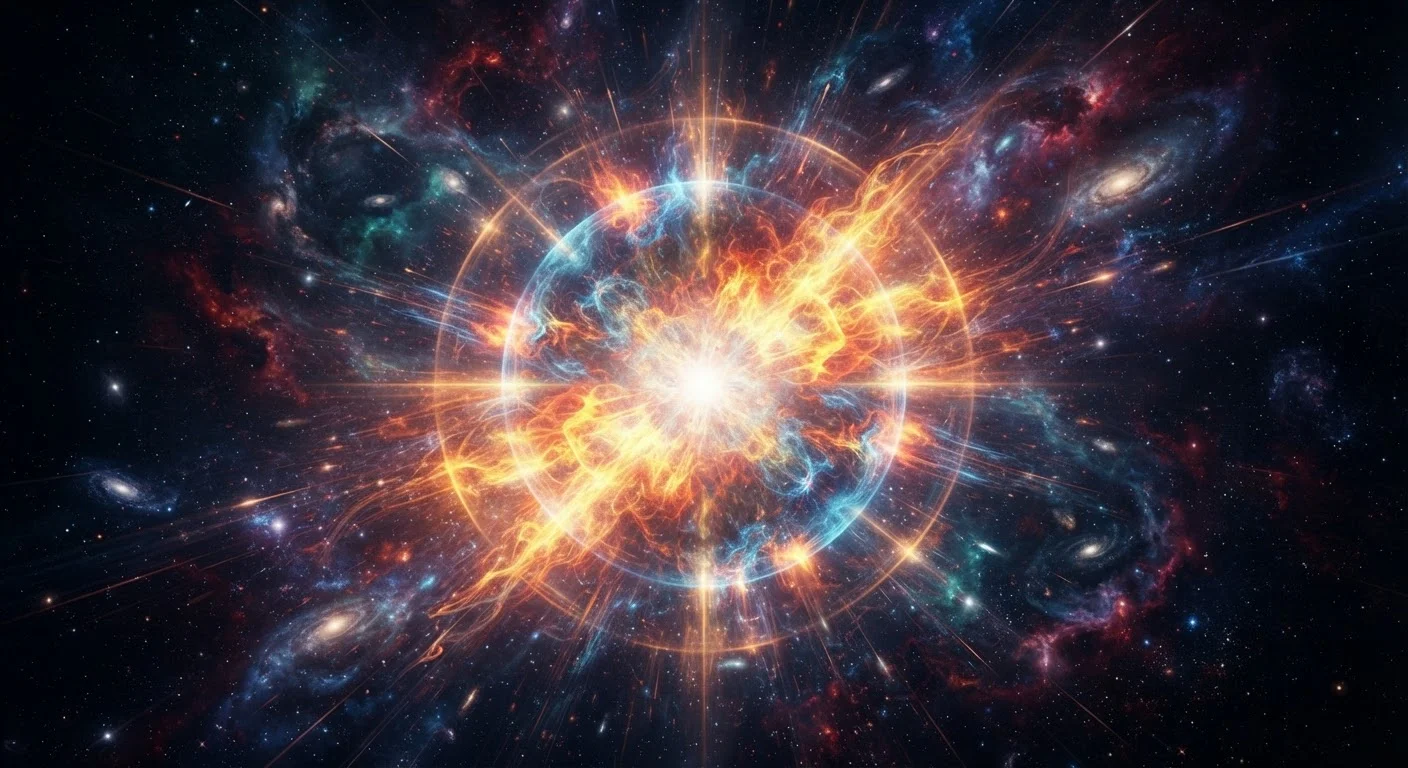
Photo: QuickAdvisor.net editorial
Key Takeaways
- The Big Bang was not an explosion in space - space itself expanded from an extremely hot, dense state.
- There was no central point of the Big Bang; the event happened everywhere simultaneously.
- The Big Bang does not describe the origin of the universe from absolute nothing.
- Stars and galaxies took hundreds of millions of years to form after the Big Bang.
- The cosmic microwave background radiation is our strongest observational evidence for the Big Bang.
Why the Big Bang Is So Widely Misunderstood
Few scientific concepts are more frequently taught - and more thoroughly misunderstood - than the Big Bang. Pop culture imagery of a dramatic cosmic explosion, combined with the misleading name itself, has left most people picturing something that doesn't match what cosmologists actually describe. The good news: the real picture is far more interesting.
These myths aren't just harmless misreadings. They obscure what is genuinely one of humanity's greatest scientific achievements - a coherent, evidence-backed account of how the observable universe evolved from an extraordinarily hot, dense state roughly 13.8 billion years ago. Understanding what the Big Bang actually was starts with clearing away what it was not.
For a grounding in the vocabulary cosmologists use, our plain-language glossary of space and astronomy terms is a helpful starting point before diving deeper.
Myth
The Big Bang was a massive explosion that happened at a specific point in empty space.
Fact
The Big Bang was the rapid expansion of space itself - not an explosion moving through pre-existing space.
The word "explosion" implies matter and energy flying outward from a central point into surrounding emptiness. That is not what happened. In the Big Bang model, space itself expanded from an extremely hot, dense state. There was no surrounding empty space for it to expand into - space, time, matter, and energy all originated together. Think of dots drawn on the surface of a balloon: as the balloon inflates, every dot moves away from every other dot. No dot is the center, and the expansion is in the fabric of the surface itself, not a movement through anything outside it.
Myth
The Big Bang happened at one specific location - the center of the universe.
Fact
The Big Bang happened everywhere at once. The universe has no center, and every point in space was equally the site of the Big Bang.
This is one of the hardest concepts in cosmology to internalize, because human spatial intuition always assigns events a location. But if space itself was created and expanded uniformly, then every point in today's universe traces back equally to the beginning. Cosmologists confirm this through the uniformity of the cosmic microwave background - the afterglow of early-universe heat - which looks essentially the same in every direction. There is no preferred spot. New astronomers frequently run into this kind of spatial assumption when they first try to visualize the cosmos.
Myth
The Big Bang explains how the universe was created from nothing.
Fact
The Big Bang model describes how the universe evolved from an extremely hot, dense early state - it does not explain what caused that state or what, if anything, preceded it.
The phrase "from nothing" makes the Big Bang sound like a claim about absolute creation, but cosmological models describe the evolution of the universe from a very early moment - not the moment of creation itself. The question of what, if anything, came "before" the Big Bang - or whether "before" is even a meaningful concept when time itself began - remains an open one in physics and philosophy. Current science does not claim to answer it. Presenting the Big Bang as a complete origin story overstates what the model actually covers.
Myth
Stars and galaxies formed almost immediately after the Big Bang.
Fact
The first stars didn't ignite until roughly 100-200 million years after the Big Bang, and galaxy formation took even longer.
The universe's first moments were far too hot and energetic for complex structures to exist. In the immediate aftermath, only subatomic particles could form. After about three minutes, protons and neutrons fused into the nuclei of light elements. It took another 380,000 years for the universe to cool enough for electrons to bind to nuclei and form the first atoms. Only after gravity had time to pull gas clouds together - hundreds of millions of years later - did the first stars ignite. The universe has a long, structured history between the Big Bang and the night sky we see today. The material between those stars also tells a rich story.
Myth
The Big Bang is just a theory - scientists aren't really sure it happened.
Fact
In science, "theory" means a well-tested, evidence-supported explanation. The Big Bang model is supported by multiple independent lines of strong observational evidence.
Colloquially, "just a theory" implies guesswork or speculation. In science, a theory is the highest standard of explanation - a framework that has survived repeated testing. The Big Bang model is supported by the cosmic microwave background radiation, the observed expansion of the universe, the measured abundances of primordial elements, and the large-scale structure of galaxy distributions. These converge on the same conclusion independently. Physicists do debate the details of the very earliest moments, and active research continues - but the broad framework is about as well-established as science gets.
What the Evidence Actually Shows
The Big Bang is not a speculation - it rests on multiple independent lines of evidence. The cosmic microwave background (CMB) radiation, first detected in 1965, is thermal radiation left over from when the universe cooled enough for atoms to form, roughly 380,000 years after the Big Bang. It fills the entire sky uniformly, which itself tells us the early universe was remarkably smooth and hot everywhere at once.
13.8 billion
Estimated age of the observable universe
Derived from measurements of the cosmic microwave background by the Planck satellite mission, published by ESA.
380,000 years
Time after the Big Bang when the CMB formed
This is when the universe cooled enough for atoms to form and photons to travel freely, producing the light we detect as the CMB today.
~25%
Helium abundance predicted by Big Bang nucleosynthesis
Observed helium abundance throughout the universe closely matches this theoretical prediction, providing strong support for the Big Bang model.
The observed abundances of light elements - hydrogen, helium, and lithium - match precisely what Big Bang nucleosynthesis models predict. And the redshift of distant galaxies, first systematically documented by Edwin Hubble, shows that the universe is still expanding today, consistent with having originated from a much smaller, denser state. To understand more about that ongoing expansion, see why astronomers think the universe is expanding and speeding up.
None of these evidence streams were designed to confirm each other - they converged independently. That convergence is precisely what gives the Big Bang model its scientific weight. If you enjoy separating scientific consensus from popular myth, the same critical thinking applies closer to home: several widely held beliefs about the human brain also don't hold up to scrutiny.
The content on this site is for informational purposes only and is not a substitute for professional advice. Always consult a qualified professional for guidance specific to your situation.