
Why Astronomers Think the Universe Is Expanding - And Speeding Up

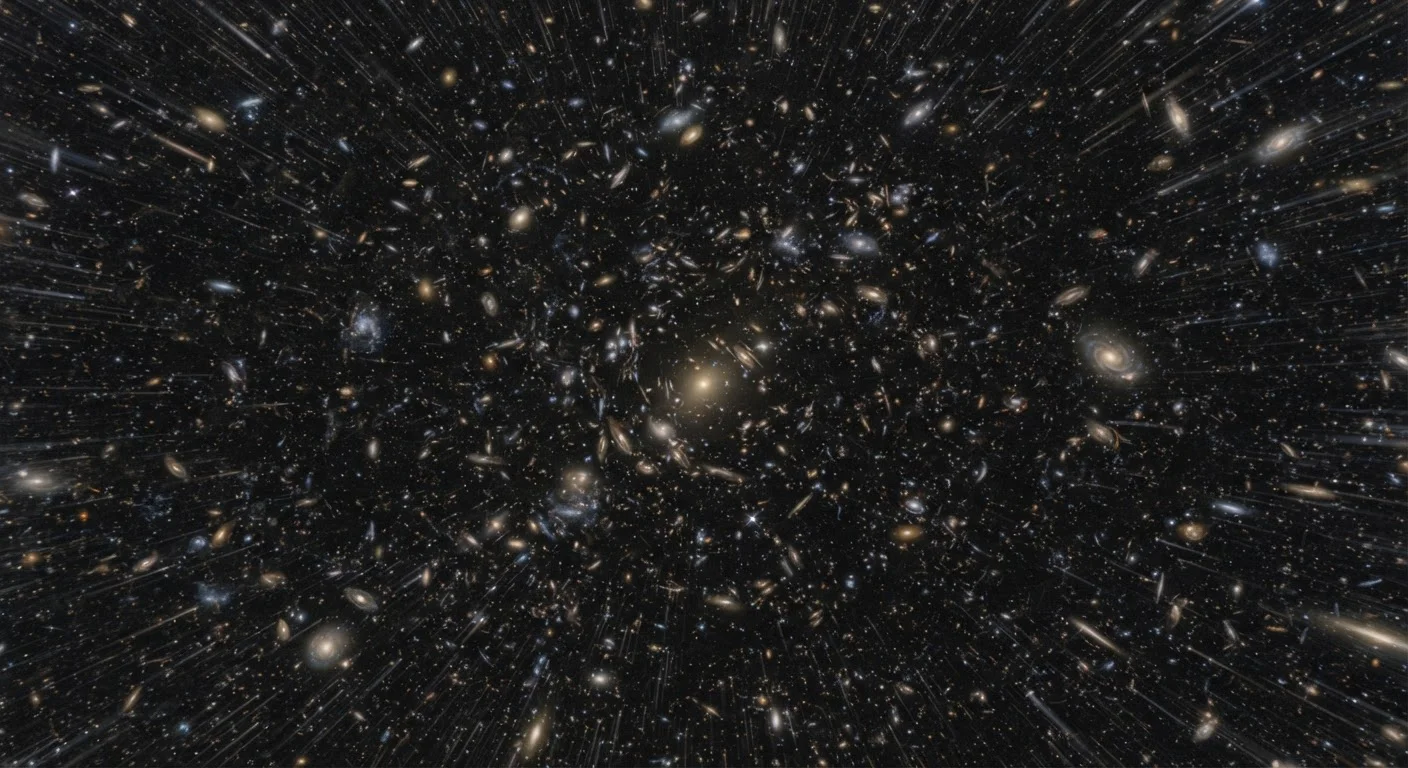
Photo: QuickAdvisor.net editorial
Key Takeaways
- Galaxies are moving apart because space itself is expanding, not because objects are flying through space.
- Edwin Hubble's 1929 observations first established that distant galaxies are receding proportionally to their distance.
- Redshift - the stretching of light waves - is the primary tool astronomers use to measure cosmic expansion.
- In 1998, observations of distant supernovae revealed that expansion is actually accelerating over time.
- Dark energy is the leading scientific explanation for the accelerating expansion, though its nature remains unknown.
- The expansion does not affect you, your city, or even the Milky Way - gravity holds local structures together.
The Raisin Bread Model That Actually Works
Picture a loaf of raisin bread rising in an oven. The raisins don't move on their own - but as the dough expands, every raisin gets farther from every other raisin. A raisin close to another sees it drift away slowly; a raisin far away appears to recede much faster, simply because there's more dough between them to stretch. That, in essence, is how astronomers understand the expanding universe.
The universe isn't galaxies flying outward through empty space from some central explosion. It's space itself - the "dough" - growing in all directions simultaneously. There is no center, no edge, and no outside. Every galaxy cluster observes every other moving away, and the recession speed increases with distance. This point trips up many people new to cosmology - see common myths about the Big Bang for a closer look at why the explosion analogy breaks down.
Redshift: The Universe's Speedometer
The key tool astronomers use to measure expansion is redshift. Light travels as waves, and when a source moves away from an observer, those waves get stretched - shifting toward the red end of the spectrum. The greater the stretch, the faster the recession. In 1929, Edwin Hubble combined measurements of galaxy distances with their redshifts and found a remarkably consistent pattern: distant galaxies were receding proportionally to how far away they were. This relationship, now called Hubble's Law, became the observational foundation of modern cosmology.
Measuring distances precisely across billions of light-years is genuinely difficult - new astronomers are often surprised by how complex the relationship between brightness and distance really is. Astronomers use "standard candles" - objects whose intrinsic brightness is known - to anchor the cosmic distance ladder. Cepheid variable stars work for relatively nearby galaxies; for farther reaches, Type Ia supernovae serve as more powerful yardsticks.
~13.8B
Age of the universe in years
Established through measurements of the cosmic microwave background by missions including the ESA's Planck satellite.
67-73 km/s
Expansion rate per megaparsec (Hubble constant)
The range reflects disagreement between two measurement methods - the so-called Hubble tension - an unresolved problem in modern cosmology.
~68%
Estimated share of universe that is dark energy
According to the standard cosmological model (ΛCDM), dark energy constitutes roughly 68% of the total energy content of the universe.
The Surprise of 1998: Expansion Is Speeding Up
For most of the 20th century, physicists assumed the expansion was gradually slowing down. Gravity, after all, should be tugging galaxies back toward one another. Two independent research teams studied distant Type Ia supernovae in the late 1990s expecting to measure that deceleration. Instead, both teams found the supernovae were dimmer than expected - meaning they were farther away than a decelerating expansion would predict. The universe wasn't slowing. It was accelerating.
This was not a minor revision. It overturned decades of assumptions and earned the 2011 Nobel Prize in Physics for the team leaders Saul Perlmutter, Brian Schmidt, and Adam Riess. The agent driving this acceleration was named dark energy - a placeholder label for whatever property of space is pushing galaxies apart with increasing speed. To understand the full picture of what's filling the universe and driving its behavior, see our explainer on dark matter and dark energy.
“The most incomprehensible thing about the universe is that it is comprehensible.”
— Albert Einstein, Theoretical physicist and developer of the general theory of relativity
What This Means for the Universe's Future
If expansion continues accelerating, the long-term future of the universe looks profoundly lonely. Galaxies beyond our local group will eventually recede faster than light can cross the growing gap - making them permanently invisible and unreachable. The observable universe will effectively shrink over cosmic time, not because the universe itself gets smaller, but because more of it passes beyond our horizon. Stars will burn out, and if the acceleration persists, the universe may trend toward a cold, dark, and diffuse state sometimes called the Big Freeze.
None of this affects structures held together by gravity. The Milky Way, the Solar System, Earth - these remain bound by forces that dwarf the influence of dark energy at local scales. Cosmic expansion is a phenomenon of the very large and the very distant. It's worth noting that the space between stars isn't truly empty either - gas, dust, and fields fill those gaps in ways that matter for how galaxies evolve even as they drift apart.
The Hubble tension - a persistent disagreement between two methods of measuring the expansion rate - remains unresolved. Some researchers suspect it points to new physics beyond the current model. Telescopes like the James Webb Space Telescope are providing ever-sharper data on distant galaxies; Webb sees the universe in ways Hubble couldn't, potentially helping to resolve this tension in coming years.
A Simple Way to Visualize Expansion
Frequently Asked Questions
The content on this site is for informational purposes only and is not a substitute for professional advice. Always consult a qualified professional for guidance specific to your situation.