
Training at Home vs. Training at a Gym: What Changes and What Doesn't

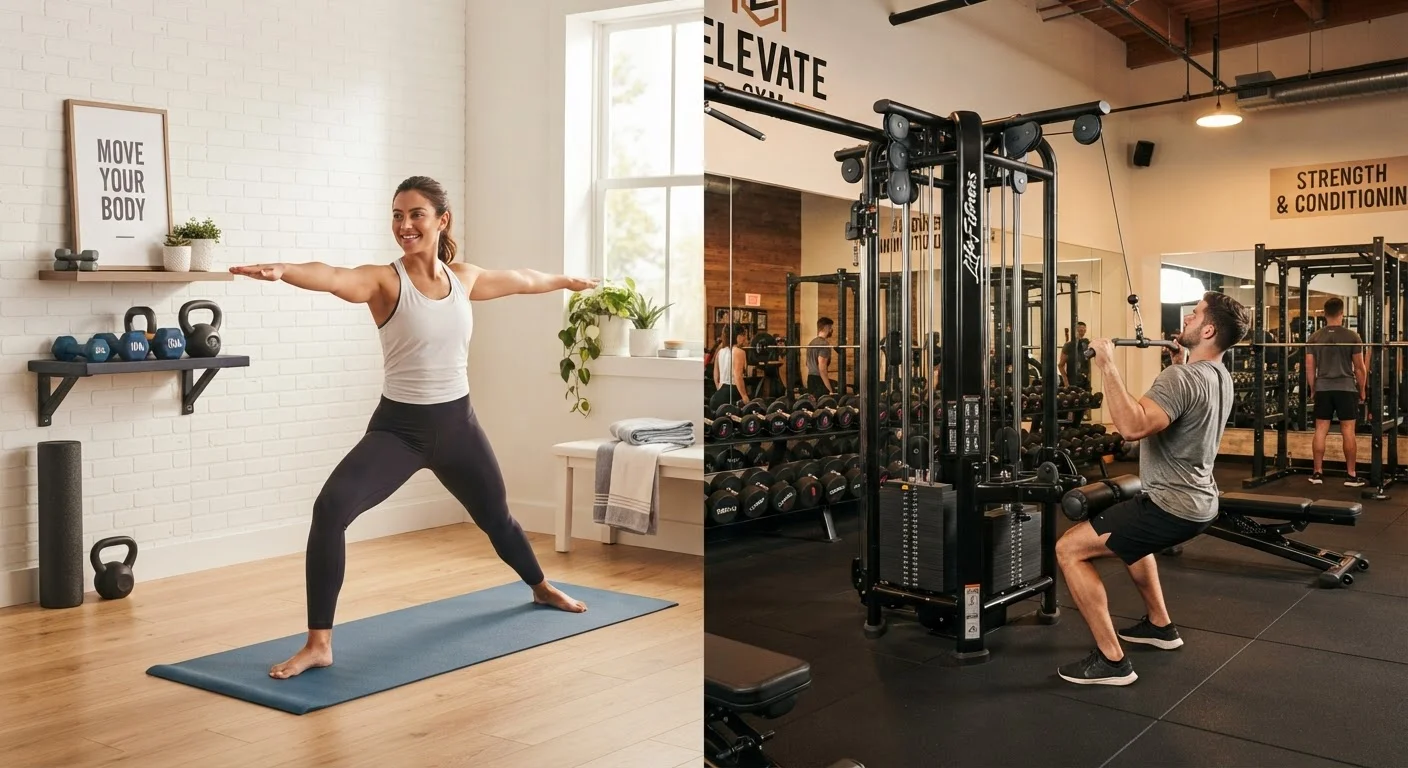
Photo: QuickAdvisor.net editorial
Key Takeaways
- Home training offers convenience and low cost; gym training provides more equipment variety and structured environment.
- The core principles of progressive overload and consistency apply equally in both settings.
- Motivation, budget, and your specific fitness goals should drive the decision.
- Most people can achieve meaningful fitness results in either environment with a sound program.
- Hybrid approaches - training at home some days and at a gym others - are a practical option for many.
No commute - eliminates a major friction barrier
Removing the travel time to and from a gym makes it significantly easier to fit sessions into a busy day, which research on habit formation suggests is one of the biggest predictors of long-term consistency.
Lower ongoing cost for most people
Once a basic home setup is purchased, the per-session cost drops to near zero, often making it more economical than a monthly membership over a multi-year period.
Flexible scheduling with no operating hours
Home training can happen at 5 a.m. or 10 p.m. without depending on a facility's hours, which matters for shift workers, parents, and anyone with an unpredictable calendar.
Wide equipment variety and progressive loading options
Commercial gyms stock cable machines, barbells, multiple plate increments, and specialty equipment that is impractical to own at home, enabling finer load progression and more exercise variety.
Structured environment cues effort and focus
A dedicated training space, away from household distractions, helps many people mentally shift into workout mode and sustain higher intensity throughout a session.
Access to qualified coaching and group energy
On-site personal trainers, group fitness classes, and training partners are resources that most gym members can access, providing instruction, feedback, and social accountability.
Equipment limitations cap certain types of progress
Heavy compound lifts like barbell squats, deadlifts, and bench press require equipment that is expensive, space-consuming, and often impractical to replicate at home - a real constraint for those pursuing strength or hypertrophy goals at higher loads.
Requires self-discipline without external accountability
Without a class schedule, trainer, or training partner, home workouts depend entirely on internal motivation, which many people find harder to sustain consistently over months.
Home distractions can erode session quality
Family members, household chores, and device notifications compete for attention in a home setting, making it harder to maintain focus compared to a dedicated training facility.
Ongoing membership cost adds up over time
Even a mid-range gym membership represents a recurring expense that, over several years, significantly exceeds the one-time cost of a functional home setup for many training styles.
Commute time reduces practical accessibility
Travel to and from a gym adds 20-40 minutes or more to each session for many people, which is one of the most commonly cited reasons for skipping workouts, according to public health surveys.
Crowds and wait times during peak hours
Popular gyms can become crowded during morning and evening rush periods, leading to wait times for equipment and disrupting planned workout structure - a frustration that causes some members to disengage.
The Real Question Isn't Where - It's Whether
The debate between home and gym training generates strong opinions, but the underlying science is less divided. Exercise physiology research consistently shows that the stimulus your muscles and cardiovascular system receive - not the zip code where you generate it - is what drives adaptation. Progressive overload, adequate recovery, and consistent effort are the levers that produce results, and neither a garage nor a weight room has a monopoly on them.
That said, the environment where you train does influence real, practical factors: how easy it is to start a session, what tools you have access to, how much you spend, and whether you stay motivated over months rather than weeks. These variables matter enormously for everyday Americans trying to build lasting habits. So while the physiological principles don't change, the logistics very much do.
For a deeper look at what separates effective programs from those that lead to burnout or stalled progress, see signs of a well-designed training program.
Advantages and Disadvantages at a Glance
Both settings come with genuine trade-offs. Understanding them clearly makes it easier to match your environment to your lifestyle - or to build a hybrid approach that captures benefits from each.
No commute - eliminates a major friction barrier
Removing the travel time to and from a gym makes it significantly easier to fit sessions into a busy day, which research on habit formation suggests is one of the biggest predictors of long-term consistency.
Lower ongoing cost for most people
Once a basic home setup is purchased, the per-session cost drops to near zero, often making it more economical than a monthly membership over a multi-year period.
Flexible scheduling with no operating hours
Home training can happen at 5 a.m. or 10 p.m. without depending on a facility's hours, which matters for shift workers, parents, and anyone with an unpredictable calendar.
Wide equipment variety and progressive loading options
Commercial gyms stock cable machines, barbells, multiple plate increments, and specialty equipment that is impractical to own at home, enabling finer load progression and more exercise variety.
Structured environment cues effort and focus
A dedicated training space, away from household distractions, helps many people mentally shift into workout mode and sustain higher intensity throughout a session.
Access to qualified coaching and group energy
On-site personal trainers, group fitness classes, and training partners are resources that most gym members can access, providing instruction, feedback, and social accountability.
Equipment limitations cap certain types of progress
Heavy compound lifts like barbell squats, deadlifts, and bench press require equipment that is expensive, space-consuming, and often impractical to replicate at home - a real constraint for those pursuing strength or hypertrophy goals at higher loads.
Requires self-discipline without external accountability
Without a class schedule, trainer, or training partner, home workouts depend entirely on internal motivation, which many people find harder to sustain consistently over months.
Home distractions can erode session quality
Family members, household chores, and device notifications compete for attention in a home setting, making it harder to maintain focus compared to a dedicated training facility.
Ongoing membership cost adds up over time
Even a mid-range gym membership represents a recurring expense that, over several years, significantly exceeds the one-time cost of a functional home setup for many training styles.
Commute time reduces practical accessibility
Travel to and from a gym adds 20-40 minutes or more to each session for many people, which is one of the most commonly cited reasons for skipping workouts, according to public health surveys.
Crowds and wait times during peak hours
Popular gyms can become crowded during morning and evening rush periods, leading to wait times for equipment and disrupting planned workout structure - a frustration that causes some members to disengage.
If you're working primarily with bodyweight or minimal gear at home, building a home workout habit with minimal space and no equipment covers practical strategies for making that format effective.
What the Numbers Suggest
Cost and access data help frame the decision in concrete terms. Gym memberships in the United States vary widely - industry surveys have put the average monthly cost between roughly $40 and $70, with premium facilities running considerably higher. A basic home setup (resistance bands, adjustable dumbbells, a pull-up bar) can be assembled for a few hundred dollars and used indefinitely, which often makes it more economical over a two- to three-year horizon.
$40-$70
Average monthly US gym membership cost
Industry surveys suggest most standard commercial gym memberships in the US fall in this range, with premium or boutique facilities often priced higher.
~67%
Gym members who rarely use their membership
Estimates from fitness industry analyses suggest a substantial majority of gym members do not use their memberships consistently, underscoring that access alone does not guarantee adherence.
$200-$500
Approximate cost of a functional home setup
A basic but versatile home gym - resistance bands, adjustable dumbbells, and a pull-up bar - can typically be assembled in this price range, representing a one-time investment.
Neither cost structure is inherently right. What matters is whether the investment you make - in money or in time - reliably gets you training.
Motivation, Accountability, and the Consistency Factor
One of the strongest practical arguments for gym training is environmental design. A dedicated facility signals to your brain that it's time to work. Other people exercising around you can raise effort levels - a phenomenon exercise scientists sometimes call social facilitation. Scheduled class times or a training partner create external accountability that many people genuinely need.
Home training flips the equation. Without a commute, there's less friction between intention and action. For people with demanding schedules, young children, or social anxiety, that reduced barrier can be the difference between training and not training. However, home environments also bring distractions - household tasks, family interruptions, and the pull of other screens - that require deliberate management.
Neither context is inherently superior for motivation; it depends on your individual psychology. The group fitness vs. solo training comparison explores the accountability dimension in more depth if that's a deciding factor for you.
Hybrid Training Is a Legitimate Strategy
For guidance on training methods that hold up regardless of where you exercise, training approaches that work across fitness levels is worth reviewing.
The content on this site is for informational purposes only and is not a substitute for professional advice. Always consult a qualified professional for guidance specific to your situation.