
American Football vs. Canadian Football: More Different Than You'd Think

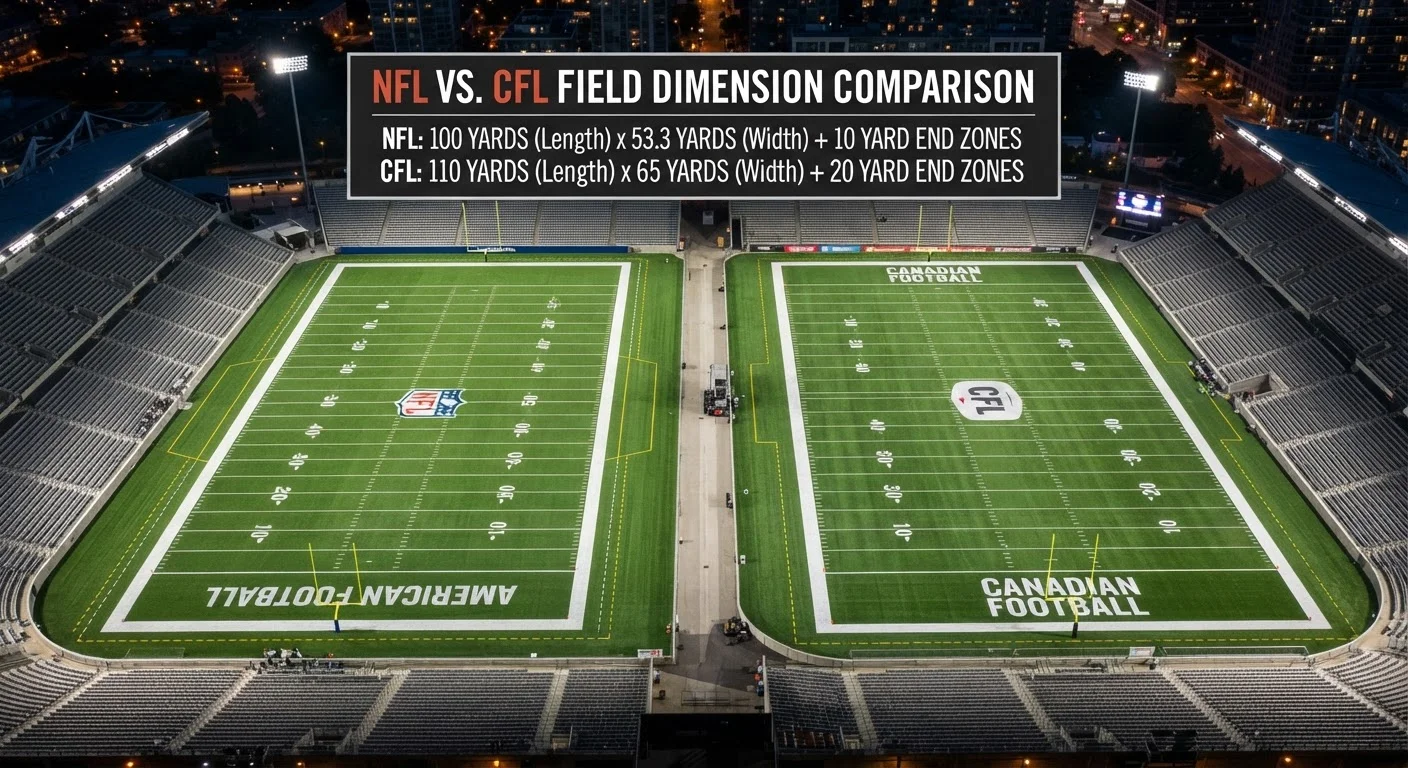
Photo: QuickAdvisor.net editorial
Key Takeaways
- The Canadian field is 10 yards wider and has deeper end zones than an American field.
- Canadian football gives the offense three downs to advance, not four.
- The 'rouge' (or single) is a uniquely Canadian scoring play worth one point.
- Canadian teams have 12 players on the field per side, compared to 11 in the American game.
- Motion rules before the snap are significantly more permissive in the Canadian game.
- Both games share the same basic objective but diverge sharply in pace, strategy, and scoring.
Same Origin, Diverging Rules
American and Canadian football both trace their roots to rugby, and both games evolved through the late 19th century on parallel but distinct tracks. Walter Camp's rule reforms in the 1880s shaped what became American football, while Canadian football retained some older conventions and added its own innovations. The result: two games that look almost identical at first glance but play very differently once you dig into the rulebook.
For casual fans, the confusion is understandable. The ball is nearly the same shape, the scoring system uses touchdowns and field goals, and the basic goal - advance the ball into the opponent's end zone - is identical. But the structural differences affect strategy, scoring frequency, and the overall feel of the game in ways that matter. As our guide to easily confused sports terms notes, similar-sounding concepts across sports can hide meaningful distinctions - and that's especially true here.
| Criterion | American Football | Canadian Football |
|---|---|---|
| Field length | 100 yards | 110 yards |
| Field width | 53⅓ yards | 65 yards |
| End zone depth | 10 yards | 20 yards |
| Players per side | 11 | 12 |
| Downs to gain 10 yards | 4 downs | 3 downs |
| The rouge / single | Does not exist | 1 point scored |
| Fair catch on punts | Yes | No (5-yard halo rule) |
| Pre-snap motion | Limited (one player, lateral) | More permissive (multiple players) |
| Play clock | 40 seconds | 20 seconds |
Field Dimensions and Team Size
The most immediately visible difference is the field itself. A Canadian football field is 110 yards long (compared to 100 in the American game) and 65 yards wide (versus 53⅓ yards). The end zones are also deeper - 20 yards in Canada versus 10 yards in the United States. That's a substantially larger playing surface, and it fundamentally changes how defenses organize coverage.
Rosters on the field reflect this too. Canadian football deploys 12 players per side rather than 11. That extra player is typically added in the defensive backfield or used as an additional receiver, which opens up the passing game and makes man-to-man coverage harder to sustain across a wider field.
65 yds
Width of a Canadian football field
The CFL field is nearly 12 yards wider than the NFL's 53⅓-yard field, significantly changing defensive spacing.
12 vs. 11
Players per side on the field
The extra player in the Canadian game is typically deployed in the secondary or as an additional receiver.
3
Downs to advance 10 yards (CFL)
Having one fewer down than the NFL forces Canadian offenses to be more aggressive and punt more strategically.
Three Downs, the Rouge, and Pre-Snap Motion
Three rule differences define the Canadian game for most newcomers:
- Three downs: Canadian teams have only three attempts to advance the ball 10 yards for a first down, compared to four in the American game. This single change has cascading effects - punting on second down becomes strategically rational, offenses face more pressure on every possession, and the pace of scoring tends to be higher.
- The rouge (or single): If a kicked ball (punt, missed field goal, or kickoff) is not returned out of the end zone by the receiving team, the kicking team scores one point. This creates late-game tactical situations that simply don't exist in the American game - a team trailing by one point might deliberately concede a rouge to get the ball back quickly.
- Pre-snap motion: In the CFL, any backfield player can be in motion toward the line of scrimmage before the snap, and multiple players can move simultaneously. The NFL permits only limited, lateral motion by a single player. This makes Canadian offensive formations more dynamic before the ball is even snapped.
If you enjoy untangling unusual sports rules, the same analytical lens applies to baseball - our breakdown of baseball's most confusing rules covers a similar category of head-scratchers.
Scoring, Clock, and Fair Catches
Scoring values are largely the same - a touchdown is worth six points in both games, a field goal three, a safety two - but the rouge adds an extra dimension to Canadian scoring that affects late-game decisions significantly. A team can win a CFL game by engineering a rouge; that scenario is simply impossible in the NFL.
Clock management differs too. The Canadian play clock runs 20 seconds from the referee's whistle, versus the NFL's 40-second play clock from the end of the previous play. This keeps Canadian games moving at a noticeably brisker pace. Additionally, the CFL does not use a fair-catch rule on punts - instead, the kicking team must give the returner a five-yard buffer, which leads to more dynamic and contested return plays.
For fans who follow the NFL structure and want to understand how that league's season and playoff system works, our walkthrough of the NFL season explains the format from preseason through the Super Bowl.
This article is for informational and educational purposes only. Rule details reflect general published guidelines for each league and may be subject to updates; always consult official league sources for the most current rulebook information.
The content on this site is for informational purposes only and is not a substitute for professional advice. Always consult a qualified professional for guidance specific to your situation.