
Pacific Northwest vs. Mountain West: Two Very Different Versions of the American Outdoors

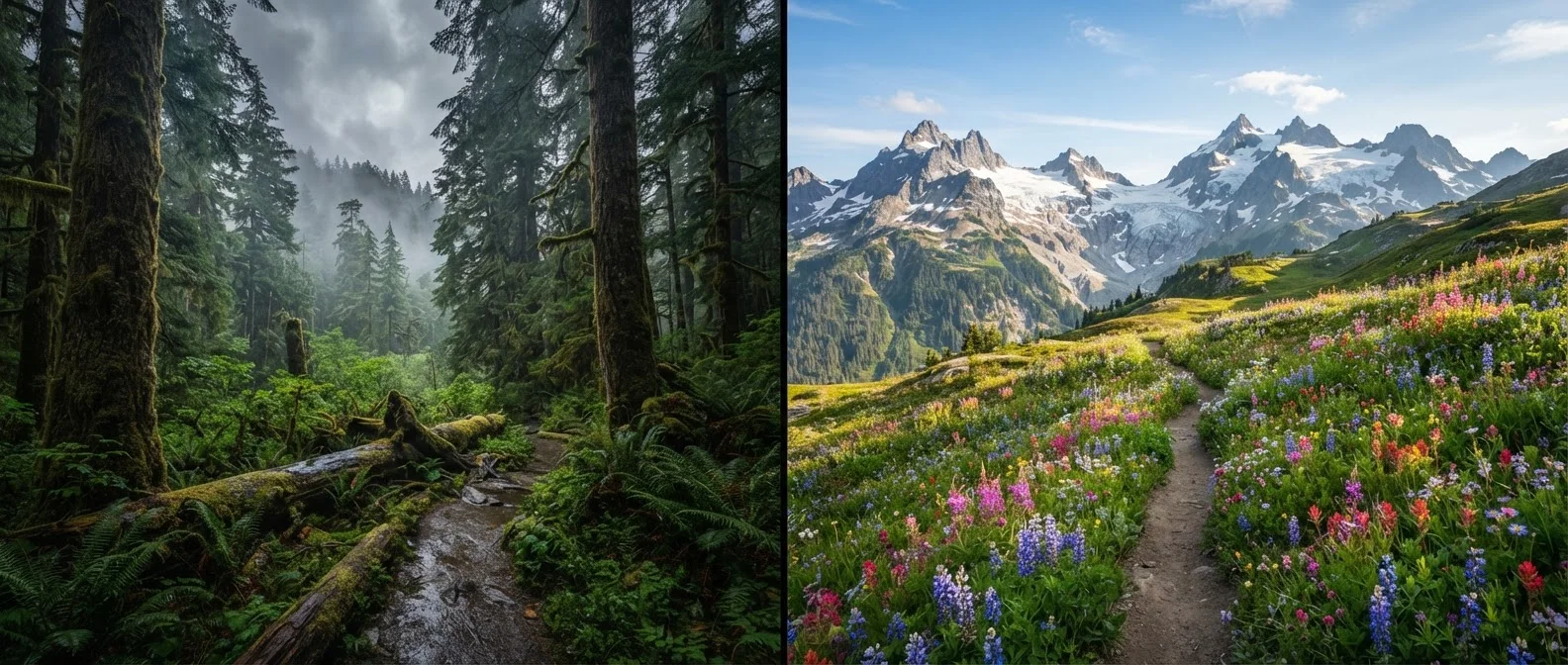
Photo: QuickAdvisor.net editorial
Key Takeaways
- The Pacific Northwest is defined by moisture, ancient forests, and active volcanoes; the Mountain West by elevation, open skies, and dramatic geological variety.
- Outdoor access differs significantly - PNW weather demands flexibility while Mountain West summers offer more consistent conditions.
- Both regions offer extraordinary national parks, but the experiences they deliver are fundamentally different in feel and character.
- The Mountain West covers a broader geographic and climatic range, from high desert to alpine tundra.
- Shoulder-season travel carries distinct trade-offs in each region - access, weather, and crowds all shift with the calendar.
What Each Region Actually Looks Like
The Pacific Northwest - broadly Washington, Oregon, and the Idaho panhandle - is a land shaped by water. Moisture-laden air rolling off the Pacific collides with the Cascades, producing temperate rainforests so lush they feel almost prehistoric. Hoh Rainforest in Olympic National Park receives over 12 feet of precipitation annually. Volcanic peaks define the skyline: Mount Rainier, Mount Hood, Mount St. Helens. The coastline is rugged, wild, and - importantly - rarely warm enough to swim. This is a region where green dominates and gray skies are part of the package, not a weather complaint.
The Mountain West is harder to pin down because it spans so much territory - Montana, Wyoming, Colorado, Utah, Idaho, and Nevada all qualify, with Arizona and New Mexico sharing characteristics. What unifies it is elevation and geological drama. The Rockies and their neighboring ranges create a spine of high-altitude terrain that drops into high desert basins and canyon country. The air is drier, the sky is bigger, and summer days typically arrive reliably blue. This is John Ford landscape - sweeping, sun-washed, and enormously varied.
| Criterion | Pacific Northwest | Mountain West |
|---|---|---|
| Climate character | Wet, temperate, maritime | Drier, variable, continental |
| Dominant landscape | Rainforest, volcanoes, rugged coast | Rocky peaks, high desert, canyon country |
| Best season for most visitors | July-September | June-September (varies by sub-region) |
| Winter recreation | Skiing available, conditions variable | World-class skiing, long season |
| Landscape variety within region | Moderate - forest, coast, volcanic peaks | High - alpine, desert, canyon, grassland |
| Urban gateway cities | Seattle, Portland | Denver, Salt Lake City, Bozeman |
| Crowd pressure at parks | High in summer, manageable off-peak | Very high at top parks; reservation systems common |
Weather, Seasons, and Planning Reality
Weather is where these two regions diverge most decisively for trip planning. In the Pacific Northwest, summer (July-September) is genuinely glorious - mild, mostly dry, and spectacularly green. But the window is real. Spring and fall bring persistent rain, and winter at elevation means serious snowpack. Travelers who go in May expecting Seattle-in-July weather often come back disappointed. Flexibility and layering are non-negotiable.
The Mountain West offers a wider planning sweet spot in summer, but elevation introduces its own variables. Afternoon thunderstorms are common at altitude in July and August, particularly in Colorado and Wyoming. High passes can receive snow any month of the year. And the desert portions - think southern Utah's canyon country - can hit triple digits in midsummer, making spring and fall far more comfortable there. Understanding which sub-region you're visiting matters enormously.
If you're weighing when to go, this guide on peak versus off-season travel trade-offs is worth reading before you book. Crowds and access look very different depending on your timing in both regions.
Elevation Changes Everything
National Parks and Iconic Experiences
Both regions are home to some of the country's most celebrated national parks, but the experiences they offer feel entirely distinct. In the Pacific Northwest, Olympic and North Cascades deliver a sense of wild remoteness that feels almost primordial - enormous old-growth trees, braided glacial rivers, and coastline where the forest meets the ocean. Crater Lake, formed in the collapsed caldera of a volcanic eruption roughly 7,700 years ago, is one of the most visually striking places in the country.
The Mountain West's park roster is staggering in scope: Glacier, Grand Teton, Yellowstone, Zion, Bryce Canyon, Arches, Rocky Mountain National Park. Each offers a completely different visual grammar. Yellowstone sits atop a supervolcano and contains more geothermal features than anywhere on Earth. Grand Teton offers what many consider the most photogenic mountain range in North America. Zion and Bryce deliver canyon landscapes that require no prior experience with geology to appreciate as extraordinary.
12+ ft
Annual precipitation in Hoh Rainforest, WA
Olympic National Park's Hoh Rainforest is one of the wettest places in the contiguous United States, according to National Park Service data.
10,000+
Geothermal features in Yellowstone
Yellowstone National Park contains more geothermal features than any other location on Earth, per the National Park Service.
14,000+ ft
Peaks in Colorado alone
Colorado has 58 peaks exceeding 14,000 feet in elevation - among the highest concentrations of high-altitude terrain in the lower 48 states.
For travelers curious about how regions with equally dramatic landscapes differ in character, compare how the Pacific Northwest stacks up against the American Southwest's canyon country and ancient cultures - a region that overlaps significantly with Mountain West geography.
Who Should Go Where - and When
The Pacific Northwest rewards travelers who embrace atmospheric weather, prefer lush and moody landscapes, and want to pair outdoor adventure with genuinely compelling urban culture. Seattle and Portland are among the most interesting mid-size cities in the US, and both sit within easy reach of wilderness that would take other states hours to access. Road trips through the Columbia River Gorge or along the Olympic Peninsula coastal strip are among the great American drives.
The Mountain West suits travelers with a broader range of outdoor priorities - skiing, canyon hiking, wildlife watching, high-altitude backpacking, or simply driving through geological theater. Its sheer size means it can absorb crowds better than most, though popular parks like Zion and Arches have implemented reservation systems to manage summer volume. If shoulder-season travel appeals, the honest case for off-season travel covers what you gain and give up when you go before or after peak.
Neither region is objectively better. They represent two very different relationships with the American landscape - one intimate and green, one vast and sun-drenched. The question is which version of the outdoors speaks to you right now.
The content on this site is for informational purposes only and is not a substitute for professional advice. Always consult a qualified professional for guidance specific to your situation.