
How Tire Pressure Affects Handling, Braking, and Blowout Risk

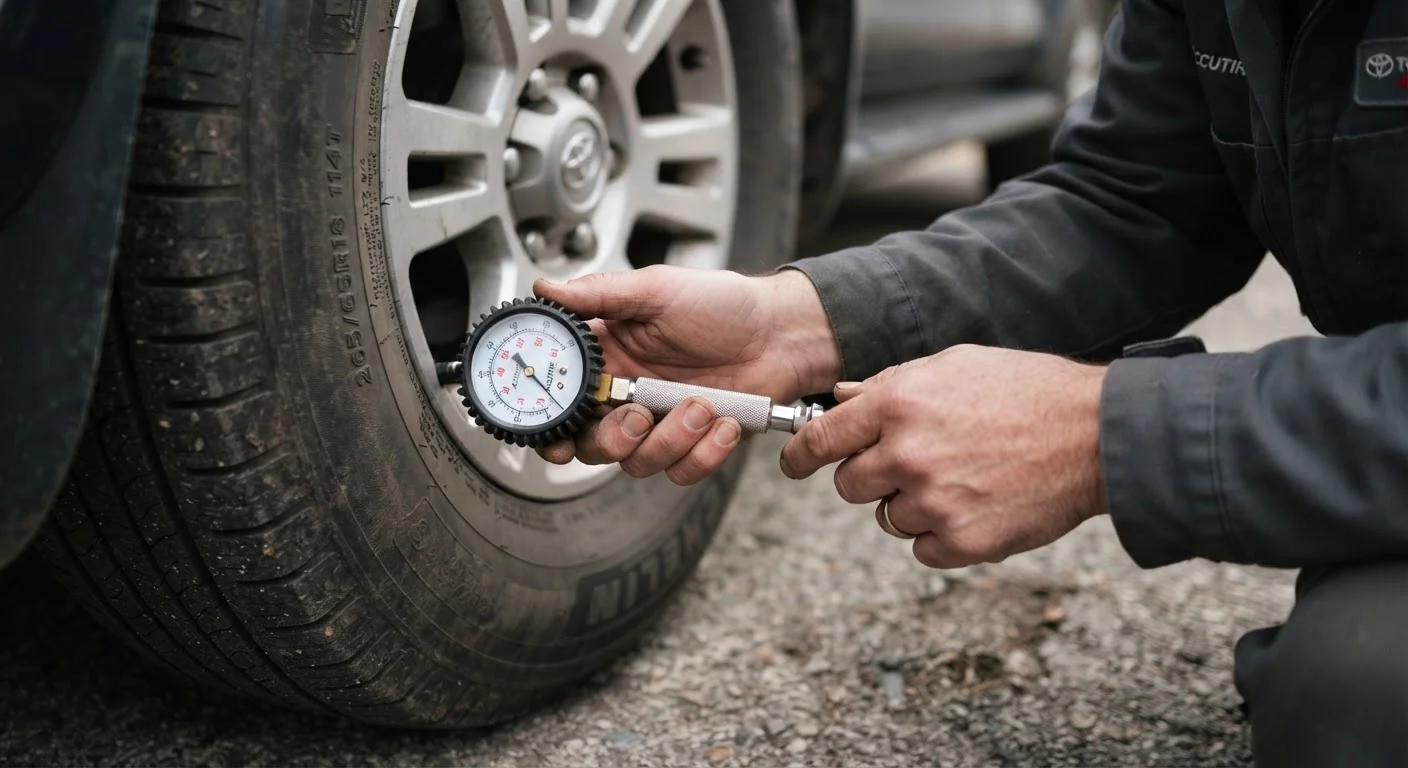
Photo: QuickAdvisor.net editorial
Key Takeaways
- Under-inflated tires increase stopping distances and raise blowout risk, especially at highway speeds.
- Over-inflated tires reduce the contact patch with the road, making handling unpredictable.
- Tire pressure drops roughly 1 PSI for every 10°F decrease in outside temperature.
- The recommended PSI is found on the driver's door jamb sticker, not the tire sidewall.
- Tires should be checked monthly and before any long road trip, ideally when cold.
- A sudden blowout at speed is one of the most dangerous tire failure modes - proper inflation is the primary prevention.
Why Tire Pressure Is a Safety Issue, Not Just a Maintenance Detail
Most drivers treat tire pressure as a minor inconvenience - something to address when a warning light appears or a tire looks visibly soft. In reality, PSI is one of the most direct levers affecting how your vehicle handles, responds to steering inputs, and stops in an emergency.
Tires are the only part of your car in contact with the road. That contact patch - roughly the size of a hand for each tire - transmits every braking, accelerating, and cornering force. Pressure determines the shape and size of that patch. When it's off, even by 10 PSI, the physics of that contact change in ways that affect your safety margin.
The Car Maintenance hub covers a wide range of upkeep topics, but tire pressure stands out because its effects are immediate and invisible until something goes wrong. Understanding the mechanics helps drivers take this simple task more seriously.
~1 PSI
Pressure lost per 10°F temperature drop
This relationship between ambient temperature and tire pressure is well established in automotive engineering and cited by NHTSA consumer guidance.
25%
Under-inflation level that triggers TPMS alert
Federal law requires TPMS systems to warn when any tire drops to 25% below the recommended pressure - by which point handling is already compromised.
1-2 PSI
Natural pressure loss per month
Tires lose air through normal permeation even without a slow leak, making monthly checks the standard recommendation from most safety organizations.
Under-Inflation: The More Dangerous of the Two Extremes
When a tire is under-inflated, its sidewalls flex more than designed. That excess flexing generates heat - and heat is the primary driver of tire failure. At highway speeds, a significantly under-inflated tire can build internal temperatures that weaken its structure, ultimately leading to a sudden blowout. NHTSA data has consistently identified tire problems, including under-inflation, as a contributing factor in thousands of crashes each year.
Beyond blowout risk, low pressure degrades handling in subtler ways. The tire's contact patch grows unevenly, making the vehicle feel sluggish in corners and less responsive to steering inputs. Braking distances increase because the tire cannot transfer force to the road as efficiently. Wet-road performance suffers most, as an improperly shaped contact patch is less effective at channeling water away.
Under-inflated tires also wear faster along the outer edges of the tread, creating a wear pattern that signals the problem - but only after significant damage has already occurred.
Check Pressure Before Long Drives
Over-Inflation: Less Common, Still Consequential
An over-inflated tire is harder and more rigid than intended. The contact patch shrinks to the center of the tread, meaning less rubber is gripping the road at any given moment. This reduces traction in both dry and wet conditions and makes the vehicle more sensitive to lateral forces - the kind encountered during lane changes or evasive maneuvers.
Ride quality suffers noticeably with over-inflation, but the safety concern is the loss of impact absorption. A hard tire transmits road shock directly into the suspension and is more prone to cracking or failing when it strikes a pothole or curb at speed. Tread wear concentrates in the center strip, shortening tire life.
It's worth noting that some drivers intentionally over-inflate tires slightly to improve fuel economy. While there is a marginal efficiency gain, it comes at a measurable cost to grip and ride comfort - a tradeoff most safety professionals consider unfavorable.
How to Check and Maintain Correct Tire Pressure
The correct pressure for your vehicle is not on the tire itself. The number molded into the tire sidewall is a maximum structural rating. Your vehicle's recommended operating PSI - which accounts for weight, load rating, and suspension design - appears on a sticker inside the driver's door jamb or in your owner's manual.
Check pressure when tires are cold - meaning the car has been stationary for at least three hours. Driving heats the air inside tires and temporarily raises pressure readings, making a warm-tire check inaccurate. Use a quality dial or digital gauge; the caps on most valve stems are not reliable pressure indicators.
Check all four tires individually, as pressure can vary between them. Don't forget the spare. If your vehicle has a TPMS warning light, understand that it typically only triggers when pressure has dropped 25% or more - well past the point where handling is already degraded. Monthly manual checks remain the reliable standard.
For a broader look at tire health including tread depth and rotation schedules, see our guide on tire pressure, tread, and rotation.
Frequently Asked Questions
The content on this site is for informational purposes only and is not a substitute for professional advice. Always consult a qualified professional for guidance specific to your situation.