
The Difference Between a Solar System, a Galaxy, and the Observable Universe

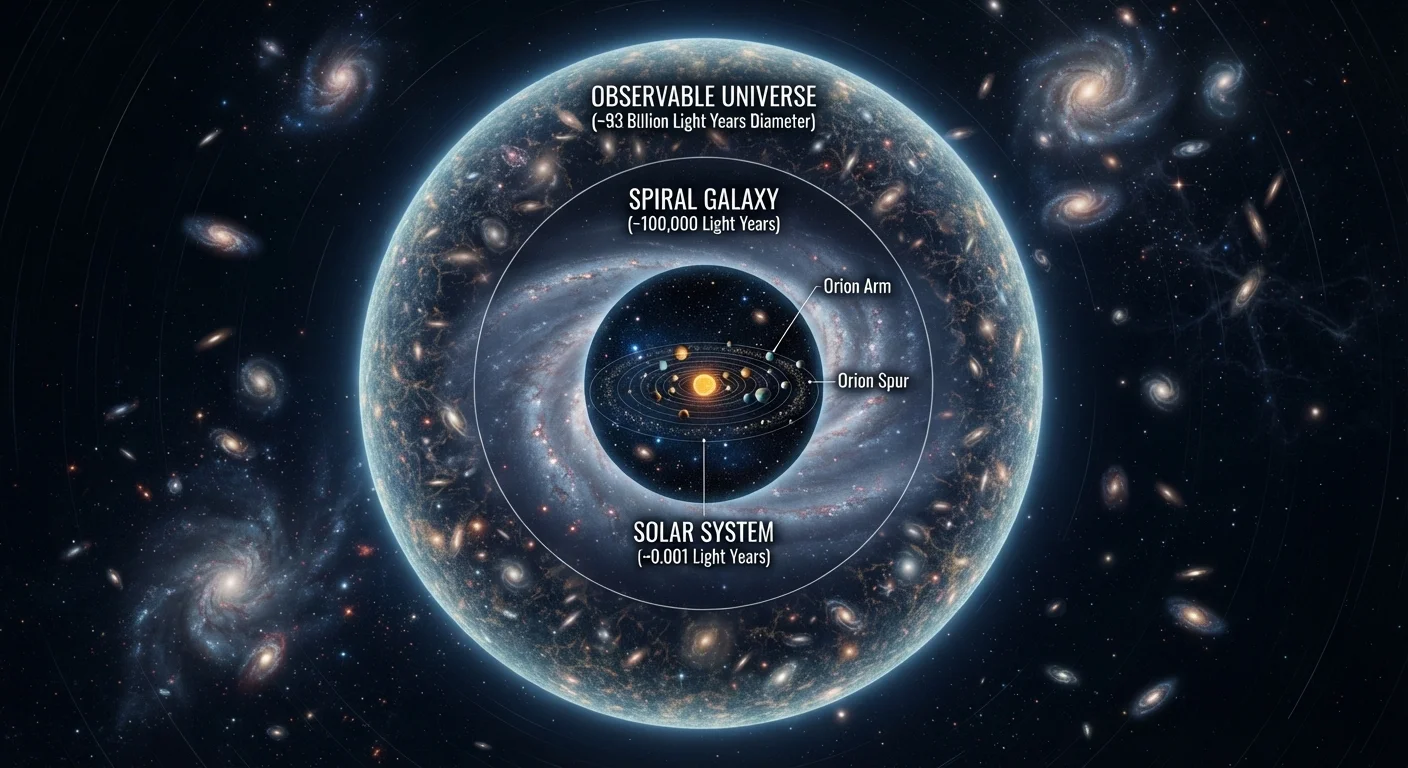
Photo: QuickAdvisor.net editorial
Key Takeaways
- A solar system is one star and all the objects gravitationally bound to it.
- A galaxy contains anywhere from millions to trillions of stars, plus gas, dust, and dark matter.
- The observable universe spans about 93 billion light-years and contains an estimated two trillion galaxies.
- Each scale is nested inside the next - our solar system sits inside the Milky Way, which sits inside the observable universe.
- The observable universe is not the whole universe - it is only the portion whose light has had time to reach us.
A Solar System: One Star, Its Worlds, and Everything in Between
A solar system consists of a single star - or occasionally multiple stars - and all the objects gravitationally bound to it. That includes planets, dwarf planets, moons, asteroids, comets, and vast clouds of dust and gas. Our own solar system, anchored by the Sun, extends roughly 100,000 astronomical units (AU) to the outermost reaches of the Oort Cloud, a distant shell of icy bodies believed to be the source of long-period comets.
To put that in perspective: light takes about 8 minutes to travel from the Sun to Earth, but it would take more than a year to cross the full extent of the Oort Cloud. That feels enormous - until you zoom out.
Solar systems are common. Astronomers have confirmed thousands of exoplanet systems orbiting other stars in our galaxy alone, suggesting that planetary formation is a routine byproduct of how stars are born. For a broader glossary of space terminology, see key astronomy terms explained.
| Criterion | Solar System | Galaxy / Observable Universe |
|---|---|---|
| Primary component | One star (or a few) | Millions to trillions of stars / trillions of galaxies |
| Approximate size | ~100,000 AU (Oort Cloud) | Galaxy: ~100,000 light-years / Universe: ~93 billion light-years |
| Held together by | Star's gravity | Galaxy's gravity + dark matter / cosmic web |
| Our example | The Solar System (Sun + 8 planets) | The Milky Way / the observable universe |
| Contains the other? | No - nested inside a galaxy | Galaxy contains solar systems; universe contains galaxies |
A Galaxy: Cities of Stars Across Cosmic Time
If a solar system is a single house, a galaxy is an entire city - or more accurately, an entire metropolitan region containing hundreds of billions of houses. A galaxy is a gravitationally bound system of stars, stellar remnants, interstellar gas, dust, and dark matter. Galaxies range enormously in size: dwarf galaxies may hold just a few million stars, while giant elliptical galaxies can contain several trillion.
Our home galaxy, the Milky Way, is a barred spiral galaxy estimated to contain 100 to 400 billion stars. Its disk spans roughly 100,000 light-years across. Our solar system sits in one of its minor spiral arms - the Orion Arm - about 26,000 light-years from the galactic center.
Galaxies are not uniformly scattered through space. They cluster into groups and superclusters. The Milky Way belongs to the Local Group, a collection of more than 50 galaxies. The Local Group itself is part of the Virgo Supercluster, which is part of an even larger structure called Laniakea. Understanding how humanity came to map these structures took centuries of incremental discovery.
~200-400 billion
Estimated stars in the Milky Way
NASA estimates the Milky Way contains between 100 and 400 billion stars, with current mid-range estimates around 200-400 billion.
~2 trillion
Galaxies in the observable universe
A 2016 study published in The Astrophysical Journal Letters, led by Christopher Conselice, revised the galaxy count upward to approximately two trillion.
93 billion light-years
Diameter of the observable universe
Despite the universe being 13.8 billion years old, cosmic expansion means the observable sphere extends about 46.5 billion light-years in every direction.
The Observable Universe: The Limit of What Light Can Tell Us
The observable universe is not the same as the universe itself - a distinction that matters enormously. It refers only to the sphere of space from which light has had enough time to reach Earth since the Big Bang, roughly 13.8 billion years ago. Because the universe has been expanding since then, the radius of the observable universe is estimated at about 46.5 billion light-years, giving it a total diameter of approximately 93 billion light-years.
Within that sphere, astronomers estimate there are around two trillion galaxies, though many are too faint and distant for current instruments to resolve individually. Instruments like the James Webb Space Telescope are pushing those limits further than ever - Webb sees the universe differently than Hubble by capturing infrared light that reveals the earliest galaxies.
Beyond the observable universe, space almost certainly continues - but we have no way to detect or measure it. Everything we know about cosmic structure, dark energy, and the fate of the universe is derived from this finite, observable bubble. It is the outer boundary of human knowledge, not the outer boundary of existence.
Why 'Observable' Doesn't Mean 'All of It'
The content on this site is for informational purposes only and is not a substitute for professional advice. Always consult a qualified professional for guidance specific to your situation.