
Stargazing From Your Backyard: What You Can Actually See Without a Telescope

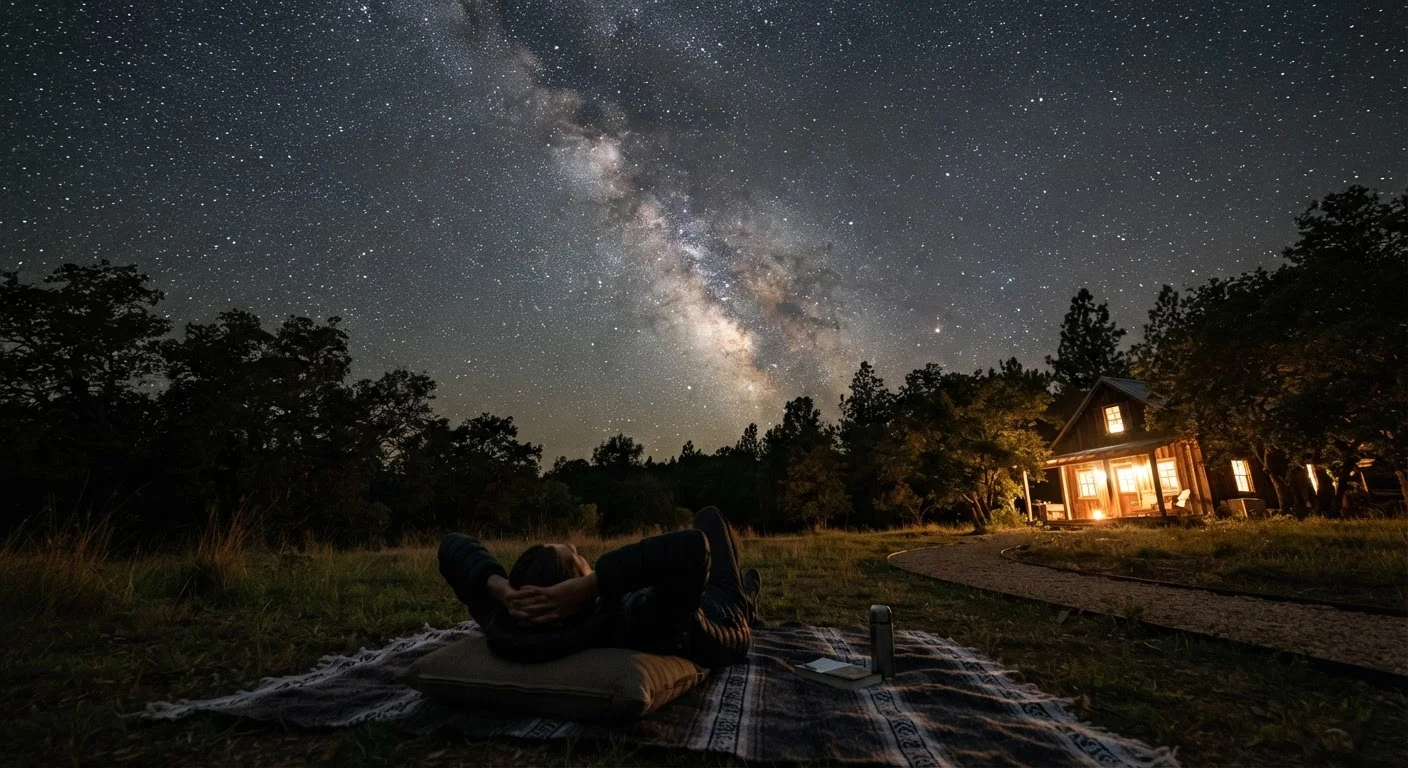
Photo: QuickAdvisor.net editorial
Key Takeaways
- The naked eye can detect thousands of stars, five planets, and the Milky Way under dark conditions.
- Planets don't twinkle like stars - they shine with a steady light, making them easier to identify.
- Dark adaptation takes about 20-30 minutes and dramatically improves what you can see.
- Light pollution is the biggest obstacle for most backyard observers in the US.
- Meteor showers, the ISS, and even the aurora are visible without any equipment.
- Free star-map apps make it easy to orient yourself under any sky.
Why Your Eyes Are Surprisingly Powerful
Most people assume astronomy requires expensive gear. It doesn't - at least not to start. The human eye is a remarkably sensitive instrument, capable of detecting light from objects billions of miles away under the right conditions. On a clear, moonless night far from city lights, your eyes can resolve stars down to about magnitude 6 on the astronomical brightness scale, which represents thousands of individual stars.
The key limiting factor isn't your biology - it's light pollution. The artificial glow blanketing most American cities washes out faint objects, but even from a suburban backyard, you can still see dozens of bright stars, several planets, and - with patience - the diffuse glow of the Milky Way's core on moonless summer nights.
Magnitude
A scale astronomers use to measure the brightness of objects in the sky. Lower numbers mean brighter objects - Venus at magnitude -4 is far brighter than a barely visible star at magnitude 6.
Dark adaptation
The process by which your eyes adjust to low-light conditions, taking roughly 20-30 minutes as the pupils dilate and light-sensitive rod cells in the retina become fully active.
Light pollution
Artificial light scattered into the atmosphere by cities and towns, which brightens the night sky and makes faint stars and the Milky Way difficult or impossible to see.
Constellation
A recognizable pattern of stars in the sky, used as reference points for navigation and storytelling. The stars in a constellation are not physically close - they just appear grouped from Earth's vantage point.
Zenith
The point directly overhead in the sky. Objects near the zenith are viewed through less of Earth's atmosphere and typically appear clearer and brighter than those near the horizon.
Atmospheric scintillation
The rapid, random flickering of starlight - commonly called twinkling - caused by pockets of air at different temperatures bending light as it passes through Earth's atmosphere.
One habit makes an outsized difference: dark adaptation. When you step outside from a lit room, your eyes need 20-30 minutes to reach their full sensitivity as the pupil dilates and the retina's rod cells become active. Avoid looking at bright screens during this window. Even a brief glance at a phone screen resets the process.
Planets You Can Spot Without Any Equipment
Five planets are visible to the naked eye and have been observed by humans since antiquity: Mercury, Venus, Mars, Jupiter, and Saturn. Venus is the easiest - it's the brightest object in the night sky after the Moon, often appearing dramatically in the west after sunset or the east before sunrise. Jupiter runs a close second and is bright enough to cast a faint shadow on very dark nights.
The reliable way to distinguish a planet from a star is to check whether it twinkles. Stars twinkle because their light arrives as a single point and is easily scattered by atmospheric turbulence. Planets, being close enough to appear as tiny disks, deliver a broader bundle of light that averages out that turbulence - resulting in a noticeably steadier glow. This is one of those elegant observational tricks covered in our article on common assumptions that trip up new astronomers.
Planets also move. Track any bright, steady point over several nights and you'll see it shift position relative to the background stars - a movement ancient Greek astronomers called planetes, meaning "wanderers."
Constellations: Your Night Sky Roadmap
Constellations are not physical groupings of stars - the stars within them are often separated by vast distances in space. They are patterns humanity has projected onto the sky across cultures and millennia, serving as a navigational grid. Learning a handful of key constellations unlocks the whole sky.
Orion is the most universally recognized, visible from nearly all of North America during winter months. Its three-star belt is impossible to miss. From there, follow the belt's leftward line to find Sirius, the brightest star in the entire night sky. In summer, the Summer Triangle - formed by Vega, Deneb, and Altair - dominates the overhead sky and serves as a reliable anchor point.
A free star-map app removes the guesswork entirely. Our companion article on reading a star map for the first time explains how to interpret magnitude scales and celestial coordinates so you can navigate confidently without getting overwhelmed.
Start With Just Three Constellations
Fleeting Phenomena Worth Watching For
Some of the most spectacular sights in the night sky are temporary. Meteor showers occur when Earth passes through debris trails left by comets. The Perseids in August and the Geminids in December are two of the most reliable, each capable of producing dozens of visible meteors per hour under dark skies - no equipment needed.
The International Space Station (ISS) is the brightest human-made object in the night sky, easily visible as a fast-moving point of light that crosses the sky in under six minutes. NASA's Spot the Station service provides precise pass times tailored to your location.
Under certain geomagnetic conditions, the aurora borealis (Northern Lights) can reach as far south as the northern continental United States. Major solar events push the aurora's visibility boundary significantly southward - it's worth setting up alerts from the NOAA Space Weather Prediction Center if you live at northern latitudes.
The space between stars is far from empty - it's filled with gas, dust, and magnetic fields that interact with all of this light in fascinating ways. Our article on what fills the space between stars explores the invisible medium your starlight travels through to reach your eyes.
Setting Yourself Up for Success
The single most effective upgrade you can make costs nothing: get away from lights. Even driving 20-30 miles from a city center can reveal dramatically more sky. Light-pollution maps, available freely online, help identify nearby dark-sky zones.
Beyond that, a few practical habits go a long way:
- Choose nights within a few days of a new moon, when moonlight won't wash out faint objects.
- Allow at least 20 minutes of dark adaptation before judging what you can see.
- Use a dim red flashlight to read maps - red light preserves night vision in a way white light does not.
- Check weather and atmospheric transparency forecasts; a technically clear night with poor atmospheric stability can make the sky look blurry.
Understanding the vocabulary of astronomy also enriches the experience. Terms like magnitude, zenith, and conjunction come up repeatedly, and our plain-language guide to key space terms gives you a solid foundation. The night sky has been humanity's companion for millennia - and it's still there, waiting, just above your rooftop.
Frequently Asked Questions
The content on this site is for informational purposes only and is not a substitute for professional advice. Always consult a qualified professional for guidance specific to your situation.