
Why the James Webb Space Telescope Sees the Universe Differently Than Hubble

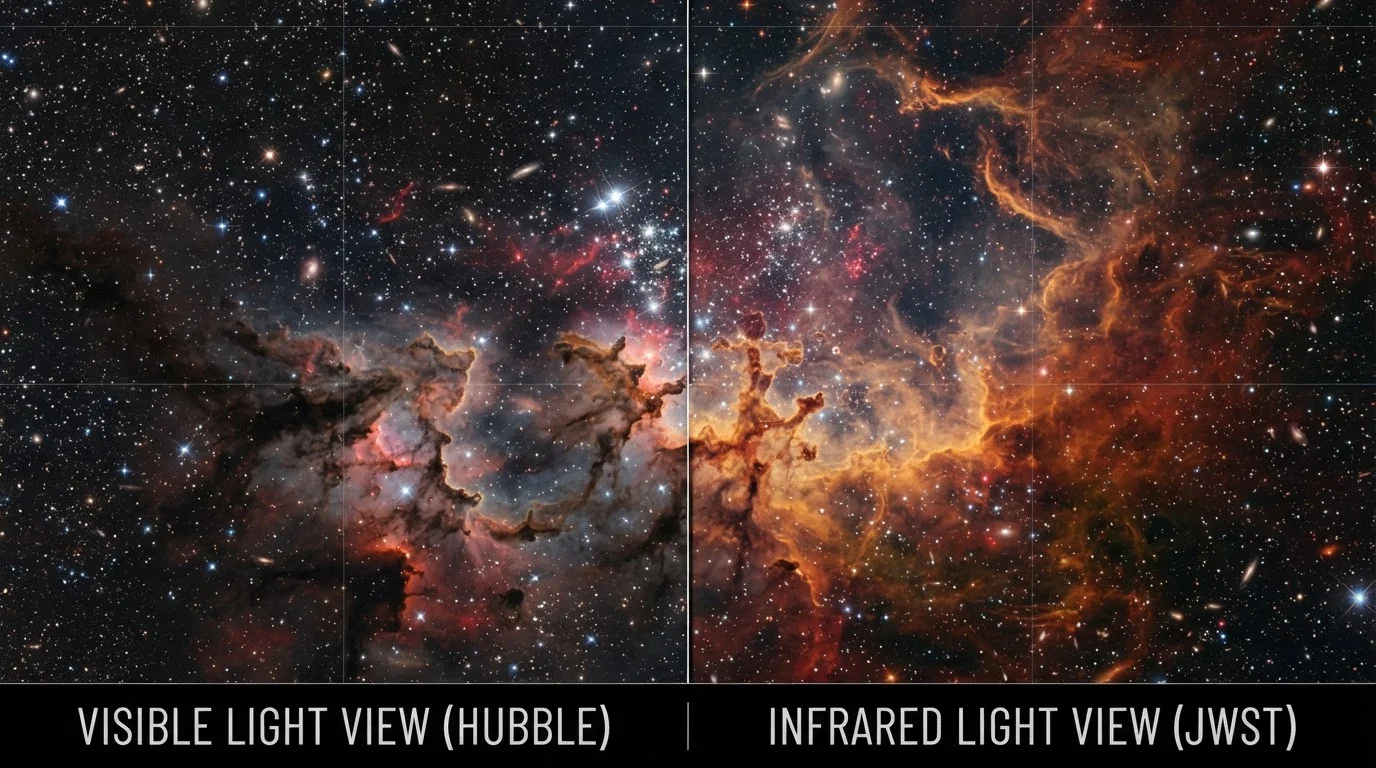
Photo: QuickAdvisor.net editorial
Key Takeaways
- Hubble primarily sees visible and ultraviolet light; Webb is tuned to infrared wavelengths invisible to human eyes.
- Webb's infrared vision lets it detect light from galaxies formed just a few hundred million years after the Big Bang.
- Webb orbits about 1 million miles from Earth - far beyond Hubble's low Earth orbit - enabling colder, more sensitive observations.
- Webb's mirror is roughly six times larger in collecting area than Hubble's, capturing far more light per observation.
- The two telescopes are complementary, not competitive - each reveals aspects of the universe the other cannot.
It's All About the Light
When most people picture a space telescope, they imagine something like a giant camera floating above Earth's atmosphere, snapping sharp pictures of stars. That basic description fits both Hubble and Webb - but the kind of light each instrument collects is fundamentally different, and that difference determines everything they can see.
Light comes in a wide range of wavelengths, only a narrow slice of which the human eye detects as visible color. Hubble was designed primarily to observe in that visible range, plus some ultraviolet light. Webb, by contrast, is engineered to observe in the infrared - wavelengths longer than red light, which we experience as heat radiation but cannot see.
This isn't a minor technical tweak. It's a completely different window onto the cosmos. To understand why that matters, it helps to understand a concept called redshift: as the universe expands, light from distant objects gets stretched to longer wavelengths. The further away a galaxy is, the more its light shifts toward the infrared. Hubble often can't detect that stretched light at all. Webb is built specifically to catch it.
| Criterion | Hubble Space Telescope | James Webb Space Telescope |
|---|---|---|
| Primary wavelength | Visible & ultraviolet light | Near- and mid-infrared light |
| Mirror diameter | 2.4 meters (7.9 feet) | 6.5 meters (21.3 feet) |
| Orbital location | ~340 miles above Earth | ~1 million miles (L2 point) |
| Operating temperature | ~-90°C (-130°F) | ~-233°C (-387°F) |
| Sees through dust clouds | Limited capability | Yes - infrared penetrates dust |
| Earliest galaxies observable | Up to ~13 billion years ago | Within ~300M years of Big Bang |
| Serviceable by astronauts | Yes (five servicing missions) | No - too far from Earth |
| Launch year | 1990 | 2021 |
Size, Position, and Temperature
Webb's advantages extend beyond just the type of light it captures. Three engineering factors set it apart dramatically from Hubble.
Mirror size: Hubble's primary mirror measures 2.4 meters (about 7.9 feet) across. Webb's segmented gold-coated mirror spans 6.5 meters (21.3 feet), giving it roughly six times more light-collecting area. A larger mirror gathers more photons per second, enabling Webb to detect far fainter and more distant objects.
Orbital position: Hubble orbits just 340 miles above Earth in low Earth orbit - close enough that astronauts serviced it five times. Webb operates at a gravitationally stable point called Lagrange Point 2 (L2), roughly 1 million miles from Earth. This remote location keeps Webb permanently shielded from the Sun, Earth, and Moon by its tennis-court-sized sunshield, which is critical for infrared observation.
Operating temperature: Infrared detectors must be extremely cold to avoid being overwhelmed by their own heat. Webb's instruments operate near -233°C (-387°F). Its sunshield reduces the temperature difference between its sun-facing and space-facing sides by approximately 300°C. This level of thermal control would have been impossible in Hubble's orbit. These physical realities - not just sensor choice - are what make Webb capable of seeing things Hubble never could.
6.5 m
Webb's primary mirror diameter
NASA reports Webb's mirror collects roughly six times more light than Hubble's 2.4-meter mirror, enabling detection of far fainter objects.
~1M miles
Webb's distance from Earth
Webb orbits at Lagrange Point 2, approximately 1 million miles from Earth - too far for any crewed servicing mission with current spacecraft.
13.8B yrs
Age of the universe
Webb is capable of observing light emitted just a few hundred million years after the Big Bang, offering views of the universe's earliest structures.
What Each Telescope Has Revealed
Hubble's contributions to astronomy are extraordinary. Over more than three decades, it confirmed the accelerating expansion of the universe (a discovery tied to dark energy research), measured the age of the universe with new precision, and produced iconic images that changed how scientists and the public picture the cosmos. Those achievements are part of the milestones that shaped our understanding of the cosmos.
Webb has opened new frontiers in just a short operational period. Its first deep-field image revealed thousands of galaxies in a patch of sky smaller than a grain of sand held at arm's length - including some of the most distant galaxies ever observed. Webb has also begun characterizing exoplanet atmospheres with a level of chemical detail previously impossible, and it has revealed previously hidden star-forming regions inside dust clouds that Hubble could not penetrate.
Importantly, astronomers use Hubble and Webb together. Hubble's visible-light observations complement Webb's infrared data, producing a more complete picture of the same objects. Webb doesn't make Hubble obsolete - it makes the combined view richer. A common misconception is that newer always means better across all dimensions; in telescope science, different tools reveal different truths about the same vast scales of space.
The content on this site is for informational purposes only and is not a substitute for professional advice. Always consult a qualified professional for guidance specific to your situation.