
Extended Warranties vs. Manufacturer Warranties: Weighing the Trade-Offs

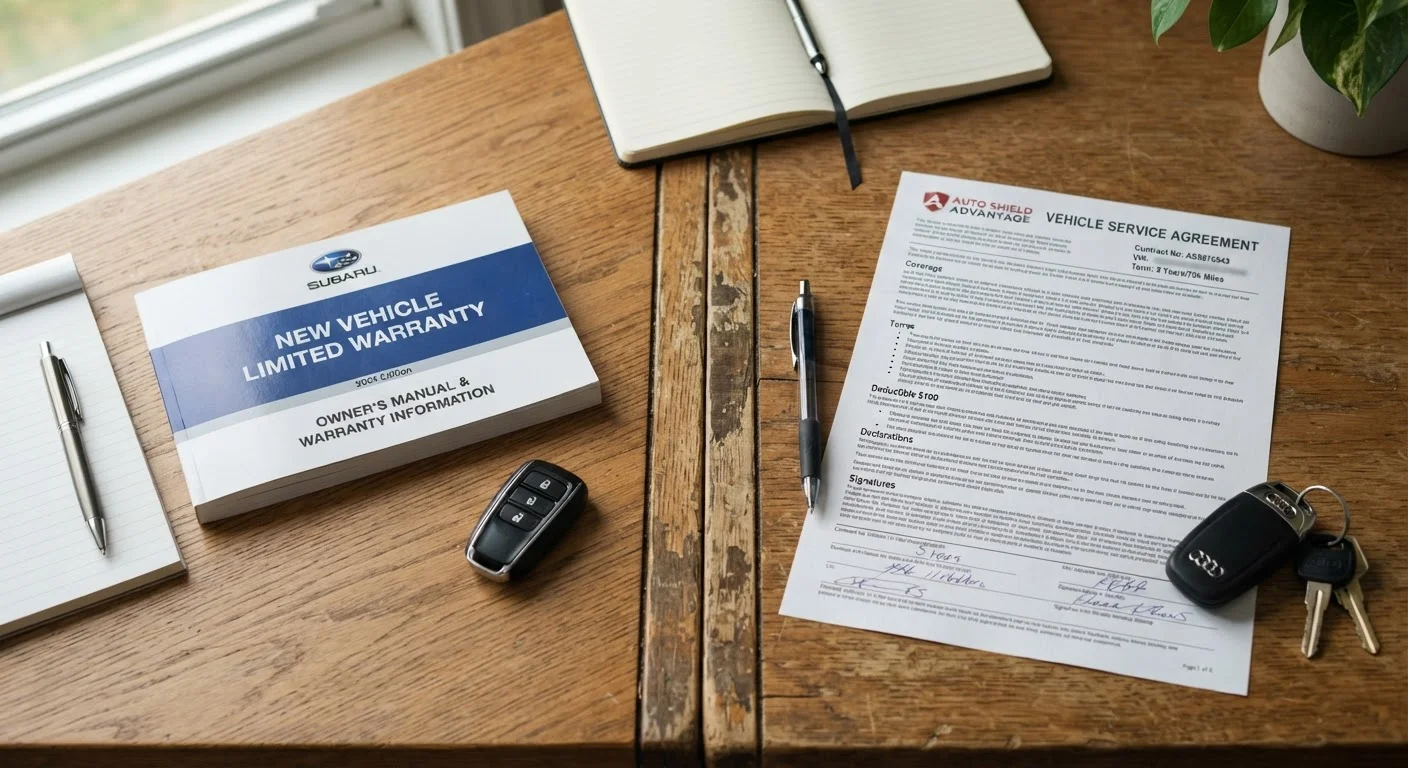
Photo: QuickAdvisor.net editorial
Key Takeaways
- Manufacturer warranties are included in the purchase price and governed by federal law; extended warranties are optional contracts sold separately.
- Extended warranties often exclude the same repairs most likely to occur, making coverage less comprehensive than advertised.
- The Magnuson-Moss Warranty Act protects consumers' rights regardless of which type of warranty applies.
- Reading exclusions - not just coverage duration - is the most important step before purchasing any extended warranty.
- For many buyers, the expected cost of repairs over a vehicle's life may not justify the premium paid for extended coverage.
What Each Warranty Actually Is
A manufacturer warranty - also called a factory warranty - is a written guarantee included with a new vehicle or product at no separate charge. It commits the maker to repair or replace defective parts for a defined period. In the auto context, these typically come in layers: a bumper-to-bumper warranty (often three years or 36,000 miles) and a longer powertrain warranty (often five years or 60,000 miles). These figures vary by manufacturer and are not universal.
An extended warranty - more accurately called a service contract under federal law - is a separate agreement, usually sold by a dealer, automaker's finance arm, or a third-party administrator. You pay a premium (either upfront or rolled into financing), and the contract promises to cover certain repairs after the factory warranty expires, or sometimes alongside it.
The legal distinction matters. Manufacturer warranties are subject to the Magnuson-Moss Warranty Act, a federal consumer protection law that sets minimum disclosure requirements and prohibits certain unfair conditions. Service contracts, by contrast, are regulated differently - primarily as insurance products - and their terms vary widely. For a closer look at the legal language involved, see our guide on implied vs. express warranties.
Coverage: What's In, What's Out
Manufacturer warranties are generally exclusionary on the comprehensive tier - meaning everything is covered except a listed set of items (routine maintenance, wear-and-tear parts, damage from accidents). This structure tends to favor consumers because unlisted components are covered by default.
Most extended service contracts flip that logic. They use an inclusionary structure: only the parts explicitly named in the contract are covered. That's a critical difference. Electrical gremlins, sensors, and software-integrated components - some of the most expensive modern repairs - may simply not appear on the list.
| Manufacturer Warranty | Extended Warranty (Service Contract) | |
|---|---|---|
| Cost to consumer | Included in purchase price | Separate premium, often $1,000-$3,000+ |
| Coverage structure | Exclusionary (broad by default) | Inclusionary (named parts only) |
| Legal framework | Magnuson-Moss Warranty Act | State insurance/contract law |
| Who backs it | Vehicle manufacturer | Dealer, automaker arm, or third party |
| Claim denial risk | Lower; terms federally regulated | Higher; contract language varies widely |
| Duration flexibility | Fixed by manufacturer | Variable; buyer selects term |
| Transferability | Often transfers to new owner | Varies by contract; may require a fee |
Common exclusions in extended contracts include pre-existing conditions, maintenance-related failures, corrosion, and consequential damage (when one failed part damages another). Before signing, count the exclusion pages, not just the coverage pages. The fine print matters more than duration in almost every real-world claim scenario.
Cost and the Self-Insurance Question
Extended warranties are priced as risk products - the seller expects to profit. Industry data consistently shows that most consumers pay more in premiums than they recoup in covered repairs. That doesn't make extended warranties irrational purchases, but it does mean the math should be explicit, not assumed.
Run the Numbers Before You Sign
One practical framework: estimate what the contract costs over its full term (including any financing interest if rolled into a loan), then research the average out-of-pocket repair cost history for that specific vehicle model. If your expected repair exposure is lower than the contract cost, the contract is functioning more like peace-of-mind insurance than a financial hedge.
Also weigh opportunity cost. Premiums paid into an extended contract are premiums not sitting in an emergency repair fund. A self-funded repair reserve - money you control, with no claim denials - is a legitimate alternative for disciplined savers. For a broader lens on long-term ownership costs, see thinking through total cost of ownership.
Practical Steps Before You Decide
If you're evaluating an extended warranty at a dealership, the negotiation context matters. Extended service contracts are almost always negotiable in price, and dealers may present them as time-sensitive to create urgency - a framing worth resisting. For a broader list of questions to ask before committing to any dealership transaction, see questions worth asking at a dealership.
- Request the full contract in writing before agreeing - not a summary brochure.
- Check who backs it: Is it the automaker's own program or a third-party administrator? Third-party companies can go out of business, voiding your contract.
- Verify the claims process: Does the contract require pre-authorization for every repair? Which repair facilities are approved?
- Look for cancellation terms: Many states require a pro-rated refund if you cancel within a defined window. Know your state's rules.
- Don't overlap unnecessarily: Buying an extended warranty that starts while the factory warranty is still active means paying for redundant coverage during the overlap period.
The Buying & Owning hub has additional guidance on navigating the full vehicle ownership lifecycle.
The content on this site is for informational purposes only and is not a substitute for professional advice. Always consult a qualified professional for guidance specific to your situation.