
Longevity vs. Low Upfront Cost: Thinking Through the Total Cost of Ownership

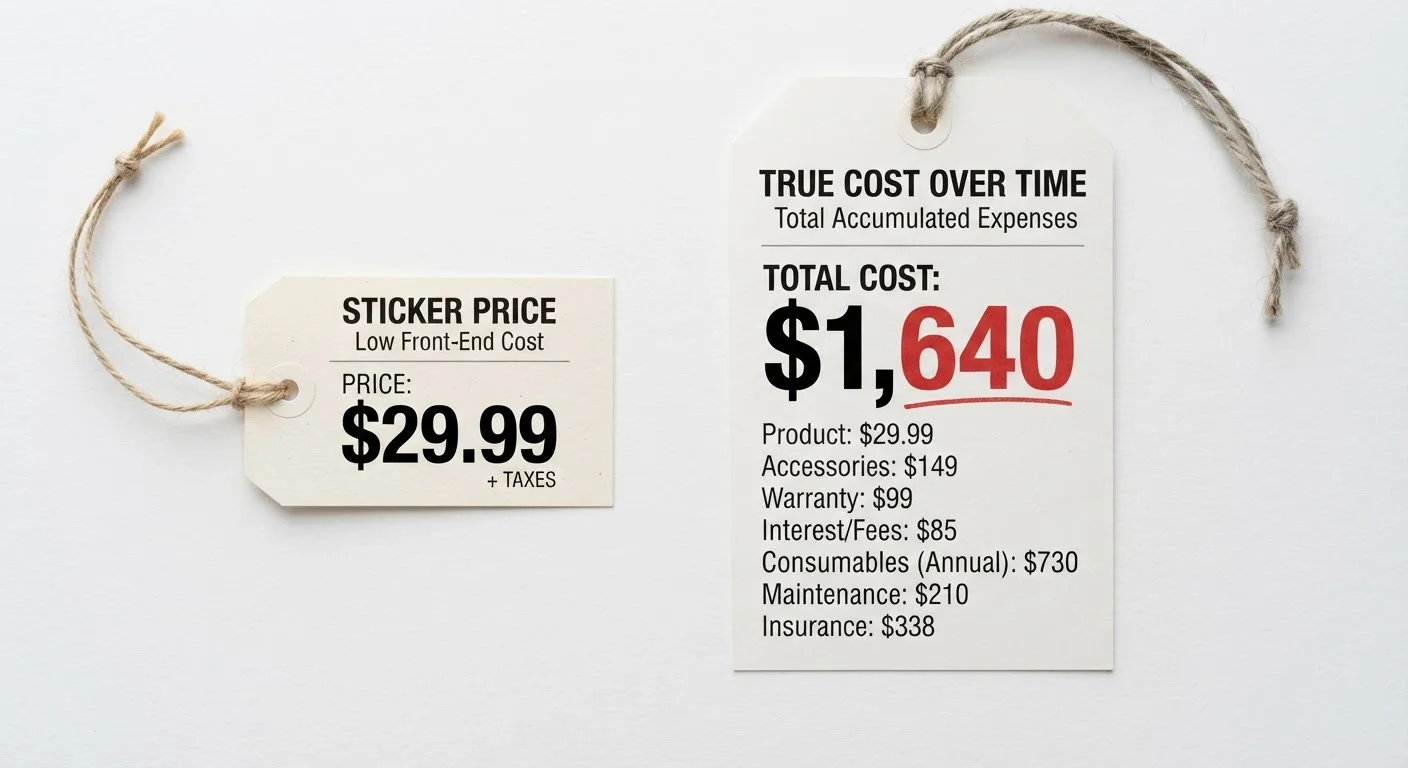
Photo: QuickAdvisor.net editorial
Key Takeaways
- Total cost of ownership (TCO) includes purchase price, maintenance, consumables, energy use, and lifespan.
- A cheaper upfront price can easily become the more expensive option when all ongoing costs are counted.
- Longer product lifespan typically lowers annualized cost, even when the purchase price is higher.
- Consumable costs - ink, filters, blades - are a common hidden driver of long-term expense.
- Calculating a simple annual cost helps make apples-to-apples comparisons between options at different price points.
Why the Sticker Price Is the Wrong Starting Point
Retailers and manufacturers have a structural incentive to make you focus on purchase price. It's the number that fits on a tag, anchors a comparison, and drives impulse decisions. But for most purchases that you'll use regularly over months or years, the purchase price is a fraction of what you'll actually spend.
Total cost of ownership (TCO) is the framework that captures the full picture. It adds up what a product costs to buy, run, maintain, and eventually replace or dispose of - spread over the period you actually own it. Dividing that total by the number of years gives you an annualized cost that makes genuinely different options comparable on equal terms.
Before evaluating any significant purchase, it helps to work through a structured checklist. Our product evaluation framework walks through that process in detail. The TCO lens covered here fits directly inside that broader approach.
The Four Cost Categories That Matter
A reliable TCO estimate accounts for four distinct buckets:
- Purchase price: The upfront amount paid, including taxes and required accessories at the point of sale.
- Consumables: Recurring supplies the product requires to function - printer ink, vacuum bags, water filters, razor blades, replacement batteries. These often dwarf the original purchase price over time.
- Maintenance and repairs: Routine servicing (oil changes, blade sharpening, cleaning kits) plus the realistic probability of repairs during the ownership period. Products with longer warranties shift some of this cost to the manufacturer - see our breakdown of extended versus manufacturer warranties for how to factor that in.
- Energy and operating costs: Electricity, fuel, or water consumption over the product's life. A less efficient appliance can cost meaningfully more per year to run than an efficient one, even if it was cheaper to buy.
| Low Upfront Cost Option | Higher Upfront Cost Option | |
|---|---|---|
| Purchase price | Lower | Higher |
| Consumable costs | Often higher per year | Often lower per year |
| Expected lifespan | Shorter | Longer |
| Annualized cost (long-term use) | Often higher | Often lower |
| Best for uncertain/short use | Yes | Less so |
| Repair/maintenance frequency | Typically higher | Typically lower |
| Energy efficiency | Varies, often lower | Varies, often higher |
Lifespan is the multiplier that sits across all four categories. A product lasting eight years at moderate annual cost will almost always beat a cheaper product replaced every three years - provided the usage pattern supports it.
Running a Simple TCO Calculation
You don't need a spreadsheet to make a useful estimate. A straightforward formula works for most purchases:
TCO = Purchase Price + (Annual Operating Costs × Expected Years of Use)
Then divide the result by expected years of use to get an annualized cost per year. Compare that number - not the sticker - between the options you're evaluating.
For example: a product priced at $80 that costs $40 per year in consumables and lasts four years has a TCO of $240, or $60 per year. A competing product priced at $150 that costs $15 per year in consumables and lasts six years has a TCO of $240 as well - identical over that period - but the annualized cost drops to $40 per year if you keep it longer. The premium option becomes the clear value choice for any owner who uses it consistently beyond the four-year mark.
Check Consumable Costs Before You Buy
This same logic applies to vehicles, where depreciation, fuel, insurance, and maintenance all stack on top of a purchase price. The full lifecycle of vehicle ownership and how depreciation works are worth reading for anyone weighing a car purchase with TCO in mind.
When Low Upfront Cost Actually Wins
TCO analysis doesn't automatically favor the expensive option. There are genuine scenarios where lower purchase price is the rational choice:
- Short or uncertain ownership periods: If there's a real chance you'll need to sell, donate, or replace the item within a year or two, paying a premium for longevity rarely pays off. The leasing versus buying decision illustrates this trade-off clearly in the vehicle context.
- Low-frequency use: A tool used twice a year doesn't accumulate the operating hours that justify a durability premium.
- Rapidly changing categories: In technology especially, a product may become obsolete before it wears out. Paying for longevity in a category where you'll want to upgrade anyway misallocates money.
- Budget constraints are real: An affordable product that meets your needs now is better than an unaffordable one that doesn't get purchased at all. TCO is a planning tool, not a reason to overspend today.
The goal of TCO analysis is clarity, not justification for spending more. It helps you see clearly - and then decide based on your actual situation rather than a number chosen by a marketing team.
The content on this site is for informational purposes only and is not a substitute for professional advice. Always consult a qualified professional for guidance specific to your situation.