
Pantry Stocking, Bulk Buying, and Unit Price Math: A Practical Primer

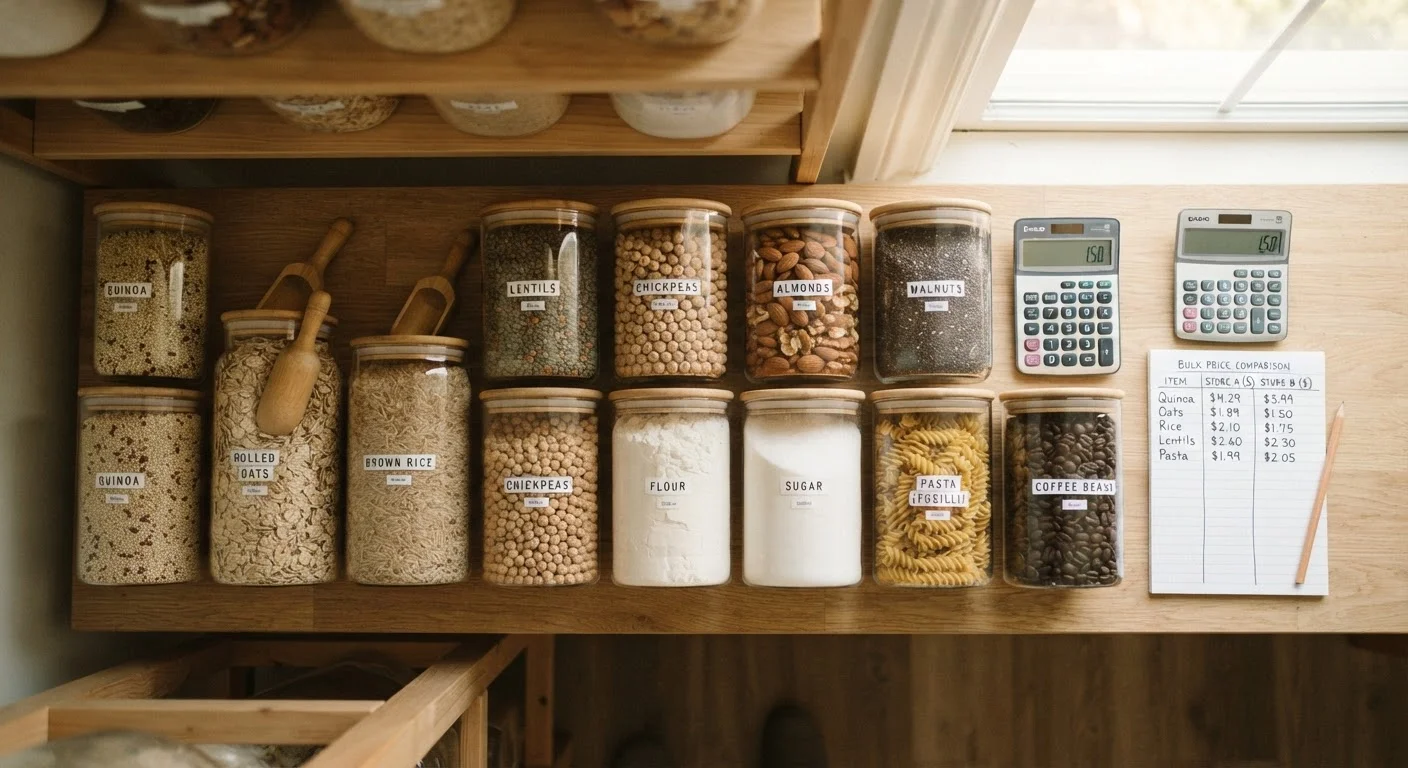
Photo: QuickAdvisor.net editorial
Key Takeaways
- Unit price - cost per ounce, pound, or count - is the only reliable way to compare package sizes.
- Bulk buying saves money only when you will actually use the product before it expires or degrades.
- Storage space, shelf life, and household size all determine whether bulk buying makes sense for you.
- Warehouse clubs and bulk bins are not automatically cheaper than standard grocery stores.
- A simple calculator habit at the shelf prevents impulse buys disguised as deals.
Why Bigger Packages Don't Always Mean Better Value
Walk into any grocery store and you'll encounter packages engineered to look like deals. A 64-oz bottle of olive oil sits next to a 16-oz bottle. The large one costs more in total - but is it actually cheaper? That question is at the heart of smart pantry stocking, and the answer requires one straightforward calculation: the unit price.
Unit price is the cost per standard unit of measure - per ounce, per pound, per count, per fluid ounce. Most U.S. grocery stores are required to display unit pricing on shelf tags, but the font is often small, the units inconsistent between competing products, and the math easy to ignore under fluorescent lights with a full cart. That's exactly what retailers count on.
Understanding how retailers frame prices as apparent bargains is part of becoming a more deliberate shopper. Our article on retail pricing psychology breaks down the specific techniques used to nudge you toward larger or more profitable purchases.
Shelf Tags Are a Starting Point, Not a Guarantee
What You Need Before You Start
Getting unit price math right doesn't require special equipment or expertise - just a consistent habit. Here's what helps:
What you will need
Smartphone calculator
Performs the division needed to calculate unit price at the shelf.
Small notepad or notes app
Records unit prices across stores so you can compare over time.
Pantry inventory list
Tracks what you already have at home to avoid duplicate bulk purchases.
Once you have these in hand, the process is the same whether you're at a warehouse club, a grocery chain, or a bulk-bin store.
How to Run the Unit Price Math
Follow these steps each time you face a size or packaging decision at the shelf. The habit takes under a minute once it's routine.
Read the shelf tag unit price first
Before doing any math yourself, check the small print on the shelf tag. Most U.S. grocery retailers are required by state law to display unit pricing. If it's there and the units match between products you're comparing, you may already have your answer. Just confirm the units are identical - cost per ounce versus cost per pound is an easy source of confusion.
Calculate unit price yourself when tags are missing or inconsistent
Divide the total price by the total quantity: Unit Price = Total Price ÷ Total Quantity. For example, a 28-oz can of tomatoes for $2.24 works out to $0.08 per ounce. A 14-oz can for $1.26 is $0.09 per ounce. The larger can wins on unit price - but only by a penny per ounce, so other factors (storage, need) matter too.
Account for any coupons or loyalty discounts before comparing
A digital coupon or store loyalty discount changes the effective price - recalculate unit price using the discounted total, not the shelf price. A smaller package with a coupon applied can easily undercut a bulk package priced at full rate.
Factor in realistic usage before committing
Ask yourself: at your normal consumption rate, will you use this product before it expires or loses quality? If you use one jar of peanut butter per month and the bulk pack contains six jars, check the best-by date. If it expires in four months, you're not saving - you're buying waste at a discount.
Record the winning unit price for future reference
Jot down the lowest unit price you found for staple items. Over several shopping trips, you'll build a personal price baseline - a reference point that tells you instantly whether a current price is genuinely good or just packaged to look that way. This is one of the most effective long-term habits for consistent savings without comparison-shopping rabbit holes. For more efficient strategies, see price comparison without the rabbit hole.
For a broader look at how this fits into overall grocery spending strategy, see our guide on eating well on a budget.
When Bulk Buying Actually Makes Sense - and When It Doesn't
Unit price math can confirm that a bulk package is genuinely cheaper per unit. But a lower unit price is only a real saving if you actually use the product. Before committing to a large quantity, run a second mental check:
- Shelf life: Non-perishables like dried beans, white rice, pasta, canned goods, salt, and sugar have long stable shelf lives and are strong bulk candidates. Whole-grain flours, nuts, and oils go rancid faster - check the best-by date and your realistic usage rate.
- Household size: A five-pound bag of spinach is a deal for a family of five and a loss for a single person. Be honest about consumption pace.
- Storage capacity: Bulk buying requires space. If items end up in a hot garage or cramped cabinet with poor airflow, quality degrades faster than the savings justify.
- Membership fees: Warehouse clubs charge annual fees. Factor that cost into your first year's math - the per-unit savings need to exceed the membership cost before you break even.
Bulk Buying Can Increase Spending, Not Reduce It
A well-organized pantry built around items you genuinely rotate is the foundation of consistent savings. See pantry staples that make weeknight cooking easier for a practical starter list of high-utility dry goods. And if you're still working out your overall household budget, our beginner's budgeting guide walks through the fundamentals without assumptions.
The content on this site is for informational purposes only and is not a substitute for professional advice. Always consult a qualified professional for guidance specific to your situation.