
Speed Limits, Road Conditions, and the Gap Between Legal and Safe

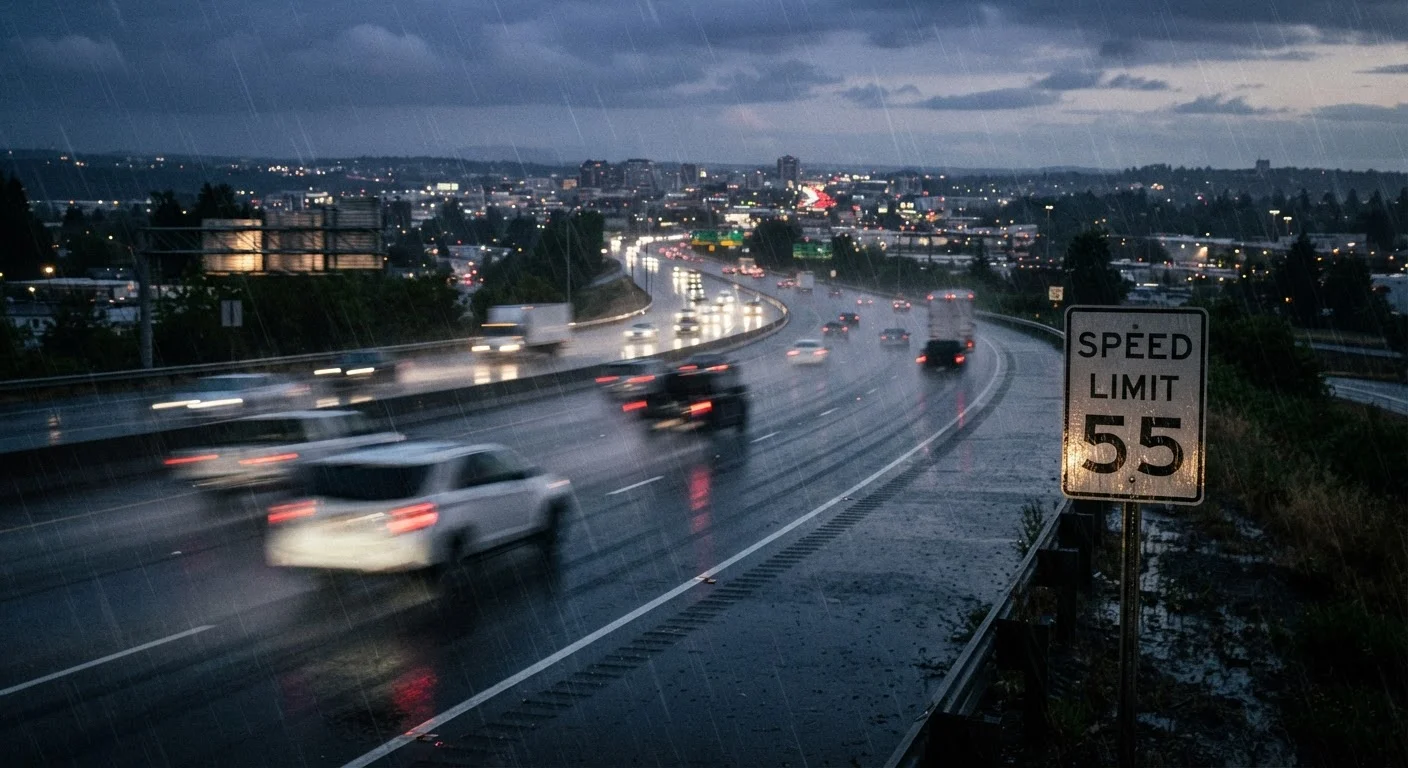
Photo: QuickAdvisor.net editorial
Key Takeaways
- Posted speed limits are legal ceilings, not safety guarantees for every situation.
- Road conditions like rain, fog, and ice can make driving at the limit genuinely dangerous.
- Stopping distance increases dramatically with speed - and even more on slick surfaces.
- Drivers have a legal and practical obligation to adjust speed for actual conditions.
- Nighttime driving, curves, and heavy traffic all reduce the margin of error at posted speeds.
- Matching your speed to conditions - not the sign - is the foundation of defensive driving.
What the Speed Limit Sign Actually Tells You
When you pass a speed limit sign, you're reading a legal instruction - not a weather report, a road quality assessment, or a traffic advisory. The number on that sign reflects the maximum allowable speed under favorable, baseline conditions: dry pavement, good visibility, normal traffic flow, and an alert driver in a properly maintained vehicle.
Change any one of those variables and the safe speed changes with it. The sign doesn't update automatically, which means the adjustment is on you. Traffic engineers design posted limits for typical optimal conditions. When conditions fall below that baseline - which happens constantly - the gap between legal and safe opens up.
Understanding this distinction is fundamental to defensive driving. It reframes the speed limit from a target to a ceiling, and it puts the responsibility for speed choice squarely where it belongs: with the driver.
How Road and Weather Conditions Change the Equation
Physics doesn't care what the sign says. Wet pavement, ice, loose gravel, and fog all reduce your vehicle's ability to stop and steer - often dramatically. On dry asphalt, a typical passenger car traveling at 60 mph needs roughly 180-200 feet to stop after the brakes are applied. On wet pavement, that figure can climb by 50% or more. On ice, braking distances can multiply several times over.
~31%
Fatal crashes involving speeding as a factor
According to NHTSA data, speeding is consistently cited as a contributing factor in roughly a third of all traffic fatalities in the United States.
50%+
Increase in stopping distance on wet pavement
Traffic safety research indicates that wet roads can increase braking distance by 50% or more compared to dry conditions at the same speed.
81 ft/sec
Distance covered per second at 55 mph
At 55 mph, a vehicle travels approximately 81 feet every second - a figure that illustrates how quickly sight-distance limitations become life-threatening.
Visibility compounds the problem. If fog or heavy rain limits your sightline to 100 feet and you're traveling at 55 mph, you're covering about 81 feet per second - leaving almost no reaction time if something appears ahead. The Insurance Institute for Highway Safety and the National Highway Traffic Safety Administration (NHTSA) both cite excess speed as a contributing factor in roughly a third of all fatal crashes, and that risk scales sharply when conditions degrade.
For a practical breakdown of how each weather type changes what's demanded of drivers, see our companion guide: how to adjust your driving in rain, fog, snow, and ice.
Use Sight Distance as Your Speed Guide
The Legal Framework Most Drivers Don't Know About
Nearly every U.S. state codifies what's commonly called the basic speed law: a requirement that drivers operate at a speed that is reasonable and prudent for actual conditions, regardless of what the posted limit says. This means that driving 65 mph in a 65 mph zone can still be illegal - and it can still get you cited - if road conditions made that speed unsafe.
This isn't an obscure technicality. It's the legal foundation police use when issuing tickets after crashes where the driver was at or under the limit but clearly driving too fast for conditions. Courts have consistently upheld these citations.
The practical takeaway: the sign gives you an outer legal boundary, but your obligation as a driver extends beyond staying under the number. Nighttime driving adds another layer of risk - fatal crash rates rise sharply after dark, partly because drivers maintain daytime speeds in conditions with significantly reduced sight distance. Our piece on why night driving is statistically riskier walks through the specific factors at play.
Practical Ways to Calibrate Your Speed to Conditions
Adjusting speed to conditions isn't about driving slowly for its own sake - it's about preserving your margin of safety. A few principles make this easier to apply in real time:
- Match your speed to your sight distance. If you can't see far enough to stop before reaching what you can see, you're driving too fast - regardless of the speed limit.
- Account for following distance first. Stopping distance increases with speed and degrades further in poor conditions. Tailgating is more dangerous than most drivers realize - adding space ahead of you is one of the most effective buffers you have.
- Slow for curves and intersections. Speed limits on straight sections don't necessarily account for curve geometry. Posted advisory speeds on curves are separate guidance - treat them seriously.
- Reduce speed incrementally as conditions worsen. Don't wait until you feel out of control. Lower your speed gradually as rain intensifies, visibility drops, or traffic thickens.
Awareness of your vehicle's blind spots also plays into speed management - faster travel reduces the time you have to respond to objects or vehicles in unseen areas. Our guide on what your blind spots actually cover explains this in detail.
Frequently Asked Questions
The content on this site is for informational purposes only and is not a substitute for professional advice. Always consult a qualified professional for guidance specific to your situation.