
Heat and the Home Cook: Conduction, Convection, and Radiation Explained

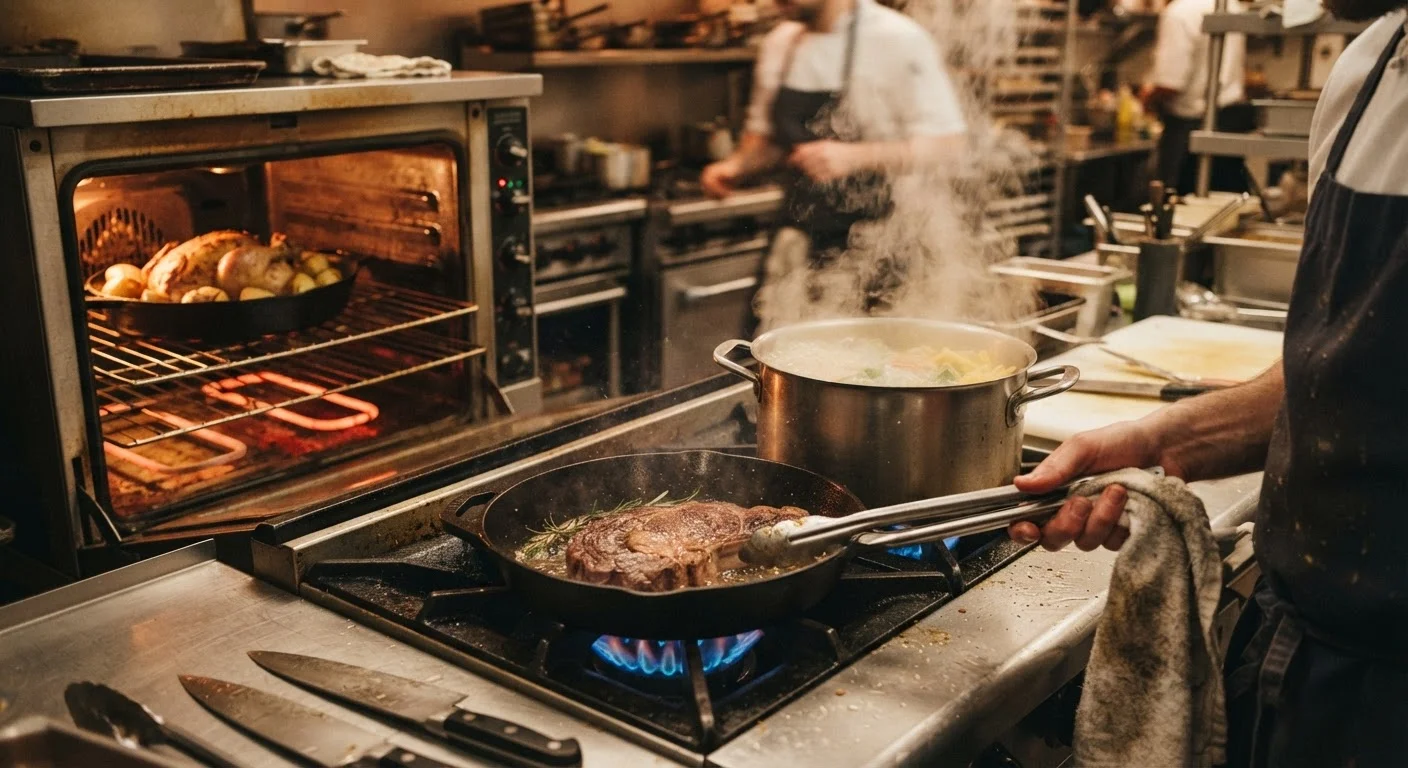
Photo: QuickAdvisor.net editorial
Key Takeaways
- Conduction transfers heat through direct contact between surfaces - critical for searing and pan cooking.
- Convection uses moving air or liquid to distribute heat - the principle behind boiling, steaming, and convection ovens.
- Radiation delivers heat via electromagnetic waves - how broilers and open flames work.
- Understanding which mode dominates helps you choose the right pan, temperature, and technique.
- Most cooking methods combine two or more heat transfer modes at once.
Conduction: The Power of Direct Contact
Conduction is the most intuitive heat transfer mode in the kitchen. It occurs when thermal energy passes directly from one object to another through physical contact - from burner to pan, from pan to food, or from boiling water to a submerged vegetable.
The efficiency of conduction depends heavily on the materials involved. Copper and aluminum conduct heat rapidly and evenly, which is why they appear in professional cookware. Cast iron conducts heat more slowly but retains it powerfully once it reaches temperature - making it the material of choice for a hard sear. Stainless steel alone conducts poorly, which is why quality stainless pans use aluminum or copper cores.
Conduction is also at work within food itself. When you sear a thick steak, the exterior heats almost instantly via conduction from the pan, but heat must then travel inward through the meat's own molecular structure to reach the center. This internal conduction lag is exactly why resting meat after cooking matters: heat continues moving toward the center even off the flame. For more on how these stovetop dynamics play out in practice, see how sautéing, pan-frying, and stir-frying differ.
Match Your Pan to the Heat Mode
Convection: Heat on the Move
Convection transfers heat through the movement of a fluid - either liquid or gas. In a pot of boiling water, hot water rises, cools at the surface, and sinks back down, creating continuous circulation that cooks food more uniformly than if the water were still. The same principle governs steaming, braising, and deep-frying.
In the oven, natural convection occurs as hot air near the heating elements rises and cooler air descends. Convection ovens accelerate this process with a fan, forcing air across the food's surface and stripping away the insulating layer of cool, moisture-saturated air that naturally forms around food. The practical result is faster browning and more even cooking - which is why convection mode is favored for roasting vegetables and baking pastries.
Convection isn't limited to the kitchen. The same physics that circulate heat through your oven also drive weather patterns and ocean currents - a connection explored in why warm air rises and shapes weather.
25°F
Typical temperature reduction with convection mode
Food scientists and culinary educators broadly recommend reducing oven temperature by approximately 25°F when switching from conventional to convection mode to avoid over-browning.
~212°F
Temperature at which water convects vigorously
At sea level, water reaches its boiling point at 212°F (100°C), at which point convective circulation becomes vigorous enough to cook most foods efficiently through liquid heat transfer.
3×
Faster heat transfer: water vs. still air
Water conducts and convects heat significantly more efficiently than still air - a key reason that poaching and boiling cook food faster than dry oven heat at the same nominal temperature.
Radiation: Heat Without Contact
Radiation is the only heat transfer mode that requires neither direct contact nor a physical medium. It works through electromagnetic waves - primarily infrared radiation - that travel through air or even a vacuum and are absorbed by whatever they strike. The sun warming your face and a broiler crisping the top of a casserole operate on the same fundamental principle.
In the kitchen, radiation is the dominant force in broiling, grilling over open flame, and toasting. The food's surface absorbs radiant energy and heats rapidly, producing the caramelization and browning associated with Maillard reactions. Distance and position matter significantly: moving food closer to a broiler element dramatically increases radiant intensity, since energy decreases with the square of distance.
Microwave ovens represent a specialized form of radiation cooking, though they use microwave-frequency energy rather than infrared. Microwaves penetrate food and cause water molecules to vibrate, generating heat from within rather than from the surface - essentially the inverse of broiling.
Understanding these three modes together sharpens your instincts throughout the kitchen. For the specific temperatures that correspond to these processes, kitchen temperatures worth knowing by heart puts the numbers in context. And for a broader look at what heat does once it reaches food, what heat actually does to food explains the flavor and texture transformations that follow.
Frequently Asked Questions
The content on this site is for informational purposes only and is not a substitute for professional advice. Always consult a qualified professional for guidance specific to your situation.