
Seasoning Throughout the Cook vs. Seasoning Only at the End

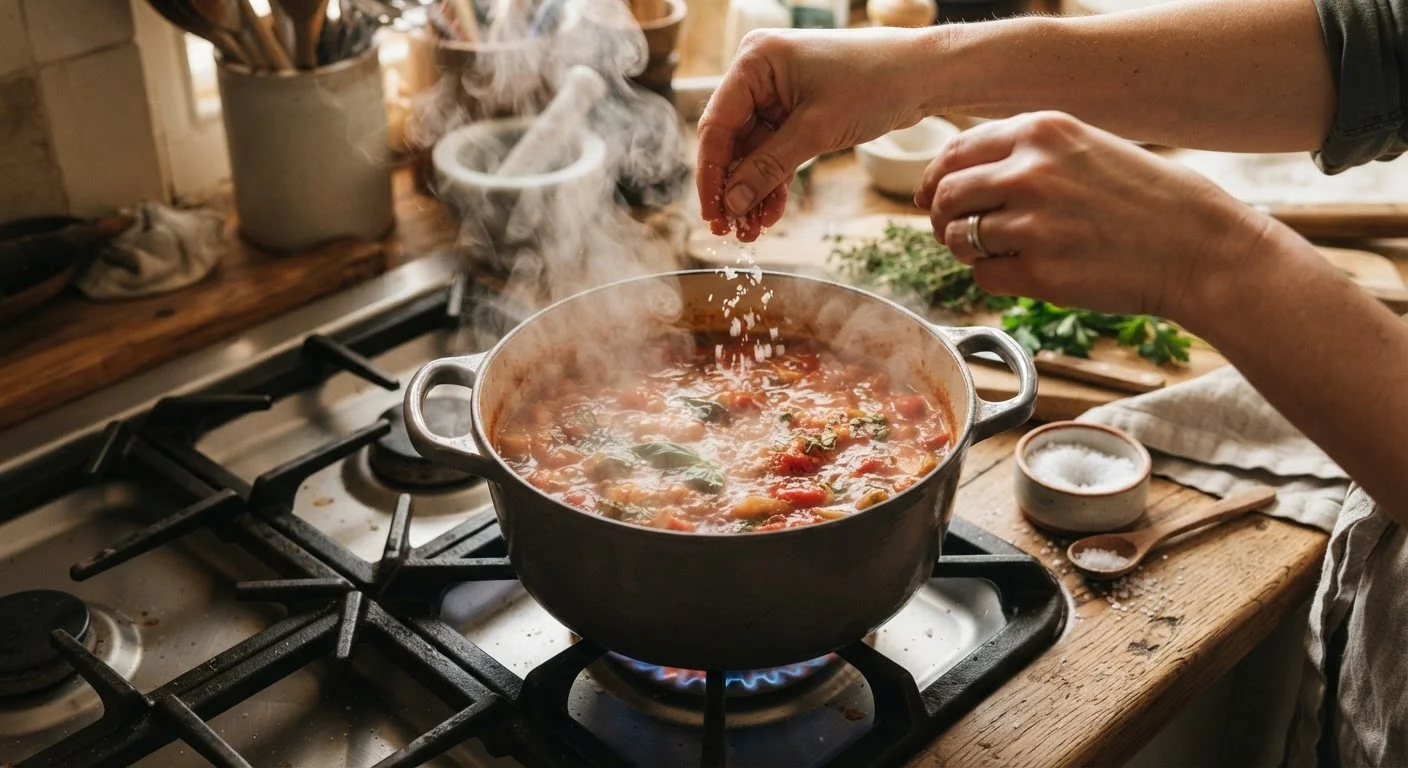
Photo: QuickAdvisor.net editorial
Key Takeaways
- Salt added early penetrates food and seasons it from within, while finishing salt stays on the surface.
- Layering seasoning at multiple stages builds more complex, rounded flavor than a single application.
- Seasoning only at the end is useful when liquid reduces significantly and sodium concentrates unpredictably.
- Different seasonings - salt, spices, fresh herbs - each have an optimal moment in the cooking process.
- Neither approach is universally correct; the best method depends on the dish and cooking technique.
Why Timing Matters in Seasoning
Most home cooks focus on how much salt to use. Professional cooks think equally hard about when to add it. The timing of seasoning fundamentally changes how flavor integrates into food - and understanding this distinction is one of the fastest ways to improve your cooking.
Salt, at its core, draws moisture through osmosis and then penetrates cell walls over time. Add it early, and it has the opportunity to migrate into the interior of proteins, vegetables, and starches. Add it late, and it coats the surface, delivering a brighter but shallower hit of flavor. Neither outcome is wrong - they're simply different tools.
To understand what salt actually does chemically and structurally, see our guide to what salt, fat, acid, and heat do to food. That foundation makes the timing question much easier to answer.
| Criterion | Seasoning Throughout | Seasoning Only at the End |
|---|---|---|
| Flavor depth | Deep, integrated, layered | Bright, surface-level |
| Control over sodium | Requires tasting at each stage | Precise final adjustment |
| Best for | Braises, soups, roasts, pasta | Reductions, salty-ingredient dishes |
| Spice timing | Dried/whole spices added early | Fresh herbs and finishing salts |
| Risk of over-salting | Higher in reduced sauces | Lower; salt added once |
| Skill required | Palate development, active tasting | Restraint and final judgment |
The Case for Seasoning Throughout
Layering seasoning across a recipe - salting meat before it hits the pan, seasoning vegetables as they soften, adjusting the broth partway through simmering - produces depth that a single finishing application simply cannot replicate. Each layer of salt seasons a different component at a different stage of its development.
Aromatics like onions and garlic, when salted as they cook, release moisture and concentrate flavor more effectively. Proteins salted in advance (even 15-30 minutes before cooking) develop a measurably different texture: the salt draws out surface moisture, which then reabsorbs, seasoning the meat from within. Pasta water seasoned generously before the pasta goes in flavors the pasta itself, not just the sauce.
Spices also behave differently depending on timing. Whole spices and dried spices benefit from early exposure to fat and heat - a process called blooming - which releases fat-soluble flavor compounds. Fresh herbs and finishing spices, by contrast, lose their brightness quickly and are better added toward the end.
40-50 min
Time salt needs to fully penetrate chicken breast
Food science research on dry-brining indicates salt needs significant contact time to migrate beyond the surface of dense proteins.
3-4×
Flavor compound increase from blooming spices in fat
Culinary science sources note that fat-soluble aromatic compounds in dried spices are released far more efficiently when briefly heated in oil before liquid is added.
For cooks learning to read recipes more strategically, our article on reading a recipe like a cook offers useful context on how professional recipe writers build in seasoning cues.
The Case for Seasoning Only at the End
There are genuine situations where holding off on salt until the very end is the smarter move. The clearest example is any dish involving significant reduction. As liquid evaporates from a pan sauce, braising liquid, or risotto, everything left behind becomes more concentrated - including sodium. A dish seasoned aggressively at the start of a long reduction can finish oversalted with no remedy.
Similarly, when cooking with inherently salty ingredients - cured meats, soy sauce, fish sauce, store-bought broths - early seasoning can compound unpredictably. Tasting at the end, when all components are present, gives you the most accurate read on where the dish actually stands.
End seasoning also preserves the freshness of finishing elements. A squeeze of lemon, a scatter of flaky salt, or torn fresh herbs added at the table or just before plating contribute brightness and textural contrast that cook-through seasoning cannot provide. These are finishing touches, not substitutes for layered flavor - but they matter.
Our stock vs. broth guide explains why the sodium level of your cooking liquid - often overlooked - is a major variable in the seasoning equation.
How to Use Both Approaches Together
The most effective cooks don't choose one approach exclusively - they use both with intention. A well-built dish typically has seasoning at the foundation (salted cooking water, bloomed spices, salted proteins), seasoning during cooking (adjusted incrementally as flavors develop), and seasoning at the finish (flaky salt, fresh herbs, acid).
The practical skill this requires is tasting as you go. It sounds obvious, but many home cooks season by formula and taste only at the table. Developing the habit of tasting at each stage - and asking whether a dish needs more salt, more acid, or simply more time - is what separates confident cooks from hesitant ones.
A Note on Salt Types and Timing
Seasoning strategy also interacts with cooking method. High-heat techniques like sautéing and stir-frying move fast, leaving little time for adjustments; early seasoning decisions matter more. Slow-cooked dishes offer more opportunity to correct as you go. Our comparison of sautéing, pan-frying, and stir-frying shows how heat intensity shapes the decisions you make inside the pan - including when to season.
The content on this site is for informational purposes only and is not a substitute for professional advice. Always consult a qualified professional for guidance specific to your situation.