
Whole Foods vs. Ultra-Processed Foods: What the Research Actually Shows

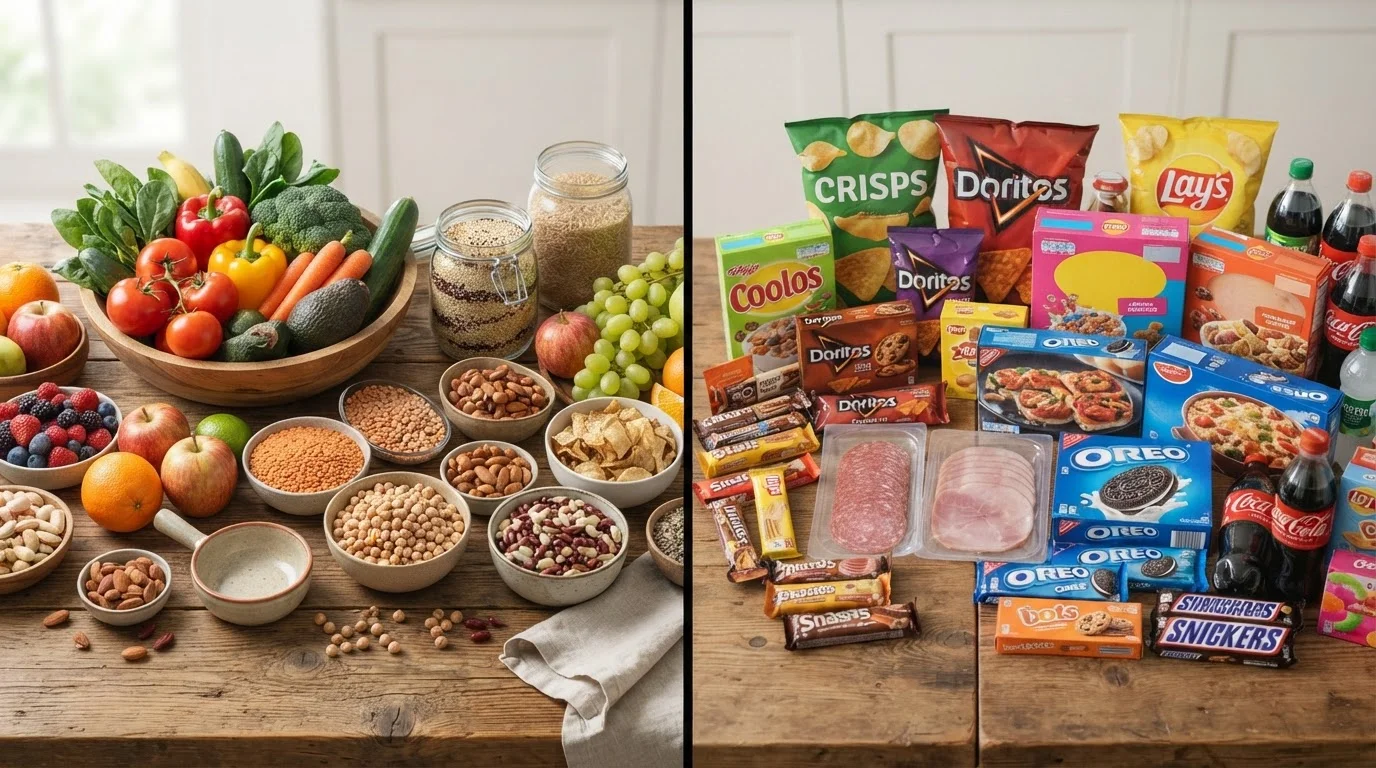
Photo: QuickAdvisor.net editorial
Key Takeaways
- The NOVA classification system defines ultra-processed foods by their industrial formulation process, not just their nutrient content.
- Research consistently associates higher ultra-processed food intake with increased risk of cardiovascular disease, type 2 diabetes, and early mortality.
- Whole foods retain naturally occurring fiber, vitamins, minerals, and beneficial phytonutrients often lost or degraded during heavy processing.
- Ultra-processed foods make up an estimated 57-60% of total daily calories for the average American adult.
- Reducing ultra-processed food consumption doesn't require perfection - incremental shifts toward minimally processed options are well-supported by evidence.
How Scientists Define These Categories
Not all processed food is the same. Freezing vegetables or pasteurizing milk involves processing, but these methods preserve nutrients and don't fundamentally alter the food's character. The key distinction researchers use comes from the NOVA classification system, developed by nutrition epidemiologists at the University of São Paulo. NOVA groups foods into four categories based on the nature and extent of processing - not simply on nutrient profiles.
Under NOVA, whole or minimally processed foods include fresh fruits and vegetables, plain meats, eggs, legumes, and whole grains. Ultra-processed foods (NOVA Group 4) are industrial formulations that typically contain ingredients rarely used in home cooking: emulsifiers, artificial flavors, hydrogenated oils, colorants, and preservatives. Think packaged snack cakes, flavored chips, reconstituted meat products, and many breakfast cereals.
For a deeper look at one specific dimension of this issue, see why ultra-processed food is a distinct category - the NOVA framework matters because it predicts health outcomes in ways that simple nutrient analysis often misses.
| Criterion | Whole Foods | Ultra-Processed Foods |
|---|---|---|
| NOVA Classification | Groups 1-2 (minimally processed) | Group 4 (industrial formulations) |
| Fiber Content | Naturally high in many cases | Typically low; matrix disrupted |
| Additives & Preservatives | Absent or minimal | Common; emulsifiers, colorants, flavors |
| Satiety Per Calorie | Generally higher | Generally lower; hyperpalatable |
| Micronutrient Retention | Naturally intact | Often lost; sometimes re-fortified |
| Chronic Disease Association | Lower risk in research | Higher risk in multiple large studies |
| Convenience | Varies; some prep required | High; shelf-stable, ready-to-eat |
| Cost Accessibility | Affordable in staple forms | Varies; often affordable per unit |
What the Research Consistently Shows
Large observational studies have found robust associations between ultra-processed food consumption and a range of adverse health outcomes. A 2019 cohort study published in JAMA Internal Medicine involving more than 44,000 French adults found that a 10-percentage-point increase in the share of ultra-processed foods in the diet was associated with a statistically significant increase in all-cause mortality risk. Similar findings have emerged from studies in Spain, Brazil, the United Kingdom, and the United States.
Mechanistically, researchers point to several factors. Ultra-processed foods tend to be energy-dense and hyperpalatable - engineered to override normal satiety signals. They are typically low in fiber, which plays a critical role in gut microbiome health, blood sugar regulation, and cardiovascular protection. A landmark randomized controlled trial published in Cell Metabolism in 2019 by Kevin Hall and colleagues at the National Institutes of Health found that participants on an ultra-processed diet consumed significantly more calories per day compared to those eating minimally processed foods matched for total sugar, fat, fiber, and macronutrients - suggesting that something beyond simple nutrient content drives overconsumption.
57-60%
Ultra-processed foods' share of U.S. adult calorie intake
Research published in BMJ Open using NHANES data estimated that ultra-processed foods account for the majority of daily caloric intake among American adults.
~500 kcal/day
Extra calories consumed on ultra-processed diet
The 2019 NIH randomized controlled trial by Hall et al. found participants eating ultra-processed food ad libitum consumed roughly 500 more calories per day than on the unprocessed diet.
+12%
Increased all-cause mortality risk per 10% increase in UPF intake
A 2019 cohort study in JAMA Internal Medicine reported this association among over 44,000 French adults after adjusting for multiple confounding variables.
Whole foods, by contrast, retain naturally occurring micronutrients, antioxidants, and phytonutrients that work synergistically. The fiber matrix in whole grains, for example, slows glucose absorption in ways that isolated nutrients in a fortified cereal cannot replicate. For more on this, see our overview of what changes when wheat gets processed.
Important Caveats and Limitations
It's important to be transparent about what the research can and cannot tell us. The majority of evidence linking ultra-processed foods to poor health outcomes comes from observational studies, which identify associations but cannot prove causation. People who eat more ultra-processed foods may also have other lifestyle or socioeconomic factors that influence health - a challenge researchers call confounding.
Observational Evidence Has Real Limits
Additionally, the NOVA system itself is not without critics. Some nutrition scientists argue that classifying all ultra-processed foods as a single category obscures meaningful differences within the group. Plain yogurt with added pectin (a NOVA Group 4 food technically) is quite different from a packaged pastry. Research is ongoing to refine these distinctions.
That said, the consistency of findings across multiple countries, study designs, and populations gives researchers reasonable confidence that the general direction of evidence is meaningful. The 2019 NIH randomized trial, in particular, provides stronger causal support than observational data alone. See our explainer on nutrition myths that persist despite the evidence for context on how to evaluate competing nutrition claims.
Practical Guidance: Shifting the Balance
Nutrition research does not support an all-or-nothing approach. The goal for most people isn't eliminating every packaged food from their diet - it's gradually shifting the balance toward more minimally processed options. Even modest improvements in diet quality are associated with meaningful health benefits in population-level research.
Some evidence-grounded strategies include: prioritizing whole fruits and vegetables over juice or fruit snacks; choosing plain oats, brown rice, or whole grain bread over flavored instant packets or white bread; selecting canned or frozen legumes and vegetables (minimal added ingredients) as affordable, accessible whole-food staples; and cooking at home more often, which naturally reduces reliance on ultra-processed convenience foods.
For practical strategies on improving meal quality without a complete dietary overhaul, see getting more nutrients from your meals without overhauling your diet.
This article is for general informational and educational purposes only and is not a substitute for professional medical or dietary advice. Consult a qualified healthcare provider or registered dietitian for guidance specific to your individual health needs.
The content on this site is for informational purposes only and is not a substitute for professional advice. Always consult a qualified professional for guidance specific to your situation.