
Holiday Tables Across America: How Tradition and Heritage Collide at Thanksgiving

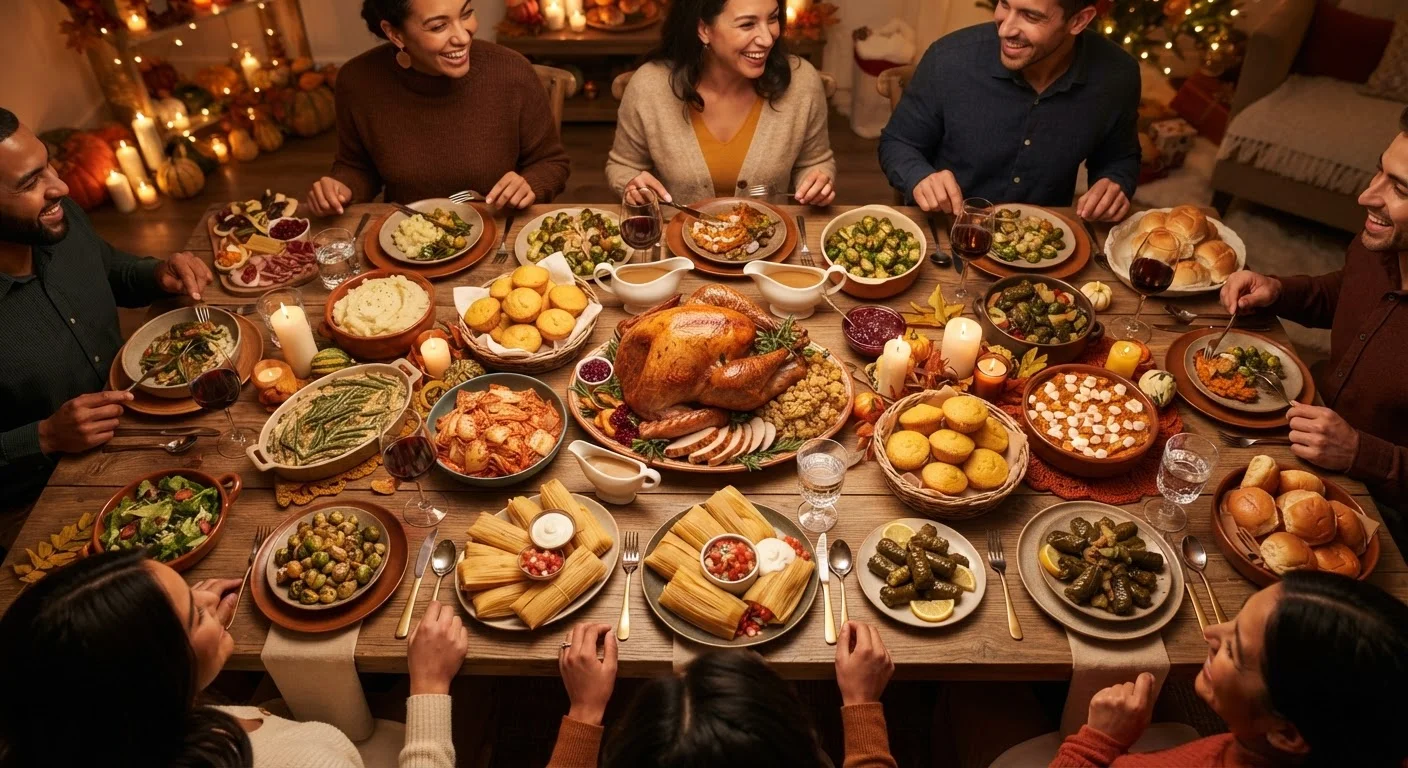
Photo: QuickAdvisor.net editorial
Key Takeaways
- Thanksgiving menus across America vary significantly based on regional, ethnic, and family heritage.
- The holiday meal functions as a form of cultural negotiation between tradition and assimilation.
- Many families incorporate dishes from their ancestral cuisines alongside the iconic turkey centerpiece.
- Food at Thanksgiving is as much about identity and memory as it is about nutrition or flavor.
- Indigenous foodways predate the Thanksgiving narrative and continue to shape American cuisine.
The Myth of the Unified American Feast
Ask most Americans to picture a Thanksgiving table and a familiar image emerges: a bronzed turkey, a bowl of mashed potatoes, green bean casserole, and a pumpkin pie cooling on the counter. But peer behind that postcard image and the actual variety is staggering. For millions of households, that canonical spread either doesn't exist at all or shares real estate with dishes that tell a very different story.
Thanksgiving is often framed as a unifying national ritual, but the meal itself has never been uniform. What families cook reflects where they came from, where they settled, and how much of their heritage they chose - or were pressured - to preserve. The holiday table is less a mirror of American sameness and more a map of its layered origins.
Each wave of immigration reshaped what Americans eat, and Thanksgiving is no exception. The holiday absorbed those waves rather than resisting them, even if the dominant cultural narrative didn't always acknowledge it.
Heritage on the Holiday Table
For Black American families, particularly those with roots in the South, Thanksgiving often centers on a distinct set of dishes - macaroni and cheese baked until bubbling, collard greens slow-cooked with smoked meat, candied yams with a caramelized crust, and cornbread dressing that bears little resemblance to the packaged stuffing mix version. These aren't deviations from tradition; they are the tradition, rooted in the foodways of the American South and the long history of African-American cooking.
Latino families - a term that encompasses dozens of distinct national and regional food cultures - frequently bring their own interpretations. In Mexican-American homes, tamales may appear alongside the turkey. Puerto Rican households might serve pernil, a slow-roasted pork shoulder, as the true centerpiece. Filipino-American families sometimes prepare pancit or lumpia as essential components of the feast.
46M+
Turkeys consumed on Thanksgiving annually
According to the National Turkey Federation, Americans consume more than 46 million turkeys each Thanksgiving - making it the single largest turkey consumption event of the year.
~14%
Foreign-born share of U.S. population
The U.S. Census Bureau reports that roughly 14% of the U.S. population is foreign-born, a figure that reflects the immigrant diversity shaping holiday food traditions across the country.
573+
Federally recognized Indigenous nations in the U.S.
The Bureau of Indian Affairs recognizes more than 573 distinct Indigenous nations in the United States, each with their own food traditions that predate and often inform the Thanksgiving story.
Dishes that crossed borders have long found a place at American tables, and Thanksgiving is one of the most vivid settings for that process. The meal becomes a form of cultural memory - grandmothers insisting on recipes written in another language, parents translating those instructions for children who've never visited the homeland.
The Negotiation Happening at Every Table
Sociologists and food scholars describe Thanksgiving as a space of ongoing cultural negotiation. First-generation immigrants may resist replacing their familiar festive dishes with American ones. Their children, raised between two cultures, often feel the pull of both. By the third generation, the table might feature a hybrid spread that reflects all of those tensions at once - turkey and tamales, stuffing and sticky rice.
“Food is never just food. It carries history, memory, and belonging. When a family brings a dish to the holiday table that others don't recognize, they are making a claim - this is part of us, too.”
— Psyche Williams-Forson, Professor of American Studies and food culture scholar
This negotiation isn't always comfortable. Family meals can surface real friction around belonging, assimilation, and respect. Whose food takes precedence? Whose recipes get written down and passed forward? Which dishes get dismissed as strange by in-laws who've never encountered them? Food becomes a proxy for larger questions of identity and acceptance.
The potluck format - everyone bringing a dish from home - captures this dynamic especially well. When Thanksgiving becomes a kind of communal potluck, heritage dishes don't have to compete; they coexist.
What Indigenous Foodways Reveal About the Holiday
No honest accounting of Thanksgiving and food culture can ignore Indigenous context. The crops at the heart of the holiday's founding mythology - corn, squash, and beans (the so-called Three Sisters), along with turkey - were cultivated and managed by Indigenous peoples long before European contact. The food cultures of pre-contact North America were rich, sophisticated, and highly regional.
For many Indigenous communities today, Thanksgiving is a complicated occasion - one that some mark as a Day of Mourning rather than celebration. Others use it as an opportunity to center Indigenous foods and reclaim the narrative around what the holiday's agricultural abundance actually meant and to whom. Wild rice, fry bread, venison, and traditional corn preparations appear on tables as acts of cultural affirmation.
Understanding this context doesn't require abandoning the holiday, but it does invite a more honest conversation about whose traditions the meal has historically centered - and whose have been obscured.
Why It Matters That No Two Tables Are the Same
The diversity of American Thanksgiving tables isn't a problem to be solved or a deviation from some pure original. It's evidence of a living food culture that absorbs, adapts, and transforms. When a Haitian-American family serves griot alongside turkey, or a Vietnamese-American family adds a pot of pho to the spread, they are doing exactly what Americans have always done - making the holiday their own.
The tendency to flatten complex food cultures into simple categories does a disservice to this richness. Thanksgiving, at its most meaningful, isn't about enforcing a menu. It's about the act of gathering, feeding people you love, and deciding together what belongs on the table - which is, in miniature, the ongoing project of American identity itself.
The collision of tradition and heritage at Thanksgiving isn't chaos. It's the meal working exactly as it should.
Frequently Asked Questions
The content on this site is for informational purposes only and is not a substitute for professional advice. Always consult a qualified professional for guidance specific to your situation.